

- AZuR Network
- AZuR Project Group on Chemical Recycling
- European Tyre-to-Tyre Initiative
- Tyre Circular Economy
- End-Of-Life Tyres
- Tyre Thermolysis Oil
- Recovered Carbon Black
AZuR Project Group Meets At Pyrum To Advance Tyre Circular Economy
- By TT News
- October 09, 2026
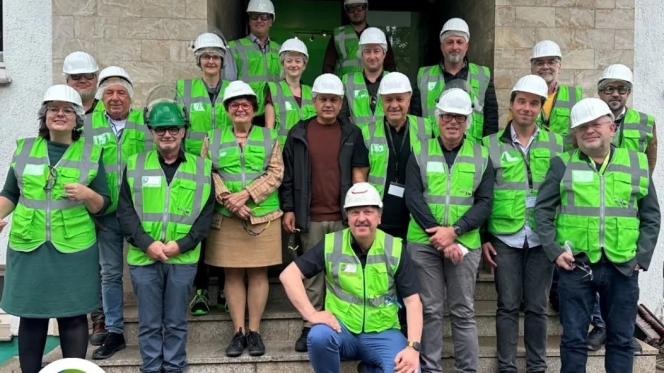
The AZuR project group on chemical recycling convened its annual in-person meeting on 1 October 2026, bringing together more than 20 network partners at Pyrum Innovations AG in Dillingen/Saar. The gathering centred on recent scientific findings, the recovery of raw materials from end-of-life tyres, the European Tyre-to-Tyre initiative and collaborative projects planned for 2027. Participants examined how recovered carbon black and tyre thermolysis oil can be more effectively integrated into industrial production processes.
A scientific highlight came from Dr -Ing Sebastian Bogdahn, who presented his dissertation on the production and ecological assessment of high-quality carbonizates derived from used tyre thermolysis. His research combined experimental investigations, process modelling and life cycle assessment, with particular attention to recovered carbon black produced during thermolysis and subsequently processed. The findings indicated that the modelled system could potentially lower global warming potential relative to fossil-based carbon black production while underscoring the significance of process control, product quality and energy supply for environmental performance.
The European Tyre-to-Tyre initiative, launched in July 2026 by Pirelli, Pyrum, Synthos and BASF, illustrated how chemical recycling processes can be embedded within industrial value chains. Pyrum converts used and rejected tyres into recovered carbon black and tyre thermolysis oil through thermolysis. The processed carbon black is then used in Pirelli's tyre manufacturing, partially substituting fossil-based industrial carbon black.
At BASF, thermolysis oil is combined with fossil raw materials to produce chemical products including butadiene and styrene. Synthos utilises corresponding feedstocks to manufacture synthetic rubbers, which are subsequently employed in Pirelli's tyre production. According to the project partners, the entire value chain remains traceable via ISCC PLUS certification.
A notable feature of the meeting was a tour of Pyrum's thermolysis plants. Divided into three groups, attendees gained insights into the technical processes and engaged directly with on-site experts. The tour clarified the technical steps required for recovering and further processing raw materials, from the handling of used tyres through to the resulting product streams.
Management emphasised the value of regular AZuR in-person meetings, which combine exchange among companies, technology providers and research institutions with exposure to real industrial applications. The gathering demonstrated the importance of collaboration across the entire value chain, with research, technology development, industrial processing and tyre production considered together to transform recovered materials into high-quality raw materials for new products. The project group will continue this exchange in 2027 through concrete projects and information initiatives.
Apollo Tyres Honours Supplier Sustainability Leaders At 2026 Awards Summit
- By TT News
- November 27, 2026
Apollo Tyres honoured its supplier partners for outstanding contributions to sustainability at the Apollo Tyres Sustainable Procurement Summit and Awards 2026. More than 800 delegates from upwards of 250 supplier firms, spread across over 20 nations, joined the virtual gathering.
Ten companies, grouped in pairs, took home awards spanning five categories. Bekaert and PCBL Chemical shared the Sustainability Champion honour. Lanxess and Momentive Performance Materials were named Green Excellence winners. Fair Workforce Practices recognition went to Sri Trang Agro-Industry and Techno Waxchem. Kraton and Orion received the Integrity in Action award, while Kumho Petrochemical and Taekwang Fine Chemical were cited for Sustainable Procurement Excellence.
Procurement Vice President Pravin Tripathi used his keynote, on the tyre maker's sustainability journey and raw material supply chain priorities, to stress net-zero goals and the need for value-chain-wide cooperation. Panel sessions then examined practical routes to cutting Scope 1, 2 and 3 emissions – from greener manufacturing and renewables to supplier involvement and low-carbon innovation.
The company thanked its vendor network for ongoing collaboration and said it would keep building partnerships aimed at tangible sustainability gains. Apollo Tyres positions the awards programme as a way to spur supplier innovation and speed the shift to a supply chain fit for the future.
JK Tyre's JKWRD Programme Kicks Off In Meghalaya With First Woman-Operated Rural Outlet
- By TT News
- November 27, 2026
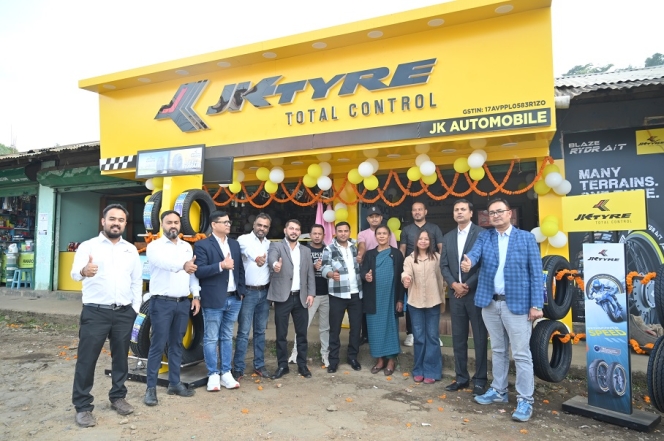
JK Tyre & Industries Ltd. has introduced the JK Women Rural Distributor (JKWRD) programme in North-East India, establishing the region’s first woman-operated rural distributorship in Nongstoin, Meghalaya. Local entrepreneur Baailang Lyngdoh Nonglait runs the outlet, which represents a practical effort to combine commercial network expansion with grassroots women’s entrepreneurship in rural markets.
Inaugurated by Nirbhay Srivastava, Head – Rural Business, and Amit Kumar, Zonal Head – East, the 1,200-square-feet Nongstoin facility serves as a single-window hub for rural vehicle owners and fleet operators. It stocks JK Tyre’s complete range of Passenger Car Radials (PCR), truck tyres, Light Commercial Vehicle (LCV) tyres and 2/3-wheeler tyres.
The JKWRD programme builds on the Rural Network Expansion Programme launched by JK Tyre last year. North-East India was selected as the starting point because women in the region have long been active in running local shops, weekly markets, showrooms and MSMEs, while roughly 82 percent of the North-East’s population lives in rural areas, creating strong demand for accessible, community-led tyre retail. After the Meghalaya launch, the Company intends to establish indigenous woman-led rural distributorships across the North-East.
The North-East rollout supports JK Tyre’s broader push to deepen distribution reach across India. Backed by steady domestic demand, the Company operates a nationwide network of over 6,000 dealers and distributors, more than 900 exclusive brand shops and over 140 sales, service and stocking points, bringing faster service and product availability to smaller towns and hinterland routes. The initiative also aligns with the Company’s CSR philosophy of fostering women-led development and economic inclusion through skill-building, livelihood generation, education support and entrepreneurship development at its plant locations.
Anshuman Singhania, Managing Director, JK Tyre & Industries Ltd., said, “At JK Tyre, we believe that empowering women through entrepreneurship is one of the most effective ways to drive inclusive and sustainable growth. Across the North-East, women have always been central to local trade and enterprise. With the JK Women Rural Distributor Program, we are bringing that entrepreneurial energy into automotive retail while taking reliable products and service closer to rural customers. Following our rural network expansion push last year, this initiative connects business growth with meaningful livelihood creation. Starting with Nongstoin, our goal is to build indigenous, woman-run distribution points across all seven North-Eastern states and strengthen our last-mile reach.”
BKT Sets 2050 Net-Zero Target In Latest Sustainability Report
- By TT News
- November 27, 2026
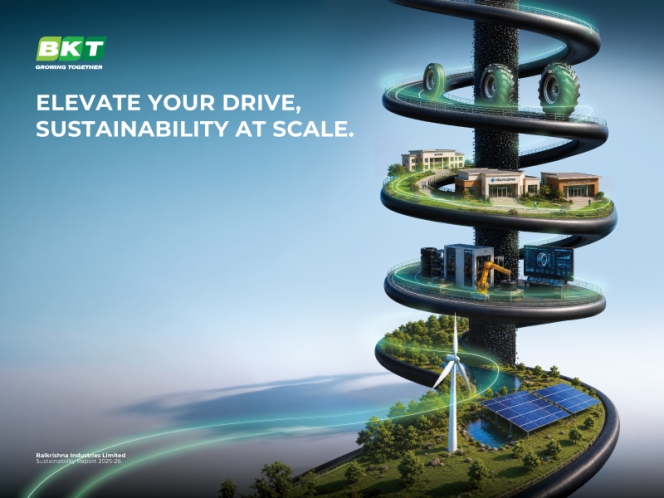
Balkrishna Industries Ltd (BKT) has set a target to achieve net-zero Scope 1 and Scope 2 emissions by 2050, alongside a 25 percent reduction in emissions intensity by 2030, as it steps up its sustainability efforts.
The company's 2025–26 Sustainability Report also highlights progress in renewable energy, water recycling, waste management and workplace safety. It introduces BKT's first Double Materiality Assessment, examining both the impact of its business activities on the environment and society and the risks and opportunities that sustainability issues present to the business.
BKT targets 25% cut in emissions intensity by 2030
Under its decarbonisation roadmap, BKT aims to reduce Scope 1 and Scope 2 emissions intensity per metric tonne of production by 25 percent by 2030, compared with the 2023–24 financial year.
During 2025–26, emissions intensity declined from 1.58 to 1.56 tonnes of carbon dioxide equivalent (tCO₂e) per metric tonne produced. Energy efficiency measures and renewable energy use helped avoid approximately 10,654 tonnes of CO₂ equivalent during the year.
Energy consumption from renewable sources and biomass reached 74,945 gigajoules (GJ), an increase of 107 percent from the previous financial year. Renewable electricity accounted for 10.33 percent of total electricity purchased, with BKT targeting a 20 percent share by 2030.
“Managing climate risks requires a rigorous approach based on data, measurable objectives, and increasing integration across different business functions,” commented Dr Anurrag Khandelwal, general manager – ESG at BKT. “Our efforts focus on strengthening monitoring systems, improving process efficiency, and assessing environmental impacts, so that industrial decisions are supported by increasingly comprehensive and reliable information.”
Product life-cycle assessments guide research
Research and development also feature prominently in BKT's sustainability strategy. During 2024–25 and 2025–26, the company conducted life-cycle assessments (LCAs) of six products representing different tyre categories and carbon black.
The assessments followed international ISO 14040 and ISO 14044 standards and were independently verified by external parties. They examine environmental impacts across different stages of product life cycles, providing information to guide product design, raw material selection and manufacturing processes.
Water recycling and waste management
Water management remains another focus, particularly at production facilities located in water-stressed areas.
During 2025–26, BKT recovered and reused more than 1.05m kilolitres of treated wastewater in its manufacturing processes. Its Zero Liquid Discharge (ZLD) systems are operational at the Bhuj and Waluj plants, while implementation is under way at the Bhiwadi and Chopanki facilities.
The company also reported that 94.7 percent of the waste generated during the year was recycled or reused, avoiding landfill disposal.
On workplace safety, BKT recorded no fatalities, lost-time accidents or reportable accidents among employees and workers. The company provided more than 340,000 hours of training during the year, while the number of permanent women employees increased by 35 percent compared with the previous year.
BKT allocated INR 426.4m to corporate social responsibility initiatives covering education, healthcare, food security, rural development and environmental protection.
ESG scores improve
BKT's external sustainability assessments also recorded improvements during 2025–26. Its EcoVadis score rose to 70 from 57 in the previous year, while its S&P Global ESG score increased to 58 from 53.
Information in the sustainability report was independently verified by Bureau Veritas (India) Private Limited under the AA1000AS Version 3, Type 2, High Assurance standard.
“For BKT, resilience and sustainability are part of the same industrial vision,” stated Arvind Poddar, chairman and managing director of BKT. “Our ambition is to build an increasingly sound organization, which is able of combining growth, quality, and innovation with responsible resource management. We strongly believe that long-term competitiveness is based on our capability to continuously improve our products, industrial processes, and the standards that guide our operations.”
IIT Kharagpur Establishes Dr Rabindra Mukhopadhyay Chair Professorship
- By Sharad Matade
- November 27, 2026
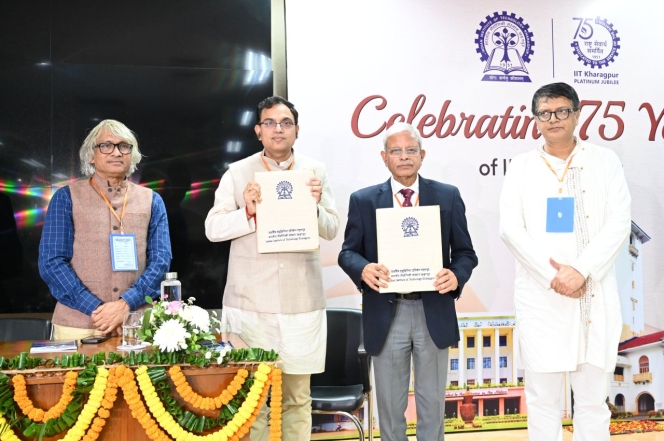
The initiative will promote advanced research and innovation in circular, sustainable and environmentally responsible materials for the tyre industry.
IIT Kharagpur has signed a Memorandum of Understanding (MoU) with its alumnus Dr Rabindra Mukhopadhyay to establish the Dr Rabindra Mukhopadhyay Chair Professorship at the institute’s Rubber Technology Centre.
The initiative aims to promote education, advanced research and innovation in circular, sustainable and environmentally responsible materials for the tyre industry. It will also provide research support to strengthen academic and scientific activities in rubber technology, with a particular focus on developing solutions to address the industry's evolving sustainability challenges.
Dr Mukhopadhyay, who completed his MSc in Chemistry in 1975 and PhD in 1978 from IIT Kharagpur, has more than 45 years of experience in the rubber industry. The establishment of the chair professorship marks his continued association with his alma mater and reflects his commitment to supporting the next generation of researchers and industry professionals.
After completing his doctorate, Dr Mukhopadhyay joined Bayer (India) Ltd's Rubber Chemicals Division in 1979, where he held various positions. In 1987, he joined JK Tyre as head of research and development and chief scientist.
He currently serves as Director and Chief Executive of the Hari Shankar Singhania Elastomer and Tyre Research Institute (HASETRI) and Advisor of research and development at JK Tyre & Industries.
Dr Mukhopadhyay's areas of expertise include reverse engineering, environment-friendly technologies, nanotechnology, advanced composite materials, circular economy and sustainable development across the rubber and allied industries.
Over his distinguished career, Dr Mukhopadhyay has authored around 200 publications and several book chapters, and holds six patents. He is a fellow of the Indian National Academy of Engineering, the Institution of Engineers (India) and the Indian Rubber Institute.
He has also contributed to academic and professional development through associations with several Indian universities and institutions as a visiting faculty member in polymer science and rubber technology. Among his other contributions is the establishment of a Centre of Excellence for Polymer Science and Rubber Technology in Mysore, focused on training and skills development.
The Dr Rabindra Mukhopadhyay Chair Professorship is expected to strengthen IIT Kharagpur's research capabilities in sustainable rubber materials and encourage closer collaboration between academia and the tyre industry as circularity, resource efficiency and environmentally responsible manufacturing gain importance.
Comments (0)
ADD COMMENT