Dunlop Motorcycle Europe Launches ScootSmart 2 All-Season Scooter Tyre

Dunlop Motorcycle Europe Launches ScootSmart 2 All-Season Scooter Tyre

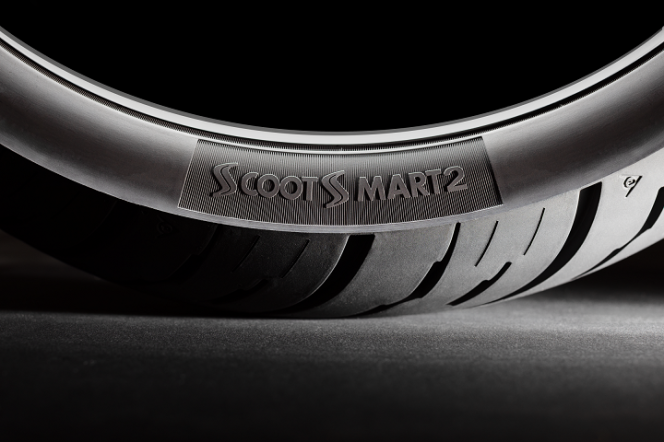
Dunlop Motorcycle Europe has strengthened its position in the urban mobility sector by launching the ScootSmart 2, a new all-season scooter tyre engineered to enhance grip, handling and durability under a variety of city riding conditions. The tyre is designed for riders who depend on their scooters for daily transportation, from short commutes to longer journeys through metropolitan areas.

Building on the original ScootSmart introduced in 2012, which gained a strong reputation among scooterists for reliable all-weather performance and longevity, the second-generation model addresses the evolving needs of modern riders. Dunlop has incorporated its sport touring expertise into the ScootSmart 2, blending advanced motorcycle tyre technologies with a design specifically tailored for scooters. The tyre features a new high silica compound that improves traction across a wide range of temperatures and road surfaces, including wet and dry conditions, while preserving mileage performance.

An all-new tread pattern distinguishes the front and rear tyres for specific handling benefits. The front tyre includes a jagged centre groove to cut through surface water and reduce braking distances, with main grooves oriented for effective water dispersion at intermediate speeds. Secondary grooves and shoulder tread elements boost grip on slippery surfaces. At the rear, a continuous tread centre supports wear resistance and dry-road traction, while the groove layout maintains wet-weather grip. Dunlop’s internal testing indicates a 10 percent reduction in wet braking distance compared to the previous version, marking a clear safety improvement.
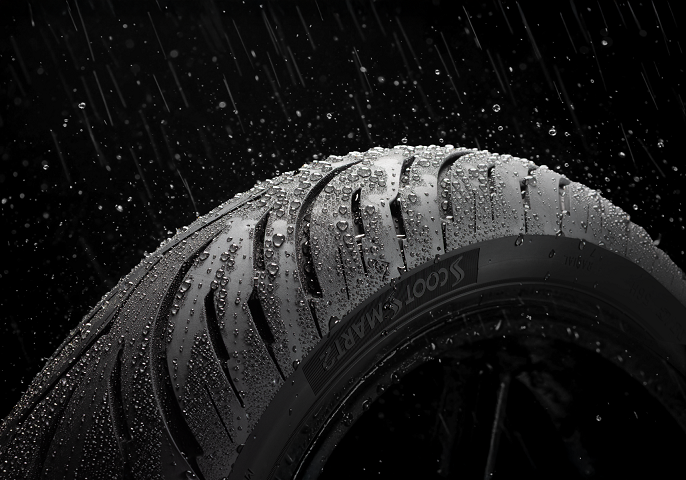
ScootSmart 2 offers extensive size coverage for a broad range of scooters, from lightweight city models and retro designs to high-end performance maxi scooters. The lineup will ultimately include 75 sizes covering rim diameters from 10 to 16 inches, accounting for roughly 84 percent of the scooter market. Availability across Europe begins in the second quarter of 2026, with the full range arriving in the fourth quarter of that year.

Roberto Finetti, Marketing Manager, Dunlop Motorcycle Europe, said, “With the introduction of ScootSmart 2, Dunlop builds on the proven success of ScootSmart to deliver a clear step forward in performance for today’s scooter riders. The tyre offers stable and well-balanced handling, even for the most demanding riders with a more spirited riding style. Urban riding is full of contrasts. ScootSmart 2 is designed to handle all of them, and our broader launch campaign brings that idea to life in a way that feels dynamic, with playful assets that resonate with the needs of riders in cities, always ready to stop and go.”

Dmitri Talboom, Product Manager, Dunlop Motorcycle Europe, said, “In developing ScootSmart 2, we set out to build on a product that already had a very strong reputation among scooter riders across Europe. We have combined expertise from our sport touring products with a design tailored to optimise urban riding, and have achieved marked improvements in wet grip, braking and handling. The end result is a tyre that gives supreme all-round performance while also delivering the versatility that is essential for everyday use across sporty, classic, high-end performance and commuter scooters.”

Sri Trang Group Advances Blue Carbon Conservation With Second Annual Coastal Restoration Initiative

Sri Trang Group Advances Blue Carbon Conservation With Second Annual Coastal Restoration Initiative

Sri Trang Group, led by Sri Trang Agro-Industry Public Company Limited (STA), the world's largest fully integrated producer and distributor of natural rubber, and Sri Trang Gloves (Thailand) Public Company Limited (STGT), a global leader in sustainable rubber glove production and distribution, executed its second annual ‘Sri Trang Go Green: Restoring Blue Carbon for Sustainability’ project on 6–7 June in Don Sak District, Surat Thani Province. The initiative convened executives, employee volunteers and residents from Baan Don Harn and Kao Charoen communities to restore coastal ecosystems and promote environmental awareness.

Marine and coastal ecosystems, which sequester carbon at rates quadruple those of terrestrial forests, anchored this year's blue carbon focus. The project pursued three core activities, including seagrass bed restoration to support carbon storage and marine larvae nurseries, the release of aquatic species to revive ecological balance and continuous monitoring of seagrass growth to guide data-driven conservation management.

The selection of Baan Don Harn and Kao Charoen leveraged their abundant mangrove forests and robust community conservation involvement. Over seventy participants joined, including Sri Trang employees from Bangkok and the southern provinces of Songkhla, Trang, Surat Thani and Chumphon, alongside the Marine and Coastal Resources Office Region 4, the Pak Prak Sub-district Health Promotion Hospital, local conservation groups, agricultural networks, Wat Singkhon School students and community volunteers. Their efforts produced 400 planted mangroves, 600 released Asian seabass, 200,000 released black tiger shrimp and 68 kg of waste collected from Nang Kam Beach, with debris sorted according to carbon credit standards for future marine debris solutions.

The initiative reinforced the vision of a green rubber company while emphasising environmental education. Asst. Prof. Pontep Wirachwong from Rajamangala University of Technology Srivijaya and Patipan Bupatae, Director of the Mangrove Resource Conservation Division at Marine and Coastal Resources Office Region 4, shared expertise on mangrove ecosystems and marine resource management to deepen participant understanding of blue carbon significance.

Community support included donations of 10,000 Satori rubber gloves to the Pak Prak Sub-district Health Promotion Hospital and sports equipment worth THB 5,000 to Wat Singkhon School. Employee engagement flourished through the ‘GoGreen – Vlog Challenge 2026’, with selected videos to be published on the ONE SRI TRANG Facebook page to broaden conservation messaging.

Building upon the 2025 project in Trang Province, the second year commenced with an April phase on Koh Libong, with monthly seagrass monitoring underway. Sri Trang Group aims to expand marine green spaces, enhance biodiversity and strengthen collaboration between private sector, government agencies and local communities to preserve natural resources for generations to come.

Veerasith Sinchareonkul, Group CEO, Sri Trang Group, said, “Participating in the restoring blue carbon ecosystems reflects our commitment to sustainable business practices and ESG principles, encompassing both environmental restoration and contributing to society and enhancing quality of life for communities. Beyond mitigating the impacts of climate change, the project also contributes to strengthening coastal ecosystems, which are vital to the livelihoods and local economies of coastal communities. We believe that the collaborative power of employees and the communities today will inspire further conservation efforts, laying the foundation for future sustainability.”

Veerin Auengteerasuwan, Human Resources Division Manager of Sri Trang Agro-Industry Public Company Limited (STA), and Chalermchai Norsakul, General Manager of Sri Trang Gloves (Thailand) Public Company Limited (STGT), representing the management and employees of both companies, shared their vision: “Environmental stewardship begins with collective action. The Blue Carbon project is another important step in encouraging Sri Trang employees to participate in restoring and conserving beach areas, which are natural carbon dioxide sinks. The initiative also fosters awareness, understanding and inspiration for collaborative and sustainable conservation of natural resources.”

Asst.Prof.Pontep Wirachwong, Head of Marine and Environmental Science, Department of Marine Science, Faculty of Science and Fisheries Technology, Rajamangala University of Technology Srivijaya, Trang Campus, said, “This project plays a vital role in the conservation and restoration of marine ecosystems, particularly in restoring seagrass beds to a healthy and abundant state. This will help increase the abundance of aquatic life and fisheries resources, which are essential to the value chain of surrounding communities. It also supports the local economy, both as a seafood production area and as a location with strong potential for sustainable tourism.”

Kerk Nuinoi, Chairman of the Ban Don Han Marine Conservation Volunteer Group and Village Headman of Moo 2, Ban Don Han, Don Sak District, Surat Thani Province, said, “On behalf of the Ban Don Han Marine Conservation Volunteer Group, I would like to express our sincere appreciation to Sri Trang Group for its continued commitment to supporting mangrove forest restoration in our area. The ‘Sri Trang Go Green’ project has contributed to restoring the richness of coastal and marine ecosystems, while encouraging the community to recognise the value of natural resources and work together to conserve mangrove forests in a sustainable manner.”

TyreSafe Marks 20th Annual Briefing And Awards With Record Attendance

TyreSafe Marks 20th Annual Briefing And Awards With Record Attendance

TyreSafe commemorated its 20th Annual Briefing and Awards this week, drawing a record-breaking crowd of over 200 representatives from the automotive, retail, manufacturing, enforcement, governmental and road safety sectors. The landmark gathering took place at The Belfry, signalling a significant escalation in the collective focus on tyre maintenance as a cornerstone of national roadway welfare.

The unprecedented turnout underscores a broad-based acknowledgment that proper tyre upkeep is essential to UK's wider road safety objectives. Opening the proceedings, TyreSafe Chair Stuart Lovatt lauded the industry's unified dedication, emphasising the necessity of preserving this cooperative drive amidst an evolving policy environment. This call to action set the tone for discussions centred on the newly released National Road Safety Strategy, the first of its kind in 15 years.

Throughout the day, experts dissected upcoming challenges and potential solutions, repeatedly stressing that cohesive collaboration and a harmonised message are vital for achieving the ambitious goals set forth by the government. The formal proceedings seamlessly transitioned into an evening gala where distinguished entities and individuals received accolades for their creative partnerships, public outreach and steadfast dedication to safeguarding motorists.

The night culminated with TyreSafe bestowing its Lifetime Achievement Award upon Lisa Scott, honouring a remarkable 40-year tenure in road safety advocacy. From her origins as a Road Safety Officer to her present managerial role at National Highways, Scott's influence on educational programmes and behavioural initiatives has been profound. As a key Steering Committee member, her mentorship has been instrumental in shaping protective measures for the public. Looking forward, TyreSafe recommits to evidence-based education and advocacy to ensure the new national strategy translates into tangible, life-saving action.

2026 TyreSafe Award Winners:

Tyre Safety in the Community – Halfords
Online & Social Media – The Motor Ombudsman
Communications – Pneumatic Components Ltd
Road Safety Partnerships – Shropshire Fire & Rescue Service
Small Tyre Retailer of the Year – TMT Tyres
Emergency Services Partner – Sussex Police Road Safety Team
Innovation & Technology – Autogem Invicta Ltd
Road Safety Organisation – Driven To Improve Ltd (My Learner Driver)
Large Tyre Retailer of the Year – Protyre Autocare
Vehicle Manufacturer – Toyota (GB) PLC
Tyre Manufacturer of the Year – Bridgestone UK
Road Safety Individual of the Year – Brad Mawson, Safer Roads Greater Manchester
Special Recognition Award – Pirelli UK Tyres Ltd
Outstanding Achievement Award – Warwickshire Road Safety Partnership
Lifetime Achievement Award – Lisa Scott

Lovatt said, “This year’s record attendance demonstrates the strength and commitment of the tyre safety and road safety community. As we welcome the first National Road Safety Strategy in 15 years, it is more important than ever that organisations across our sector continue to work collaboratively, share expertise and deliver consistent messages that help save lives. The challenges ahead are significant, but together we have the opportunity to make a lasting difference.

“Our twentieth Annual Briefing and Awards was a powerful demonstration of what can be achieved when organisations come together with a shared purpose. The quality of this year’s award entries was exceptional and reflects the incredible work being undertaken across the country to improve tyre safety and road safety. We congratulate all of our winners and finalists and thank every organisation and individual who continues to support TyreSafe’s mission of reducing tyre-related incidents on our roads.”

Continental-Engineered Tyre Adds 30 Kilometres To Renault EV Battery Range

Continental-Engineered Tyre Adds 30 Kilometres To Renault EV Battery Range

Continental has engineered a specialised tyre for French automaker Renault Group, designed to substantially extend the driving range of its electric vehicle lineup. Developed through a strategic collaboration with Renault’s innovation divisions, the new tyre achieves a rolling resistance that is up to 35 percent lower than the threshold required for the European Union tyre label’s top A rating. For an electric vehicle with a standard battery range of 500 kilometres, this reduction translates into an additional 30 kilometres per charge, a distance comparable to the journey from Paris to Versailles.

The tyre’s development began with Continental’s EcoContact 7 model, which was then extensively modified to meet Renault’s specific performance targets. Engineers implemented a uniquely formulated tread compound, a redesigned sidewall structure and an optimised internal construction to minimise energy loss. The final product was publicly presented during Renault Group’s Sustainability Tour on 8 June in Guyancourt, near Paris, showcasing how precision engineering can directly influence the efficiency and road performance of next-generation electric vehicles.

Rolling resistance remains a critical factor in vehicle energy consumption, accounting for approximately 20 to 30 percent of total energy use regardless of propulsion system. Lower resistance reduces the energy dissipated through tyre deformation and friction, a benefit that is particularly pronounced in electric cars where it directly translates to increased range. While prioritising efficiency, Continental also emphasised that the tyre maintains essential safety functions, as the tread’s friction with the road surface is vital for reliable braking and stable vehicle handling.

To achieve these results, Continental and Renault employed advanced virtual development tools, including Continental’s Driver-in-the-Loop simulator and Renault’s ROADS driving simulator. These systems allowed engineers to evaluate and refine tyre characteristics under realistic conditions early in the design phase, with seamless replication of test scenarios between both platforms. This digital approach not only accelerated the development cycle but also significantly reduced physical prototyping, enabling Continental to save up to 10,000 test tyres annually through the increased application of virtual technologies.

Dr Christian Strübel, Continental expert on the rolling resistance of car tyres, said, “Together with Renault Group, we are improving the efficiency of its new electric vehicles. Our tailor-made tyres have very low rolling resistance, which significantly increases range.”

Nicolas Champetier, VP Innovation at Renault Group, said, “Extremely low rolling resistance is key to enhancing the range of electric vehicles. With Continental, we have a strong partner by our side: thanks to our longstanding collaboration in original equipment, we can jointly develop solutions that have the potential to deliver real added value for our customers.”

20 Microns

India’s Atmanirbharta push is reshaping the tyre industry as companies leverage domestic mineral resources and advanced processing technologies to reduce import dependence and strengthen global competitiveness. Players such as 20 Microns Limited are capitalising on this shift by developing value-added fillers that enhance tyre performance while lowering costs and emissions.

As radialisation, sustainability targets and export ambitions converge, indigenous innovation is increasingly being positioned not merely as import substitution but as a strategic lever for global market integration and long-term industry transformation.

India has witnessed a sharp rise in cross-manufacturing capabilities across industries over the past decade. Once heavily dependent on imports, the country is gradually positioning itself as a manufacturing and export hub. This transition has been accelerated by Prime Minister Narendra Modi’s call for Atmanirbharta (self-reliance).

The domestic tyre ecosystem is also benefiting from this momentum, with companies that have established strengths in adjacent sectors now entering the tyre value chain. Gujarat-based 20 Microns, a speciality chemicals company operating primarily in industrial minerals and performance additives for sectors such as tyres, rubber, plastics, Paints, paper etc., has emerged as a supplier to leading Indian tyre manufacturers including CEAT.

Speaking exclusively to Tyre Trends, K K Mishra, President – Product and Business Development at 20 Microns, said, “The shift from bias-ply to radial tyres opened up opportunities for players like us to enter the tyre industry.”

Before entering the tyre segment, the company catered to multiple industries. “We supply products for 78 different applications, so tyres were not initially a focus area for us. Our entry into the segment was largely driven by customer demand,” Mishra explained.

The company’s first offering to the tyre industry was magnesium oxide. However, tyre manufacturers were already using the material in limited quantities relative to their overall raw material consumption. While some experimented with alternative fillers, these solutions often failed to deliver significant value.

Mishra pointed out that India had traditionally exported large volumes of raw minerals such as China clay, talc, mica and other industrial minerals but lacked advanced grinding and processing capabilities. As a result, European companies imported these raw materials, converted them into high-value speciality products and exported them back to India at significantly higher prices.

Recognising this gap, 20 Microns began developing nano and value-added mineral-based products domestically.

“We registered 20 Microns Nano Minerals Limited in 2004, but commercial operations started in 2012. We introduced products gradually. Our first major offering was an anti-blocking agent, which was largely imported by petrochemical Complex. These agents are used in packaging films to prevent layers from sticking together,” Mishra said.

To manufacture the product, the company installed a delamination process capable of producing platy particles. Advanced machinery was imported from Germany, and the delaminated talc products were initially supplied to Reliance Industries.

Following this success, the company realised the same technology could be applied to other minerals.

“We introduced kaolin, which also has a platy structure. Using the same delamination process, we produced nano-sized, high-aspect-ratio particles without fracturing them,” he noted.

This development became particularly relevant as the tyre industry transitioned from bias-ply to radial tyres.

“Radial tyres require improved air retention and reduced permeability. Our delaminated nano kaolin enhances these properties. We developed a product in which each particle is separated layer by layer rather than mechanically crushed,” Mishra explained.

The company recognised that global tyre manufacturers such as Bridgestone were importing similar materials from suppliers like Imerys, encouraging it to approach Indian tyre makers.

“Our first engagement was with CEAT, where the product delivered encouraging results. This was largely due to the superior quality of Indian China clay. Following CEAT’s success, we approached JK Tyre and Apollo Tyres. After two to three years of trials and validation, our product was approved and commercial supplies began,” Mishra said.

The company is now in discussions with Bridgestone, which currently imports these materials, and securing a position in its supply chain would mark a significant milestone.

MARKET OPPORTUNITY

India’s tyre industry is expanding rapidly. While the domestic market includes several major tyre manufacturers, the global supply side for speciality minerals remains concentrated among a few multinational players such as Imerys and Thiele. 20 Microns sees this as an opportunity to position itself as a global supplier.

“After establishing ourselves in India, we have started approaching international tyre manufacturers such as Pirelli and Iris Tyres, where approvals are currently underway. Globally, the transition towards radial and tubeless tyres is driving demand for such materials,” Mishra stated.

The company claims its products help reduce costs, provide reinforcement and partially replace carbon black while also supporting sustainability objectives.

Compared to carbon black or silica, the company’s product reportedly generates only around five percent of the associated carbon emissions, resulting in nearly 95 percent lower carbon output.

Additionally, the company operates its own mining facilities, where land restoration and environmental compliance form part of the extraction process.

“Around 15 percent of carbon black in tyres can be replaced with our product. Simultaneously, air impermeability improves by approximately 13–15 percent. Typical loading levels are around 15–20 percent. This means tyre manufacturers achieve carbon black replacement along with some reduction in rubber usage because improved air impermeability allows lower rubber consumption,” Mishra explained.

Beyond large tyre makers, the company is now targeting smaller manufacturers as well. Producers of two-wheeler and three-wheeler tyres have already begun adopting these solutions.

According to Mishra, several manufacturers have also expressed strong interest, with collaborative research and development activities underway to accelerate adoption.

However, he acknowledged that large-scale application in commercial vehicle tyres, where carbon black usage is significantly higher, will take time.

“Tyres are directly linked to safety, so manufacturers are understandably cautious. There is initial scepticism regarding whether replacing carbon black or introducing China clay-based fillers could affect mechanical performance. However, as successful implementation in passenger car radial tyres becomes more visible, adoption is expected to expand into commercial tyres as well,” he said. 

STRENGTHENING THE SUPPLY CHAIN

Exports currently contribute around 18 percent of the company’s total revenue, with supplies reaching 86 countries across Europe and the Americas. Mishra expects demand for delaminated products to grow three to four times over the next three to four years.

The company operates mine-site plants for kaolin, while its primary facility is located in Bhuj, Gujarat, where mining operations span 168 hectares. One mine is operational, while another is awaiting environmental clearance.

Its facilities employ advanced technologies, including cryogenic magnetic separation systems, to remove paramagnetic and ferromagnetic impurities. The kaolin slurry is processed through specialised systems to produce ultra-pure material, ensuring high-quality output.

“Indian kaolin deposits naturally offer high aspect ratios and superior platy structures. This enables two major applications. First, delaminated kaolin improves permeability and reinforcement in tyres. Second, when calcined at 1200–1,400 degrees Celsius, it can partially replace titanium dioxide, especially in paints and plastics. While this market is smaller than tyres, it still offers considerable potential,” Mishra noted.

According to the company, competition in this niche segment remains limited globally, with only a handful of manufacturers producing such specialised materials. While China competes aggressively in standard grades, the delaminated segment continues to remain relatively niche.

Sustainability has become a key focus area, as the products are derived from naturally occurring minerals that require mining and processing, yet still offer a significantly lower carbon footprint.

The company’s long-term objective is to increase the share of mineral-based fillers in tyre formulations.

“Three additional products are currently under development, including amorphous silica from diatomaceous earth and nano silicates as green tyre fillers. Delaminated talc, already supplied as an anti-blocking agent for petrochemical applications, is also being positioned by some European players as a partial carbon black substitute,” Mishra revealed.

The company recently invested INR 1 billion, fully funded through internal accruals, towards expansion. It currently operates nine plants in India along with facilities in Malaysia and Vietnam

Delaminated production capacity, currently at 400 tonnes and fully utilised by three tyre customers, is being expanded to 1,000 tonnes in response to strong global demand.

Capacity expansion is also underway in the petrochemical segment to cater to rising demand for anti-blocking agents. The company has acquired mineral assets and land in Anantapur for a talc and dolomite plant serving both tyre and non-tyre sectors, while calcium carbonate operations are being expanded in Makrana.

Expansion of the Malaysian subsidiary is expected to be funded through debt and private equity following mining asset acquisitions.

GLOBAL AMBITIONS AND FUTURE CHALLENGES

Export opportunities remain a key focus, particularly in Europe and other global markets.

“Our strategy is to first establish a strong domestic base and then expand globally through direct engagement with international manufacturers as well as distributor networks. The overseas expansion of Indian tyre companies is also creating opportunities, as approved supplier bases are being extended internationally,” Mishra said.

At the international level, concerns persist regarding the impact of replacing carbon black with China clay-based fillers on mechanical performance. However, awareness of similar global products already exists, and the company believes its 50–60 percent cost advantage could support gradual adoption despite lengthy validation cycles.

In the electric vehicle tyre segment, progress has so far been limited. Nevertheless, mineral-based fillers are recognised for offering improved flame-retardant properties, which could create future opportunities.

“Traditionally, adoption cycles in the tyre industry have been lengthy, typically taking around three years from laboratory testing to commercialisation. However, this approach is evolving following the Paris Agreement, with sustainability and circular economy goals driving greater openness towards green tyres. Artificial intelligence is also being leveraged to accelerate innovation, enhance testing and improve supply chain efficiency,” Mishra observed.

At the same time, challenges remain. The company also highlighted how readily mineral-based innovations can be replicated, leading to intensifying competition in the value-added minerals segment, where fillers are increasingly positioned as performance enhancers. While India continues to hold strength in China clay, talc, mica resources, and continues to export aggressively, imports of calcium carbonate from countries such as Malaysia, Vietnam and Egypt are also increasing.

Even as the Atmanirbharta wave drives innovation and global ambition, challenges related to validation cycles, performance concerns and rising competition persist. The ability to scale sustainably, protect innovation and build global trust will determine whether India’s mineral-based solutions evolve from cost-efficient alternatives into indispensable components of next-generation tyre manufacturing.