

Hana RFID Joins Circular Rubber Platform
- By TT News
- March 19, 2025

Hana Technologies, Inc. (Hana RFID), a global leader in the design and manufacturing of embeddable RFID tyre tags, has become the first RFID company to join the Circular Rubber Platform. This development aligns with Hana RFID’s mission to drive innovation in tyre traceability and reinforces the company’s long-standing commitment to sustainability and circularity in the tyre and rubber industry.
Hana RFID has been at the forefront of RFID-enabled tyre traceability since 2005, facilitating smooth tracking from cradle to grave and promoting circularity. Hana's RFID tyre tags, which are embedded during manufacturing, provide each tyre a distinct digital identity, facilitating complete lifetime tracking from manufacture and use to recycling and reuse. Hana hopes to promote RFID usage in sustainable tyre lifecycle management by working with leading companies in the sector, which will eventually save waste and increase resource efficiency.
Using radio frequency identification (RFID) technology, an RFID tyre tag is a tiny, embedded device that tracks, monitors and controls tyres. In addition to providing smooth connection with inventory monitoring, fleet management systems and other digital applications, such as the European Digital Product Passport (DPP), these tags produce digital twins of tyres. Hana's RFID solutions empower the whole tyre ecosystem to expedite fleet management, improve inventory control, optimize maintenance, and create creative business models that increase sustainability and efficiency.
Val Peters, VP – Marketing, Hana RFID, said, “We are excited to join the Circular Rubber Platform as the first RFID company in this initiative. RFID technology is essential for advancing a circular economy in tyre manufacturing, and we look forward to collaborating with partners across the rubber sector to drive sustainability on a broader scale.”
Enrico Koggel, Co-Founder, Circular Rubber Platform, said, “RFID technology is key to enabling a circular rubber economy. RFID enables seamless tracking from production to end-of-life recycling by connecting material and production data into each rubber product. It provides traceability and easy identification and allows for smart sorting of materials and efficient recycling to ensure responsible reuse, remanufacturing, recycling and waste reduction. We are therefore very happy to announce Hana as a new member of the Circular Rubber Platform, with the technology and experience they can provide to the platform. We look forward to sharing knowledge on RFID and working out opportunities for this technology in rubber industries that require Digital Product Passports in the near future, such as footwear.”
Vaculug Rolls Out VMS Pro Max Next-Gen Fleet Management App
- By TT News
- October 20, 2026

Vaculug has released VMS Pro Max, the next generation of its fleet management application. The product, developed over a three-year period, pairs a redesigned interface with AI-enhanced software intended to make commercial fleet management faster and more intelligent. The app is now available for download through the Apple App Store and Google Play Store.
The upgraded platform offers clear, real-time access to tyre and vehicle data, accelerates background report uploads to reduce driver time and allows measuring tools to be connected for automatic tread depth capture. It also incorporates an embedded VAN Driver Guide and can instantly flag vehicles left uninspected across 30, 60 or 90 days. Existing users must sync all pending inspections and confirm cloud upload before updating to prevent data loss.
Yokohama Rubber, dotData Partner On Human-In-The-Loop AI Agent For Manufacturing R&D
- By TT News
- October 15, 2026

The Yokohama Rubber Co., Ltd. and dotData, Inc. have announced joint development an AI agent to help engineers form hypotheses, interpret findings and make decisions in manufacturing R&D. Before full deployment, the initiative will validate the agent's required capabilities and technical feasibility.
The solution combines technical documents such as design specifications and experimental reports with engineers' accumulated expertise and features extracted from measurement data via dotData's Signal Intelligence technology. It will provide insights tailored to each project's objectives, circumstances and constraints.
The agent is not meant to produce a single correct answer. Operating in a human-in-the-loop framework where engineers retain decision-making authority, it will present multiple possibilities, perspectives and risks to broaden thinking and support professional development.
Manufacturing R&D generates diverse data through experiments, simulations, production and evaluation. Developing hypotheses requires specialised knowledge and context. Since new technology R&D rarely has one predetermined answer, abductive reasoning plays a key role. AI can add value by using data and organisational knowledge to widen engineers' perspectives rather than replace judgment.
The agent will explore measurement and experimental data patterns beyond factors engineers previously identified, combining quantitative insights with design documents and expert knowledge to reveal difficult-to-spot relationships. It will offer input from materials, design, analysis, production and evaluation perspectives, challenge existing hypotheses and raise questions about alternative interpretations and conditions. Engineers will then test hypotheses and feed results back into further dialogue, guiding Signal Intelligence processes so non-specialists can explore data features as needed.
Yokohama Rubber has advanced HAICoLab since 2020, using dotData as a foundational technology in tyre design and rubber mixing. This joint development expands those efforts, with engineers interpreting and evaluating the agent's suggestions using their own expertise rather than accepting them unquestioningly. The companies aim to transform R&D processes while strengthening engineers' creativity and judgment, establishing a new model for human-AI collaboration in manufacturing R&D.
Motoji Fujita, Head of Research & Advanced Development Division, The Yokohama Rubber Co., Ltd., said, “Since 2020, we have conducted research and development under the HAICoLab framework, drawing on the complementary strengths of people and AI to create a collaborative environment. We believe AI agents will give engineers access to perspectives beyond their own experience and enable them to evaluate hypotheses from multiple angles. Through this development initiative, we aim to advance our R&D capabilities while supporting the continued growth of our engineers.”
Ryohei Fujimaki, CEO, dotData, Inc., said, “Success in manufacturing R&D depends heavily on an organisation’s ability to connect its proprietary data and knowledge with AI. The quantitative context generated from data through automated Signal Intelligence provides a foundation for AI agents to engage engineers in practical, data-driven discussions. Together with Yokohama Rubber, which has many years of experience in advanced data utilisation, we intend to establish standards for using AI in highly specialised business domains.”
Bridgestone Deploys Easytrack At SR Technics Spain MRO Hub
- By TT News
- October 10, 2026
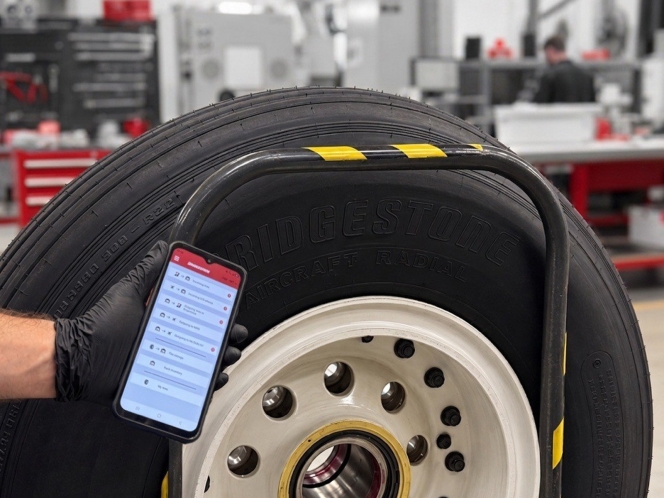
Bridgestone Aircraft Tire (Europe), a Bridgestone Corporation subsidiary, has announced the deployment of its ‘easytrack’ tyre management system at SR Technics Spain SAU, the tyre and wheel maintenance hub of global maintenance, repair & overhaul (MRO) provider SR Technics. The scalable digital platform is accessible on desktop and mobile devices.
Designed for airlines and MROs, ‘easytrack’ manages inbound and outbound tyre and wheel flows across single- or multi-site operations. It delivers real-time identification, tracking and documentation throughout each asset’s lifecycle. The project follows the solution’s first airline implementation in 2025, becoming its second customer rollout and first MRO application.
MRO providers handle large tyre and wheel volumes for multiple airlines, complicating operations. ‘easytrack’ simplifies asset management and improves traceability, accuracy, safety and productivity. At SR Technics Spain SAU, it digitalised paper-based processes, cutting processing time by 45 percent, reducing data-entry and identification errors and improving flow management across Palma de Mallorca and Madrid.
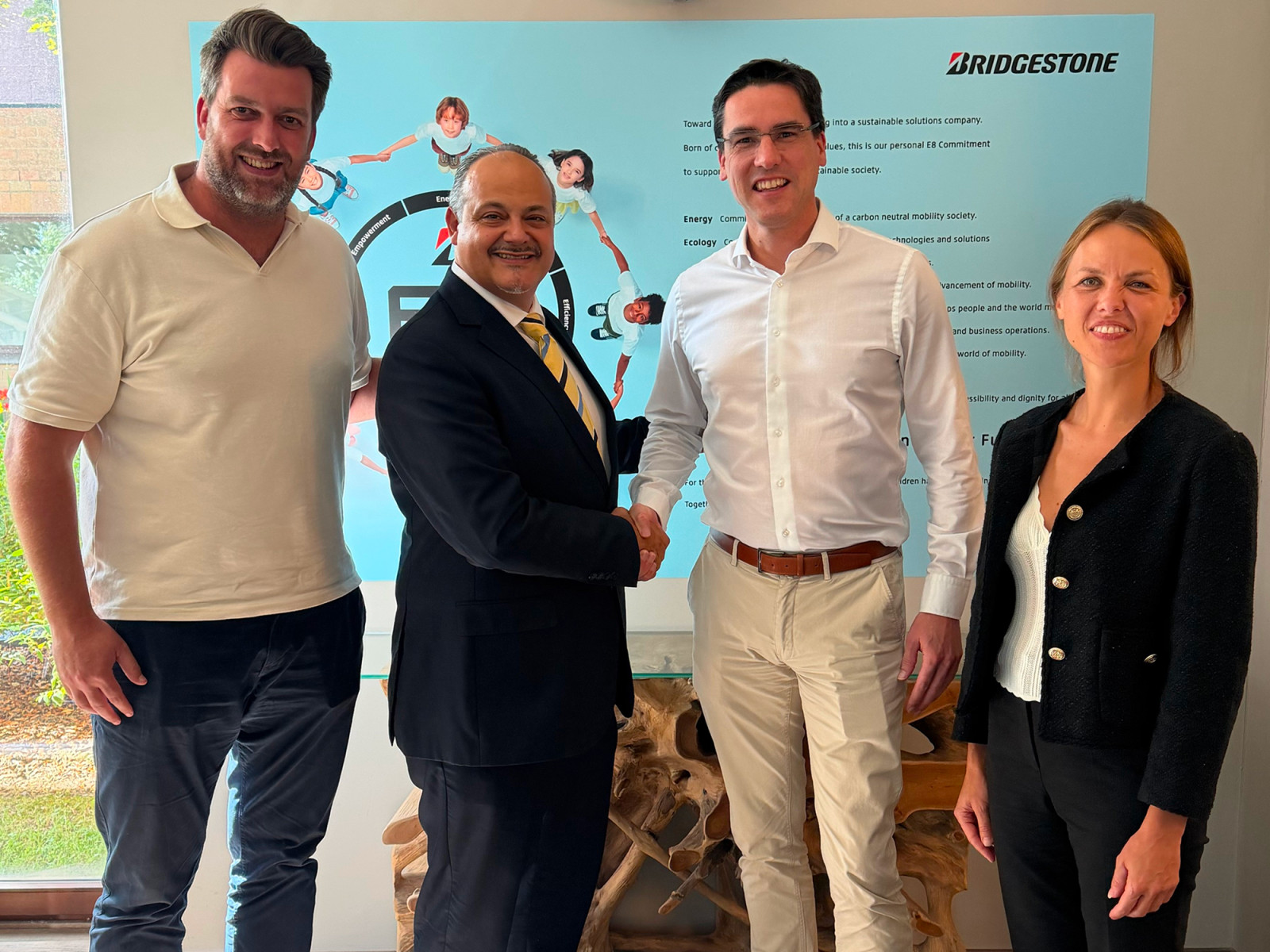
From left: David Sautois, ‘easytrack’ Product Manager, Bridgestone Aircraft Tire (Europe) S.A.; Antonio Colella, General Manager, SR Technics Spain SAU; Jean-Philippe Minet, Managing Director, Bridgestone Aircraft Tire (Europe) S.A.; Eugenie Baradzina, Commercial Director, SR Technics Spain SAU.
The results stem from a Bridgestone and SR Technics Spain SAU co-creation initiative built on long-standing partnership. ‘easytrack’ was adapted to support tyre and wheel combinations for the hub’s wheel and brake operations. Bridgestone’s expansion of airline and MRO solutions aligns with its E8 Commitment, emphasising efficiency and ecology.
Antonio Colella, General Manager, SR Technics Spain SAU, said, "The successful implementation of easytrack is a significant achievement for SR Technics Spain SAU and our teams in Mallorca and Madrid. From the very beginning, the collaboration with Bridgestone was built on trust, openness and a shared vision for innovation. Together, we have developed a solution that not only improves efficiency and traceability but also creates lasting value for our operations. We are proud to be the first MRO in the world to adopt this technology and look forward to continuing this journey with Bridgestone Corporation.”
Jean-Philippe Minet, Managing Director, Bridgestone Aircraft Tire Europe, said, “I’d like to thank SR Technics for their trust and another fruitful collaboration with Bridgestone. What the teams have jointly achieved is remarkable: co-creating through efficient teamwork and customising the Bridgestone easytrack application to digitise SR Technics tyre and wheel tracking operations. This is a brilliant example of how Bridgestone amplifies the value created at our partners.”
Michelin Connected Fleet And Doran Launch Integrated Tyre Management System
- By TT News
- September 09, 2026
Michelin Connected Fleet, a subsidiary of Michelin North America, has entered into a collaboration with Doran to integrate the latter’s tyre pressure monitoring hardware with its own Smart Predictive Tire solution. This combined offering is now accessible through the Platform Science Virtual Vehicle Marketplace, marking the first retail platform to host the integrated system.
The partnership merges Doran’s commercial tyre pressure and temperature monitors with Michelin’s predictive analytics software, creating a unified tyre management ecosystem. By fusing real-time sensor data with connected vehicle intelligence, the solution aims to enhance fleet visibility into tyre health, thereby enabling more informed maintenance scheduling and operational strategy. This development follows Michelin Connected Fleet’s recent launch of Smart Predictive Tire on the same marketplace, now broadening access to a fully bundled hardware-software package.
Utilising advanced data analytics, Smart Predictive Tire identifies emerging tyre issues through pressure and temperature readings, allowing fleets to pre-empt costly roadside failures and minimise unplanned downtime. Doran’s sensors supply the critical digital inputs that feed this predictive model, delivering comprehensive tyre oversight. The joint effort underscores both companies’ dedication to progressing connected fleet capabilities via synergistic hardware, software and data integration.
Willem Moore, President, Michelin Connected Fleet, said, "Doran provides the signal, and our Michelin Smart Leak algorithm helps translate tyre data into actionable insights that support informed maintenance decisions. By providing visibility into potential tyre conditions, fleets can evaluate issues sooner and take appropriate action based on their operational needs. Our focus is on delivering information that helps fleets manage their tyre assets more effectively and helps to support safe, efficient operations.”
Jim Samocki, President, Doran, said, “Fleets do not just need more data. They need accurate and reliable information that they can trust to reduce tyre-related repair and maintenance costs, improve uptime and keep vehicles operating safely. By combining Doran’s proven TPMS technology with Michelin’s Smart Predictive Tire solution, fleets can move beyond simply reacting to tyre issues and take a more proactive approach to tyre maintenance.”

Comments (0)
ADD COMMENT