

Tyre Recycling Reinvented
- By Gaurav Nandi
- December 18, 2025
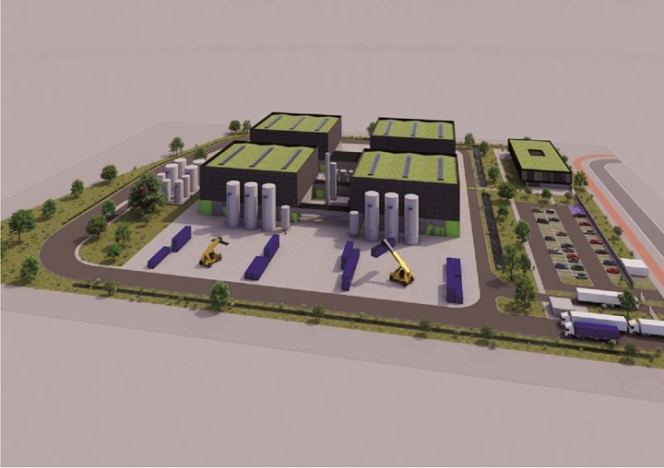
Bolder Industries is positioning itself at the forefront of circular economy innovation with its next-generation Antwerp facility, promising to recycle 6.6 million tyres annually while slashing greenhouse gas emissions by over 80 percent. While the company has proven its technology in the US with BolderBlack and BolderOil, scaling operations to Europe will test both supply chain resilience and market adoption. Beyond environmental claims, the facility’s success will hinge on replicating consistent product quality at commercial volumes, navigating regulatory frameworks and maintaining customer confidence amid global demand for sustainable industrial materials.
Bolder Industries recently secured a EUR 32 million grant from the EU Innovation Fund and an additional EUR 2 million from the Flanders region to support its Antwerp facility, which will recycle over six million tyres annually.
Scheduled to begin operations by 2027, the plant will utilise wind power and on-site heat to produce sustainable materials like BolderBlack and BolderOil, significantly reducing greenhouse gas emissions. Construction is set to commence in 2026, marking a major step towards sustainable manufacturing in Europe.
The plant will serve as a cornerstone for Europe’s circular economy ambitions and strengthen the company’s position in the growing global market for sustainable industrial materials.
Speaking exclusively to Tyre Trends, Chief Executive Officer Tony Wibbeler shared a thorough insight into the company’s strategy and technology, reflecting the company’s readiness to scale proven solutions to commercial volumes.
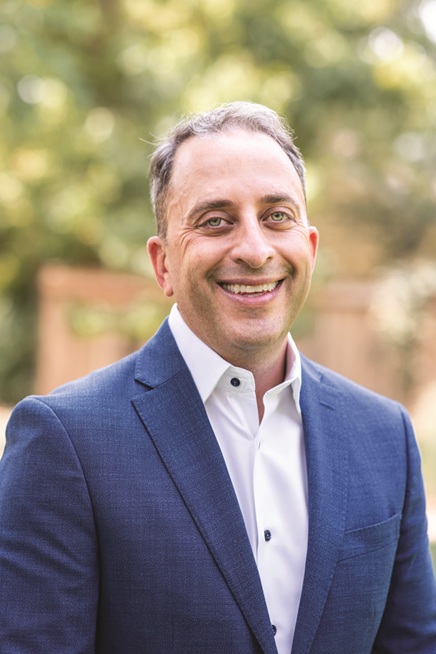 “Bolder is beyond an ambitious idea. Since 2019, we have demonstrated years of commercial success with BolderBlack and BolderOil, which are now supplied across thousands of applications in tyres, rubber, plastics and coatings. Our US operations have proven our technology at scale and the Antwerp facility is not a pilot project; it is backed by the European Commission’s Innovation Fund through CINEA as part of the NextGen Thermal Tire Re-use (N2TR) project with full capacity targeted for spring 2027,” explained Wibbeler.
“We’ve built traceability and certification frameworks like ISCC Plus, ensuring customers receive validated, circular and consistent materials. We’re not proving the concept, we’re scaling a proven solution to meet accelerating global demand,” he added.
BolderBlack, the company’s flagship product, is already integrated into more than 3,000 global applications including tyres, manufactured rubber goods, inks, coatings and plastics. BolderOil complements this by serving high-value markets such as petrochemicals, solvents, carbon black feedstocks and sustainable fuels.
“We do not focus on what others are doing. Our steadfast focus is on delivering consistent, high-quality solutions to customers who demand reliability. Our technology has consistently delivered high-quality products for over five years, making us one of the few companies with a proven commercial-scale history,” Wibbeler noted.
The company sources its feedstock exclusively from post-consumer and post-industrial end-of-life tyres and scrap rubber obtained through partnerships in the US and Europe. “Because we are not tied to oil markets, our products are shielded from oil volatility and tariffs. That
stability enables predictable pricing, typically at a discount to virgin carbon black,” contended Wibbeler.
QUALITY STANDARDS
Meeting stringent tyre maker quality standards is a continuous process. Aside from traditional certifications like ISO 9001, the company has learned a tremendous amount from its customers. “While audits can be daunting, we embrace their experiences and utilise their suggestions to improve our manufacturing processes continually,” noted Wibbeler.
The Port of Antwerp facility is designed to recycle approximately 6.6 million tyres annually at full operation. The process achieves an over 80 percent reduction in greenhouse gas emissions and reduces water use by more than 90 percent compared to conventional carbon black production. This represents a major step forward from traditional tyre disposal methods such as landfilling and incineration, which are resource-intensive and environmentally harmful.
Strategically located on a 55,152-square-metre site within the NextGen District, the Antwerp facility will house four proprietary reactors and a state-of-the-art finishing line. The plant will be powered predominantly by renewable energy including wind power and recovered heat, underscoring the company’s commitment to environmental stewardship.
Complementing the Antwerp operation, Bolder’s US expansion in Terre Haute, Indiana, will recycle a comparable volume of tyres, producing 18,000 metric tonnes of BolderBlack and 21,000 metric tonnes of BolderOil.
“Together, these two facilities create a robust transatlantic supply network that guarantees customers consistent and reliable volumes,” Wibbeler highlighted.
CIRCULAR HUB
The Antwerp facility also contributes to regional economic growth, creating at least 50 new jobs in Flanders and reinforcing Antwerp’s standing as a circular economy hub. Cleaner production, strategic port access and integration within Europe’s largest petrochemical cluster further enhance the plant’s operational advantages.
The company’s resilience stems from multiple business safeguards. These include geographic diversification, alignment with ISCC Plus and European Union frameworks and securing commercial offtake agreements before capacity expansions.
The company recently secured a significant equity investment from Tiger Infrastructure Partners, a private equity firm with expertise in scaling infrastructure projects across the US and Europe, to support growth.
“Our customer base spans the largest tyre manufacturers globally and smaller players alike. This segmentation strategy places BolderBlack into thousands of products, from performance tyres to wetsuits, exemplifying our market reach,” Wibbeler affirmed.
While BolderBlack is already in mainstream production for some manufacturers, others remain in pilot phases. Multi-year offtake contracts ensure operational stability for existing and future capacities.
Regarding the pyrolysis oil produced in the recycling process, the company emphasises a commitment to true circularity. “Our primary markets for BolderOil are carbon black oil feedstock and petrochemicals, supporting circularity goals in tyre and rubber goods industries. We anticipate entering sustainable fuels markets in Europe, though nothing has been finalised currently,” stated the executive.
Addressing concerns around pyrolysis potentially delaying landfill issues, Wibbeler said, “That critique is both misinformed and shortsighted. Pyrolysis is just one step in our broader process. Our traceable tyre-to-tyre reuse model effectively solves the problem rather than delaying it.”
Bolder Industries is actively engaged in industry forums and circular economy initiatives, promoting sustainable materials and tyre recycling advancements, highlighting its leadership role beyond operational activity. The company has achieved multiple certifications and complies rigorously with environmental and quality standards and maintains a Silver EcoVadis rating, reflecting corporate responsibility.
The growing global recycled materials market further positions it to capture market share as industries elevate environmental compliance and sustainability.
Wibbeler concluded with an ambitious outlook, stating, “The industry faces many challenges ahead. Our aim for the next decade is to expand globally, deepen partnerships and deploy a range of technologies to deliver scalable, traceable circular solutions. That’s the role we are committed to playing.”
- Association of Natural Rubber Producing Countries
- ANRPC
- Monthly NR Statistical Report
- Natural Rubber
ANRPC Publishes Monthly NR Statistical Report For August 2026
- By TT News
- October 02, 2026
The Association of Natural Rubber Producing Countries (ANRPC) published its Monthly Natural Rubber Statistical Report for August 2026, noting firmer prices in several markets. Supply constraints, stable downstream demand and persistent geopolitical and macroeconomic uncertainty shaped the month. Renewed conflict and disruptions to major shipping routes added further pressure.
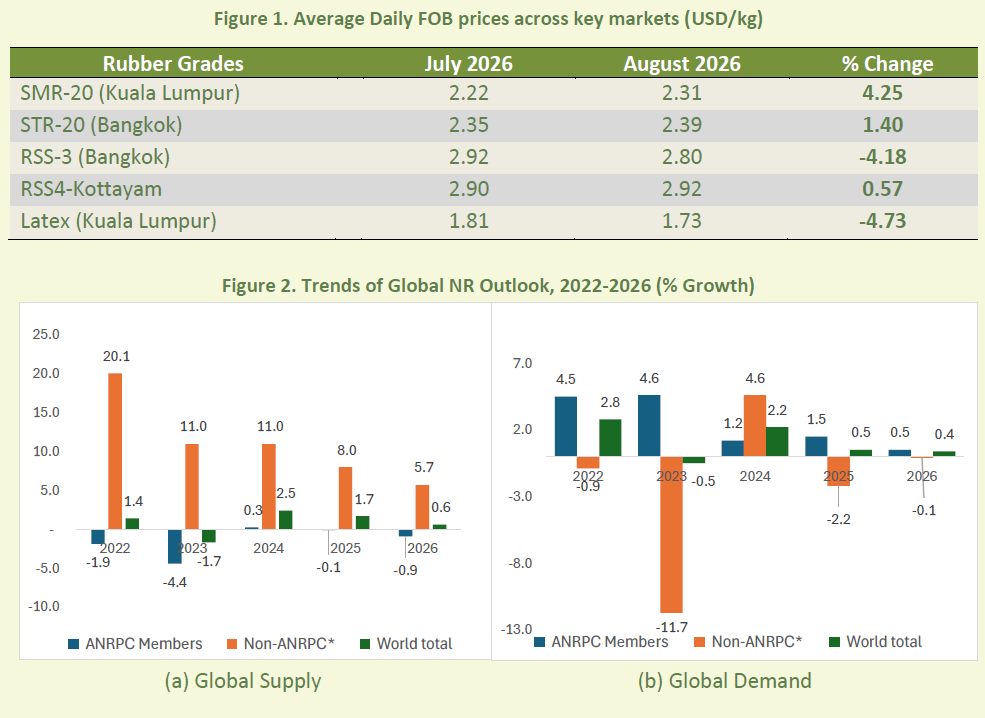
Physical prices for major grades moved in different directions. SMR-20 in Kuala Lumpur averaged USD 2.31 per kg, up 4.25 percent from July, while STR-20 in Bangkok rose 1.40 percent to USD 2.39 per kg. RSS-3 dropped 4.18 percent to USD 2.80 per kg, but RSS-4 in Kottayam gained 0.57 percent to USD 2.92 per kg. Latex-in-bulk fell 4.73 percent to USD 1.73 per kg. Brent crude averaged USD 91.08 per barrel, driven by concerns over possible restrictions on oil shipments through the Strait of Hormuz and wider Middle East instability, which raised energy supply risks and strengthened the oil market risk premium.
On trade, China's imports climbed 3.39 percent month-on-month, while India fell 10.18 percent and Malaysia dropped 8.24 percent; Viet Nam rose 5.08 percent. Exports advanced 5.63 percent in Viet Nam but declined in Thailand (-5.24 percent), Indonesia (-5.36 percent), Malaysia (-1.48 percent) and Cambodia (-1.88 percent).
Global production is projected to rise 0.6 percent to 15.039 million tons in 2026 from 14.952 million tonnes in 2025, after revisions to Thailand's 2025 output and updated 2026 estimates for Thailand, Malaysia and Indonesia. Weather, including erratic rainfall and drier Southeast Asian conditions, affected output. August 2026 production was estimated at 1.396 million tonnes, down 4.51 percent from 1.462 million tonnes a year earlier. Demand is forecast to grow 0.4 percent to 15.356 million tonnes in 2026 from 15.301 million tonnes, with the largest consumption gains expected in China, Malaysia and Cambodia. Prospects depend on vehicle sales, tyre production, shipping conditions and weather-related supply disruptions, while steady EV-linked demand supported modest growth led by China and India. The ringgit traded between RM4.02 per USD and RM4.09 per USD, and the baht between 32.68 and 33.34. The SHFE January 2027 contract averaged 18,109 CNY per tonne, up 7.78 percent month-on-month, while the SGX November 2026 contract averaged USD 2.24 per kg, up 4.32 percent.
HS HYOSUNG To Expand Mexico Investments From 2027 Under New State Agreement
- By TT News
- September 30, 2026
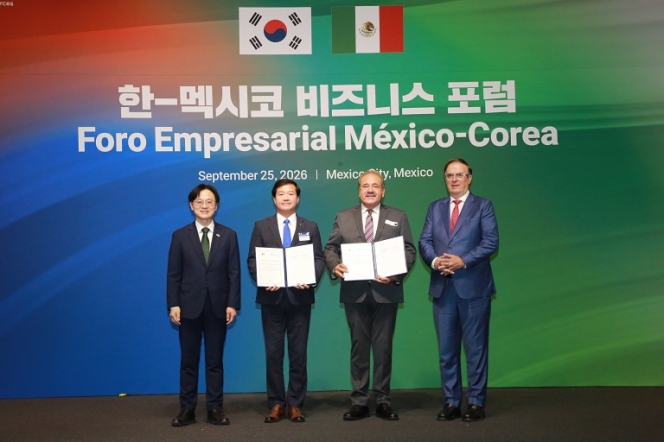
HS HYOSUNG has formalised a memorandum of understanding (MoU) with the State Government of San Luis Potosí, with the signing taking place at the World Trade Center Mexico City. The event formed part of the Korea-Mexico Business Forum, held alongside the Korean economic delegation's visit to Mexico.
Attending officials included Marcelo Ebrard, Mexico's Secretary of Economy, and Mario García Valdez, Secretary of Economic Development of San Luis Potosí. The two sides confirmed their shared resolve to back the company's local investment and regional growth. Separately, HS HYOSUNG's leadership met bilaterally with Secretary Ebrard to elaborate on its strategic vision and investment plans.
The agreement sets out a phased expansion of HS HYOSUNG's investments in San Luis Potosí beginning in 2027, with the goal of creating a major advanced materials production hub that bolsters supply for North American and wider global markets. The company's advanced materials span tyre cord, a flagship world-leading product, along with mobility, energy, aerospace and defence applications. Its North American operations, spanning Mexico and the United States, turn out tyre cord, airbag materials and mobility interior components for global leaders such as General Motors and Goodyear, underpinned by a highly dependable global supply chain.
Nak-yang Sung, CEO, HS HYOSUNG ADVANCED MATERIALS, said, “This investment goes beyond establishing a simple manufacturing base – it reflects our strategy to turn Mexico into a pivotal hub connecting North America with global supply networks. We are also committed to strengthening local supply chains and creating high-quality jobs to contribute directly to the region's industrial ecosystem.”
Kumho Petrochemical Group Shifts Focus To R&D and Speciality Materials
- By TT News
- September 25, 2026
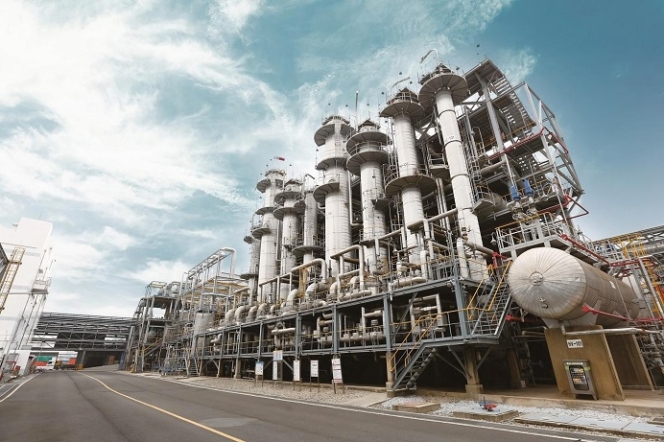
Kumho Petrochemical Group is steering its business towards research-driven, higher-value outputs as oversupply and soft demand continue to weigh on the worldwide petrochemical sector. The Seoul-based group outlined plans to boost spending on speciality chemicals, sustainable materials and novel production methods, a push intended to lift profits while building a foundation for future expansion.
Underlying the move is a deliberate evolution in the group's identity, from a bulk materials vendor to a provider of technology-backed solutions that address shifting customer requirements and stricter environmental rules. A central element of that effort involves widening the speciality lineup, exemplified by added capacity for solution styrene butadiene rubber, a synthetic rubber that enhances durability, rolling resistance and tread wear in high-performance electric vehicle tyres.
Environmental initiatives form another pillar. Facilities built by the company can trap approximately 76,000 metric tonnes of carbon dioxide each year, while separately developed technology turns recycled acrylonitrile butadiene styrene sourced from scrapped household appliances into automotive-grade interior components that satisfy performance standards and generate fewer emissions than conventional methods. The group has also joined forces with POSCO Future M and BEI on anode-free lithium-metal battery development.
Parallel technology-focused programmes are underway at affiliated units. Kumho P&B Chemicals is formulating water-based epoxy resins that curb volatile organic compound releases while incorporating more bio-based inputs to reduce carbon intensity. Kumho Mitsui Chemicals is advancing bio-based polyurethane systems and electric vehicle materials, alongside debottlenecking work to add 100,000 tonnes of annual methylene diphenyl diisocyanate capacity. Kumho Polychem, meanwhile, is targeting ethylene propylene diene monomer through low-temperature polymerisation paired with energy-efficiency improvements.
Birla Carbon Announces Asia-Wide Speciality Materials Price Hike Of Up To 15%
- By TT News
- September 22, 2026

Birla Carbon has confirmed a price increase of up to 15 percent for its Speciality Materials products across Asia, scheduled to take effect on 1 October 2026. The company pointed to significant and sustained rises in feedstock costs, driven partly by ongoing geopolitical instability and disruptions in global feedstock markets, as the reason behind the adjustment.
Although Birla Carbon pursued operational efficiencies, supply chain optimisation and disciplined cost management to soften the impact, the scale and persistence of the cost escalation left a price adjustment unavoidable. The company's sales teams will engage customers directly to explain the details and help them navigate the transition.

Comments (0)
ADD COMMENT