

Getting the Priority Sectors Right Post Lockdown
- By 0
- June 06, 2020

A recent FICCI survey made it amply clear that the Covid-19 pandemic has had a deep impact on Indian businesses which could lead to "unprecedented collapse" of the Indian economy. Only a substantive and urgent economic package by the Government could save a large section of the industry from permanent impairment, survey findings stated.
The survey has just brought to the fore what businesses, cutting across segments, have been realizing ever since the Corona outbreak led to shuttering of businesses and disruption of supply chains. A financial stimulus is, indeed, imperative in view of the huge financial impact on businesses especially to those like auto & tyre sectors who had been facing exceptional distress even before the arrival of the current pandemic. For instance, Tyre industry is poised to lose sales of nearly Rs 10000 crore due to lock-down till the end of April. There is huge blockage of funds by way of inventories of raw materials and in the form of finished goods. Many OEMs have asked for deferment of payments and realizations from the replacement market have dried out.
It is heartening to note Government’s resolve to fight back with full might. Hon’ble Prime Minister has exhorted his cabinet that Government must work on war footing to mitigate the impact of Covid-19 and strategize for the emergent conditions. However, what is of greater significance is PM’s advice to lessen the country’s dependence on other nations and give a sincere push to 'Make in India' as a long-term strategy to immune the country from external trade shocks. He emphasized on boosting India's manufacturing and exports to benefit from emerging world realties.
Certainly, it is all the more important now to identify champion sectors where the country has much better bet of attaining the ideals of Make in India. These sectors will include the ones which have significant employment potential, have proven credentials in domestic manufacturing and exports, enjoy wide acclaim for quality worldwide and have the capacity to ramp up and become global leaders.
On all these counts, Tyre Industry in India has withstood the test very well over the years. It is unfortunate that Indian Tyre Industry has remained one of the less celebrated success stories on manufacturing landscape of India. The industry has not been adequately acclaimed for sterling achievements in areas such as exports, research & development and innovation. It is time that industry’s key contribution as wheels of nation’s economy gets adequately noticed.
For one, Tyre Industry is self-sufficient in India with indigenous capacities to manufacture practically all kinds of tyres from a moped tyre to mammoth off-the-road tyres. Not many countries in the world can boast of this capability.
Not only has the Tyre Industry worked for a self-reliant India ever since independence but has emerged as a major exporter with Indian manufactured tyres being exported to more than 100 countries in the world including the most discerning ones such as US and European countries. Exports of tyres from India are in the range of Rs 12000 crore per annum (nearly 20% of the industry revenue).
Job creation potential of the Tyre Industry is huge in view of a rich value chain extending from rubber planters to tyre mechanics. Industry supports over one million Natural Rubber (NR) planters since as much as 75% of the NR produced in the country is consumed in tyre manufacturing. Another million or so are engaged in tyre manufacturing, tyre retreading and those employed at tyre dealerships and tyre repair services across the length and breadth of the country.
Indian Tyre Industry is increasingly converging with the world in terms of practices, product quality and research & development. Today India has some of the finest radial tyre manufacturing facilities in the world. International vehicle majors (OEMs) have been rolling out leading brands in India on Indian made tyres underscoring the quality edge. The Indian Tyre Industry is emerging as a force to reckon with in the global manufacturing ecosystem. As many as four Indian tyre companies find a pride of place among the top 30 tyre companies in the world.
At a time when private investments have been hard to come by, Tyre Industry in India has continued to invest handsomely in capacity creation and technology. Ongoing and recently completed investments are to the extent of Rs 51000 crore which is unprecedented in the history of the industry.
There is little doubt that India is in the sweet spot as far as tyre manufacturing goes. Seasoned entrepreneurship, availability of skilled manpower, availability of NR plantations and products surpassing international quality benchmarks –are all the ingredients to make India a hub for tyre manufacturing in the world.
Tyre Industry deserves to be a shining example of Indian manufacturing (much like IT or Pharma in the respective sectors) in view of advancements in technology, contribution to Auto and Transport sectors, job creation potential and growth projections.
Currently, several countries in the world are looking to reduce their dependence on China for political, economic and strategic reasons. US and Japan are openly looking for alternatives to China to source products which offer quality and price competitiveness. And therein lies the opportunity of casting the net wider for exports of tyres from India.
However Indian Tyre Industry can leverage this opportunity and replace China in several key markets only if production and exports are provided a policy push by the Government and bottlenecks are removed. China enjoys huge economies of scale as far as tyre manufacturing is concerned. For instance China exports tyres worth US $15 bn in a year which is nearly double the size of Indian Tyre Industry. Actually China has provided large export incentives to its tyre companies since the manufacturing capacity in China is many times that of its domestic requirements. To insulate its companies from the vagaries of fluctuation in Natural Rubber prices and availability, China is maintaining large reserves of rubber as a state policy.
Corona outbreak can work to India's advantage as the quality of tyres produced in India has received worldwide acclaim. India can leverage this opportunity, if production and exports of tyres is given a strong fillip. That requires a support to the industry much in the same way that Chinese Government has been providing to its tyre companies.
India’s economic engine needs a lot of help from the Government to restart after the lockdown. However support to a champion sector like Tyre Industry which has already proven its credentials as employment and export revenue generator will pay dividends in multiples.
JK Tyre Invests INR 11.3 Bln To Expand Capacity Across Key Segments
- By Sharad Matade
- February 18, 2026
JK Tyre & Industries is investing INR 11.3 billion to expand production capacity across truck and bus radial, passenger car radial and off-the-road tyre segments, as strong demand pushes utilisation levels close to full.
The programme will raise overall capacity by about seven percent through projects at its Banmore, Laksar and Mysuru plants. Passenger car radial expansion at Banmore has been completed and is ramping up, with full capacity expected by July 2026. Truck and bus radial capacity at Laksar is due to come on stream by April 2026, while the off-highway expansion at Mysuru is already complete.
The investment forms part of the company’s broader INR 50 billion capital-expenditure plan over five years, focused on premium passenger tyres and radial technologies. Management said the share of larger-rim passenger tyres in its mix had risen to about 31 per cent from 27 per cent a year earlier, underpinning the need for additional capacity.
Indian operations are running at more than 90 percent utilisation, with radial tyre capacity above 95 per cent and consolidated utilisation above 85 percent. The expansion is intended to support continued growth in domestic replacement and original-equipment demand, as well as exports.
Separately, JK Tyre has completed the merger of subsidiary Cavendish Industries Ltd., after improving its utilisation from roughly 30 per cent to more than 95 per cent. The integration is expected to deliver operational synergies and strengthen capacity availability across product lines.
Falken Expands 2026 Summer Tyre Range To Meet EV And SUV Demands
- By TT News
- February 18, 2026
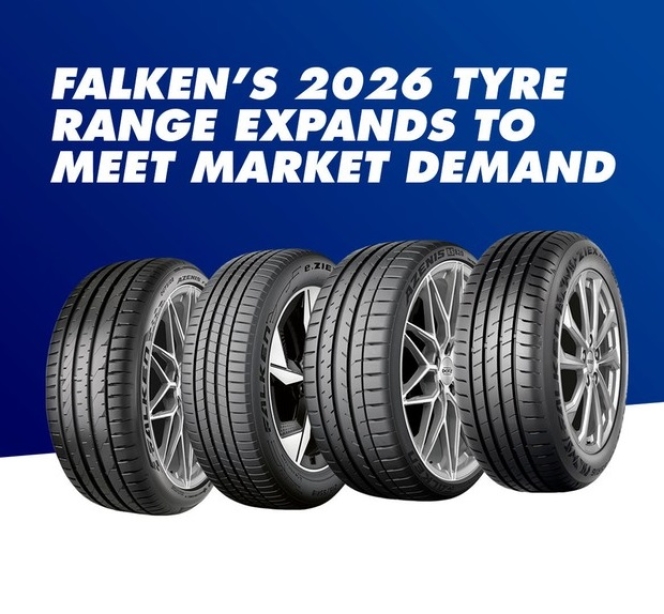
Falken Tyre Europe GmbH is reshaping its summer tyre portfolio in response to shifting automotive trends on the continent, with a significant expansion planned for 2026. The updated lineup directly addresses the growing dominance of SUVs – which now represent 54 percent of new car registrations – and the accelerating shift towards electrification, with battery-electric vehicles holding a 17.5 percent market share in the first half of 2025. These developments have created heightened demand for larger tyre sizes and increased load capacities to accommodate heavier vehicle weights and the instant torque delivery of electric powertrains, all while preserving ride comfort and safety.
A key element of this enhanced portfolio is the AZENIS FK520, which now encompasses a broader array of larger rim diameters and wider footprints to suit both premium SUVs and high-performance automobiles. Its construction continues to emphasise a balance of strength and weight efficiency, incorporating reinforcement materials that support stability during demanding cornering and braking manoeuvres on dry tarmac. This approach ensures that drivers of heavier, more powerful vehicles can still experience precise handling characteristics.
For the rapidly expanding segment of battery-electric and hybrid vehicles, the e. ZIEX line has been developed to address their unique operational requirements. New size additions cater directly to popular electric models, while original equipment approval for Audi Q6 e-tron underscores its suitability for modern EV platforms. The tyre’s engineering focuses on extending range and durability through a carefully designed tread structure that promotes uniform pressure distribution, thereby reducing internal resistance and slowing the rate of wear across the contact patch.
At the pinnacle of the range, the AZENIS RS820 draws directly from Falken’s involvement in endurance motorsport to deliver ultra-high-performance capabilities for exotic sports cars and supercars. Its compound formulation and shoulder architecture are optimized for lateral stiffness on dry circuits and reliable grip in wet conditions, a combination that has led to its selection as original equipment on a premium performance sedan. Complementing these specialist products, the ZIEX ZE320 offers a broadly accessible option for everyday passenger cars, incorporating features that reduce interior noise and improve fuel economy through a lighter, more efficient casing structure.
Marcus Schulz, Product Manager, Falken, said, “Consumer demand for EVs and SUVs is reshaping Europe’s automotive landscape and Falken is ready to meet that challenge. Our 2026 summer range has grown in the areas where we are noticing this growth, ensuring more of Europe’s drivers can rely on Falken’s safe, efficient and performant range – always backed by our five-year guarantee.”
Maxxis Tyres Dominate 2026 King Of The Hammers With Class Wins And Podium Finishes
- By TT News
- February 18, 2026
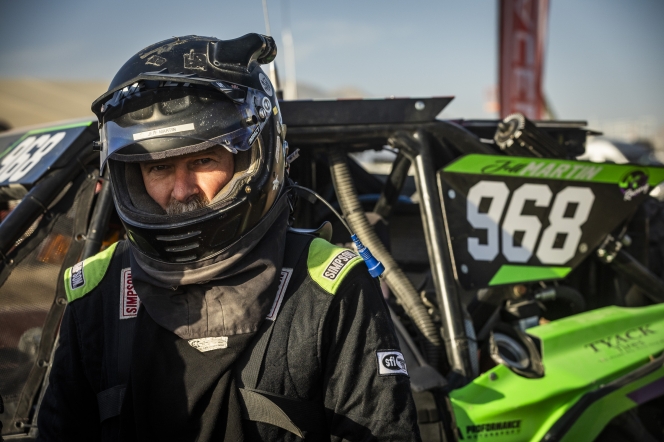
Maxxis tyres demonstrated their competitive edge during the 2026 King of the Hammers (KOH) off-road racing event, where affiliated athletes achieved notable success across several demanding vehicle classes. The most significant victory came in the premier 4900 UTV Hammers Championship, where competitor Jeff Martin secured the overall win. Martin, driving for the Blais Motorsports team in the Open UTV category, navigated the notoriously difficult Johnson Valley landscape on Maxxis Roxxzilla tyres. His performance was characterised by strategic driving and steady control, which allowed him to outpace the competition and claim the top position.
Further highlighting the capability of the Roxxzilla tyre, legendary motocross figure Jeremy McGrath turned in a remarkable performance by finishing ninth overall. This achievement was particularly impressive given that McGrath was competing in the Pro Stock NA class against a field largely composed of more powerful turbocharged vehicles. His top-ten result served as a testament to both his driving expertise and the reliability of his Maxxis rubber. The UTV Pro Modified class also saw Maxxis-supported athletes dominate the podium, with Scott Lesage taking first place and Tommy Thompson securing second.
The punishing nature of the event was evident in the experience of Can-Am driver Hunter Miller. After contending near the front of the 4900 race, Miller’s bid for victory was derailed by a steering malfunction. Despite sustaining significant damage to his vehicle, he demonstrated considerable resilience by continuing to fight through the field and ultimately finishing eighth in the Open UTV class. Before the main events, Maxxis athletes had already established a strong foundation during the earlier Desert Challenge, with Dustin Jones and Todd Zuccone each earning podium finishes in their respective classes. The collective results throughout the week’s racing reaffirmed the brand’s reputation for providing durable, high-performing and consistent tyres capable of handling the extreme and varied conditions that define the King of the Hammers.
- Association of Natural Rubber Producing Countries
- ANRPC
- Natural Rubber
- European Forest Institute
- Natural Rubber Farmers
ANRPC Hosts European Forest Institute Representative
- By TT News
- February 18, 2026
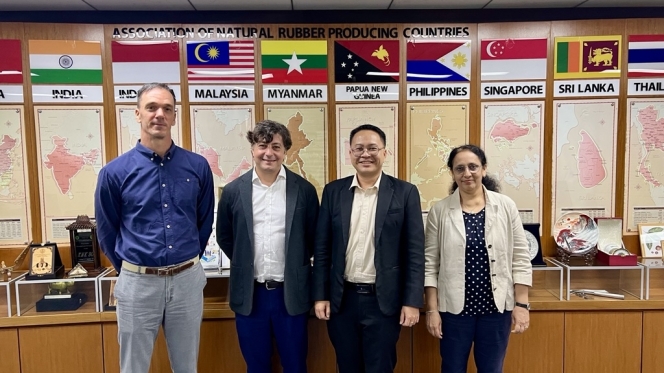
The Association of Natural Rubber Producing Countries (ANRPC) had the pleasure of welcoming Thomas Colonna, Head of the Asia Regional Office from the European Forest Institute (EFI), for a courtesy visit to its Secretariat in Kuala Lumpur on 13 February 2026.
The meeting provided a valuable platform for constructive dialogue focused on strengthening collaboration in sustainability and responsible natural resource management. Both parties exchanged views on potential joint initiatives, with particular attention given to supporting smallholder farmers across ANRPC member countries in the context of evolving global environmental requirements.
The discussions underscored a shared commitment to advancing cooperation and promoting resilient, sustainable practices within the natural rubber sector, marking a positive step forward in the relationship between the two organisations.


Comments (0)
ADD COMMENT