

- Central Marketing Inc
- Retread Information Bureau
- US Federal Aviation Administration
- FAA
- Edd Burleson
- Wilkerson
Aircraft Tyre Retreading A High-Stakes, High-Barrier Business
- By Gaurav Nandi
- September 02, 2026
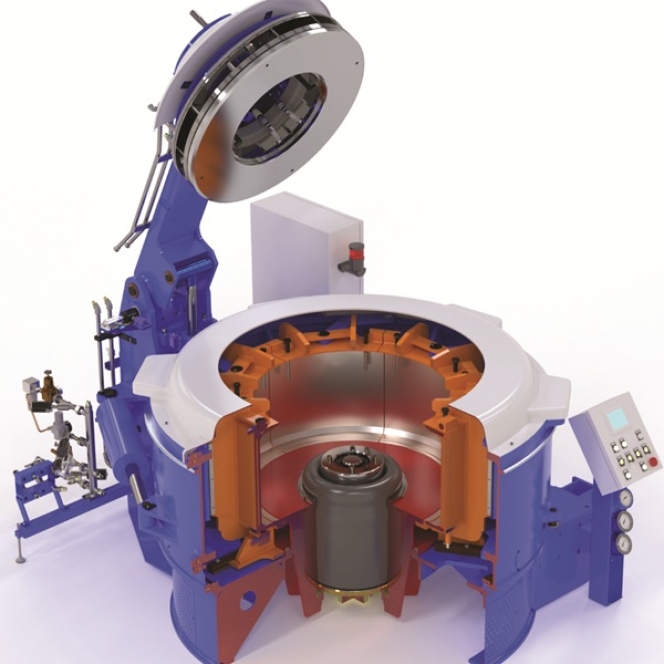
Aircraft tyre retreading may resemble truck tyre retreading on the factory floor, but the similarities end there. Stringent US Federal Aviation Administration (FAA) oversight, exhaustive inspection protocols and extensive documentation make it one of the most tightly regulated segments of the tyre industry. According to President of Central Marketing Inc., these rigorous requirements coupled with high upfront investment and the dominance of major tyre manufacturers have created a niche market where only a limited number of players can compete.
Tire Retread Information Bureau mentions that over 100,000 retreaded tyres are done annually in United States, while another report published by the United States International Trade Commission on retreaded tyres in 2012 stated approximately 80 percent of aircraft tyres in US are retreaded and that retreading saves commercial and military operators over USD 100 million annually.
Since publication of the report over a decade ago, the state of the tyre retreading industry remains quite optimistic. Market Research Future estimated that US aircraft tyre retreading market will reach USD 1.42 billion by 2035, up from USD 948.2 million in 2025.
However, aircraft tyre retreading demands for stricter regulatory oversight than conventional truck and bus tyre retreading.
 According to President Central Marketing Inc Edd Burleson, “FAA certification, rigorous inspections, extensive documentation and high entry barriers define the sector, where major tyre manufacturers dominate and independent retreaders serve mainly private aircraft operators.”
In a tete-a-tete with Tyre Trends, he delves into the dynamics of the aircraft retreading industry of United States and North America as his company has been a supplier of retreading machinery in these markets for over four decades.
“Although aircraft tyre retreading follows the hot retreading process, with many of the same steps seen in truck and bus radial retreading, the level of oversight is substantially higher. The process is fundamentally similar but is much more tightly controlled,” contended Burleson.
Everything is Federal Aviation Administration (FAA) certified. The inspection procedures are much stricter, there are more process controls, much more record-keeping and the Federal Aviation Administration oversees the entire process. The basic manufacturing process is similar, but the level of control and inspection is significantly higher.
He added that the dominance of major tyre manufacturers and strict regulatory requirements make it difficult for independent companies to enter the sector. And that’s because the smaller independent retreaders mainly service the private aircraft market rather than the major commercial airlines.
“Not everyone has the inspection capabilities or qualifications required to obtain an FAA license to retread aircraft tyres. It’s a speciality market and different from commercial truck tyre or OTR retreading,” he added.
Obtaining regulatory approval requires substantial investment before any licence is granted. A company will have to establish a plant, demonstrate its entire retreading process, undergo inspections and prove that it has the capability to perform aircraft tyre retreading.
“It’s not simply a matter of applying for a license and getting approval. You take on the risk of investing in the facility and processes before knowing whether you’ll actually be approved,” Burleson said.
In addition, entering the market isn’t easy because new plants will compete against major players like Goodyear, Michelin, Dunlop and Bridgestone. Hence, as an independent company, it’s generally conducive to enter the private aircraft market.
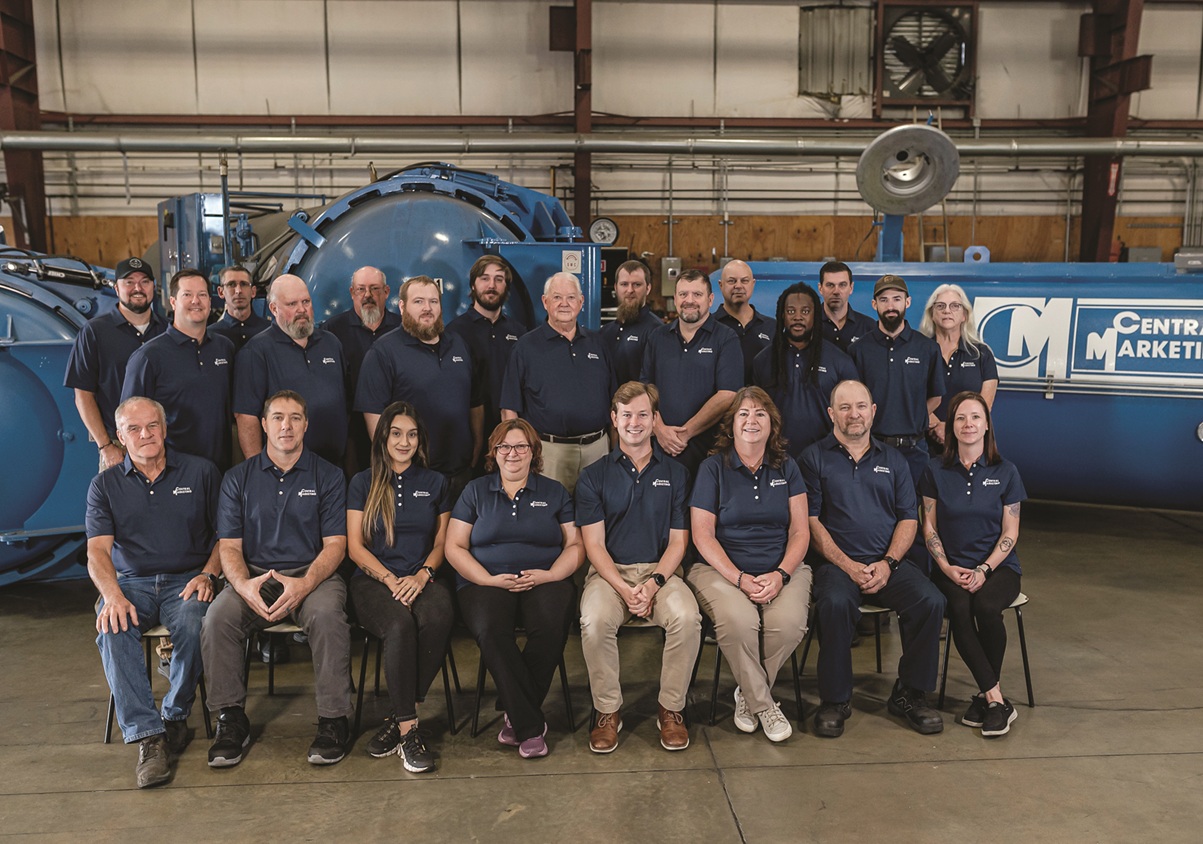 Burleson said the industry’s structure further limits competition because manufacturers sell tyre services rather than tyres themselves.
“The major players manufacture the new tyres and they’re not selling tyres but the service, most which is charged per cycle,” he said.
MARKET DYNAMICS
Aircraft tyre retreading remains a stable and highly specialised market. “The market across North America is well developed because airlines routinely retread their tyres as part of their operating model,” said Burleson.
The airlines themselves are responsible for maintaining the tyres including tyre pressure and general maintenance. The tyre company is responsible for supplying the tyres to the airlines and get paid on a per cycle basis. A cycle here means an entire take-off to landing cycle.
The number of times an aircraft tyre can be retreaded depends on the tyre size and aircraft type. “Some aircraft tyres can be retreaded two or three times, while others can be retreaded five or six times,” Burleson said.
Retreading significantly lowers operating costs for airlines by extending tyre life, he added. As a result, the cost per cycle comes down substantially. If airlines charged the same cost per cycle while using only new tyres, it would be three to four times more expensive.
The company supplies shearography inspection systems, repair machines, buffing machines, rubber extruders, laser engraving systems and curing presses. Its clientele includes Michelin, Bridgestone, Goodyear, Dunlop and one independent aircraft retreader, Wilkerson, in United States.
Besides, Central Marketing has been a servicing supplier to the tyre retreading industry as well as off-the-road, light truck, aircraft and the new tyre industries for 49 years. Its top-of-the-line computerised products have varying degrees of automation. Its base of operations is in Colonial Heights with a staff of 24 people.
Burleson described aircraft retreading as a stable market with limited growth because of the relatively small number of retreaders.
“The market is limited by the number of retreaders so it’s more of a stable market. Growth is typically around 3–5 percent annually. There’s no major boom like you’d see in an emerging market,” he said.
Unlike commercial truck tyre retreading, the aircraft sector in North America has not been affected by imports from Asian manufacturers.
“Bridgestone has one plant in US, Michelin has one, Goodyear has two and the total number of aircraft retreading plants isn’t very large,” Burleson said.
Outside United States, the market is even smaller.
“There’s a small aircraft retreader in Mexico and there isn’t any aircraft tyre retreading in Canada,” he said.
MAKING THE RETREADS
Aircraft retreading equipment differs from machinery used in commercial tyre retreading because aircraft tyres require greater precision during processing. The tyres are much more difficult to handle and buff.
Repairs are limited to very specific tolerances. Companies have to ensure their process doesn’t damage the body plies during buffing. There may be need to replace breaker belts and perform other specialised repairs.
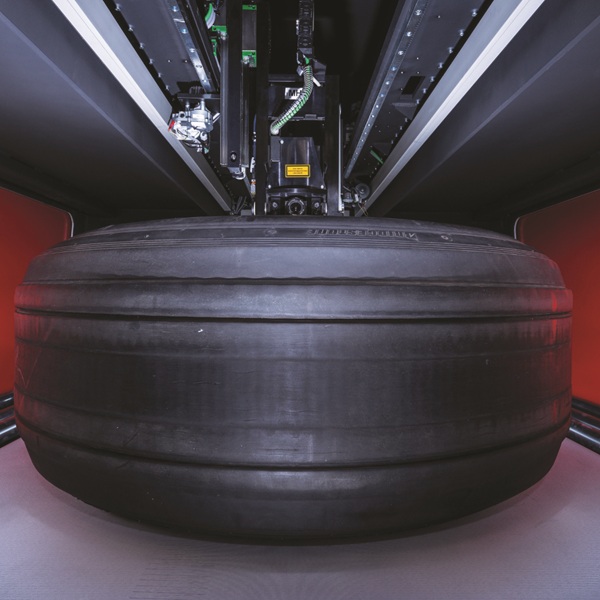
Each stage of production must comply with tightly controlled specifications. Every step of the process has to meet a specific specification.
“If the temperature drops by more than a set number of degrees during curing, then the tyre may no longer be acceptable. Aircraft retreading is governed by much stricter rules and regulations because of the nature of the application. You’re transporting people, so there can be absolutely no compromise on safety,” Burleson said.
Burleson identified shearography as the most significant technological advancement in aircraft tyre retreading.
“I would say the biggest advancement has been shearography. Another important development is laser engraving. Each time an aircraft tyre is retreaded, it’s assigned an ‘R level’ to ascertain the exact retread generation,” he said.
Laser engraving the sidewall makes record-keeping much more accurate compared with using stencils. Considerable progress has been made in buffing technology through computerised profiles too.
Automation is increasing in selected areas, although regulations limit the use of artificial intelligence as a trained human inspector must still verify and confirm the results.
SUSTAINABLE OPERATIONS
Aircraft retreading makes a significant contribution to sustainability by extending tyre life as each tyre is retreaded between three to six times.
The economics of cost savings and inexistence of Asian imports have also written an optimistic future for aircraft tyre retreading in US till now, but challenges are present for retreading machinery suppliers.
“We don’t make the machines ourselves but procure it from different countries for the US market. The challenge is providing equipment that meets our customers’ requirements and being able to service that equipment when it’s installed in their plants,” said Burleson.
However, he said that the broader retreading industry is undergoing consolidation. “In US, the East Coast is probably the largest market, followed by the West Coast, where the major population centres are,” he said.
Retreading plants are becoming larger in the TBR segment, processing higher volumes and adopting more automation. At the same time, smaller retreaders are finding it increasingly difficult to compete and many are going out of business.
Aircraft retreading is insulated from those market trends because of its unique business model.
Summing up the sector, Burleson reiterated that aircraft tyre retreading should not be viewed in the same way as commercial tyre retreading.
“The main thing people need to understand is that aircraft retreading is a speciality market. Although the process follows many of the same basic steps as commercial tyre retreading, it’s performed under much stricter controls because of the critical nature of its application. It’s not something that anyone can simply enter. It’s a highly specialised industry. Even though it’s still retreading, it shouldn’t be viewed in the same way as the normal commercial TBR market,” he noted.
Kerala Launches Twelfth Phase Of Rubber Incentive Scheme
- By TT News
- August 12, 2026
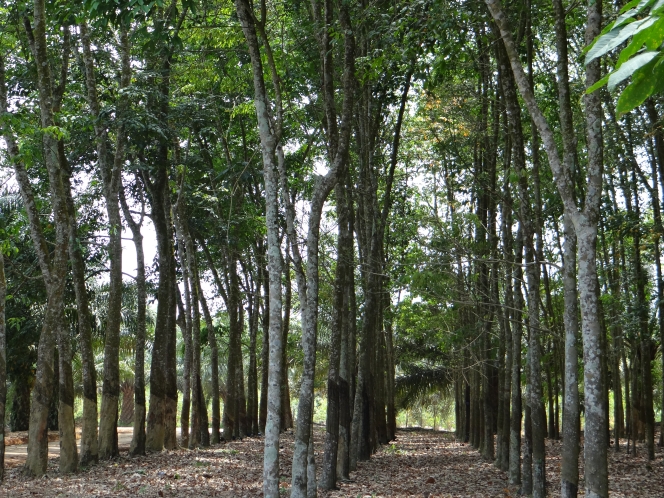
The Government of Kerala has approved the twelfth phase of the Rubber Production Incentive Scheme, extending support to natural rubber growers through a guaranteed price mechanism.
The scheme is designed to ensure a price of INR 250 per kilogram for RSS 4 grade sheet rubber. Growers who are not yet enrolled may register for the programme until 23 October 2026, according to an official statement issued on 6 August in Kottayam.
Applicants seeking new registration must submit an Aadhaar card, bank passbook copy, current year land tax receipt and a photograph to their respective Rubber Producers’ Societies. Existing participants are required to renew their registration by providing land tax receipts for the 2026–27 period.
The release added that sale invoices or purchase bills submitted under the scheme must originate from licensed dealers who comply with statutory return requirements. Further details are available through the nearest Rubber Board office.
INROAD And Rubber Board Launch Multilingual Training Videos For Rubber Growers
- By TT News
- August 06, 2026
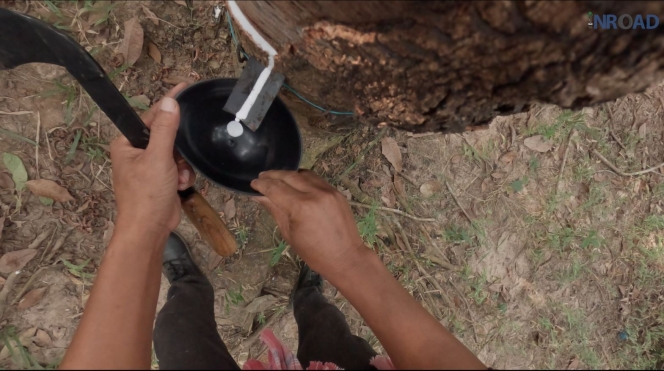
The Rubber Board of India has launched a series of educational videos as part of the iSPEED (INROAD Skilling and Production Efficiency Enhancement Drive) programme, an INR 1.50-billion initiative aimed at enhancing skill development, quality improvement and infrastructure building within the natural rubber sector. This launch comes as the plantation activities under the larger Project INROAD (Indian Natural Rubber Operations for Assisted Development) in Northeast India approach completion, shifting focus towards productivity and quality enhancement through modern training and facilities.
The newly released video series targets nearly 300,000 rubber growers in the region, covering five essential processing areas: Rubber Tapping, Rain Guarding, Grading, Rubber Sheet Making and Scientific Smokehouses. To ensure broad accessibility, the modules have been produced in Assamese, Bengali, Hindi and Malayalam, enabling effective communication with diverse stakeholders across the natural rubber ecosystem.
The official release of the videos was conducted by Executive Director M Vasanthagesan, alongside Rubber Production Commissioner Dr Siju T Nair, other senior Board officials and representatives from the Indian tyre industry. Developed over the past year with technical assistance from the Rubber Board and the Rubber Research Institute of India, the educational content combines animation with real-life field demonstrations to simplify complex scientific practices for easy adoption.
Project INROAD represents a unique collaboration between the Indian tyre industry and the Rubber Board, with support from Apollo Tyres, CEAT, JK Tyre and MRF. Over the last five years, this partnership has facilitated new rubber plantations across approximately 180,000 hectares in 113 districts of Northeast India, establishing it as the country’s largest plantation development programme of its kind.
Mohan Kurian, Chairman, INROAD Project, said, "Skill development and adoption of scientific practices are essential for improving both productivity and quality in the natural rubber sector. These multilingual videos will serve as an effective training resource for growers and complement the Rubber Board's ongoing extension efforts across the country.”
Sanjiv Saxena, Convener, ATMA Supply Chain & Resources (SCR) Group, said, "The objective of the participating member companies under INROAD is to ensure that rubber growers benefit the most from a stronger natural rubber value chain. By improving productivity and quality, we aim to help farmers realise better returns while strengthening the sustainability of the entire ecosystem."
Muraligopal, who played a key role in coordinating the development of the videos, said, "These videos are the result of close collaboration with the Rubber Board, RRII and field teams across the Northeast. Their guidance and support helped us develop practical, farmer-friendly training modules based on scientific best practices."
Zeon And Yokohama Rubber Advance Sustainable Rubber Project With New Facility Completion
- By TT News
- August 04, 2026
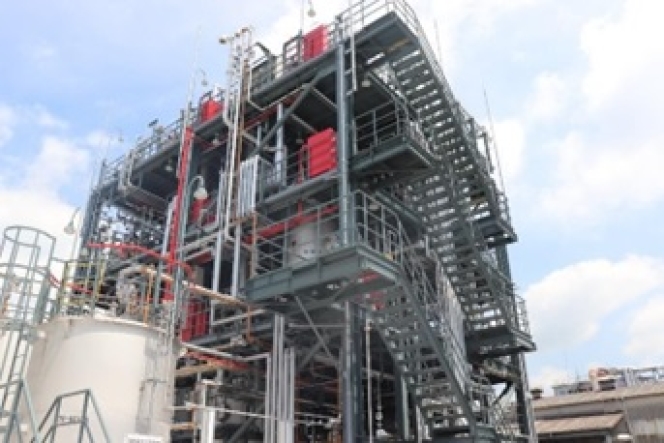
Zeon Corporation has finalised the construction of a new bench-scale facility at its Tokuyama Plant in Shunan City, Yamaguchi Prefecture, dedicated to advancing the efficient production of butadiene from sustainable ethanol sources. The project, which broke ground in July 2025, represents a strategic move to establish a naphtha-independent raw material supply chain, thereby bolstering both corporate sustainability and the broader transition towards a carbon-neutral society. The facility is slated to commence full-scale operations in January 2027, with the ultimate goal of achieving commercial viability by 2034.
A commemorative ceremony took place at the plant site on 31 July 2026, drawing a total of 46 attendees. The gathering included official representatives from Japan’s Ministry of Economy, Trade and Industry (METI), the New Energy and Industrial Technology Development Organization (NEDO) and local governmental bodies from Yamaguchi Prefecture and Shunan City. Also present were delegates from the Yokohama Rubber Company, the construction contractor and various affiliated firms, alongside Zeon’s leadership, including Akira Honma, the Corporate Officer and Tokuyama Plant Manager.
This initiative forms one half of a dual-themed research and development programme undertaken in partnership with Yokohama Rubber, under the auspices of NEDO’s Green Innovation Fund. The collaborative effort is focused on the social implementation of technologies for synthesising both butadiene and isoprene from renewable biological materials by the 2030s. As part of this process, Zeon is set to produce a prototype polybutadiene rubber using the output from the new bench-scale facility, while Yokohama Rubber will subsequently manufacture test tyres from this material and conduct performance evaluations on test tracks.
Both companies have outlined a clear roadmap, intending to finalise the core technology for societal deployment by 2030 through the operation of a larger pilot plant, with full-scale commercialisation targeted for 2034. The bench-scale facility is a critical precursor in this phased approach, providing essential data for the scale-up process.
The broader project encompasses two selected NEDO themes, both subsidised through the Green Innovation Fund. The first involves the highly efficient synthesis of butadiene from ethanol, with technical cooperation from the National Institute of Advanced Industrial Science and Technology. The second focuses on biotechnological pathways to directly produce butadiene and isoprene from plant-based materials, involving partnerships with the Institute of Science Tokyo and RIKEN. Both tracks aim to supplement synthetic rubber feedstocks and support closed-loop recycling, aligning with Japan’s 2050 net-zero emissions goal by fostering long-term industrial innovation.
- Association of Natural Rubber Producing Countries
- ANRPC
- Monthly NR Statistical Report
- Natural Rubber
ANRPC Publishes Monthly NR Statistical Report For June 2026
- By TT News
- July 31, 2026
The Association of Natural Rubber Producing Countries (ANRPC) has released its Monthly Natural Rubber Statistical Report for June 2026, a month defined by price resilience amid conflicting market forces. The provisional reopening of the Strait of Hormuz triggered a sharp 20.29 percent drop in Brent crude oil prices to USD 85.40 per barrel. However, this bearish signal was counterbalanced by persistent supply constraints from El Niño-related weather disruptions across major producing regions.
Physical rubber prices posted broad-based gains across most grades. SMR-20 rose 1.39 percent to USD 2.32 per kilogramme, while STR-20 gained 2.61 percent to USD 2.55 per kilogramme. RSS-3 and RSS-4 advanced 4.98 percent and 5.88 percent to USD 3.09 and USD 2.84 per kilogramme, respectively, though latex eased 1.44 percent to USD 1.94 per kilogramme. On the trade front, China's imports surged 7.14 percent month-on-month, while India and Viet Nam declined. Export growth was recorded for Cambodia, Viet Nam and Indonesia, though Thai shipments contracted.
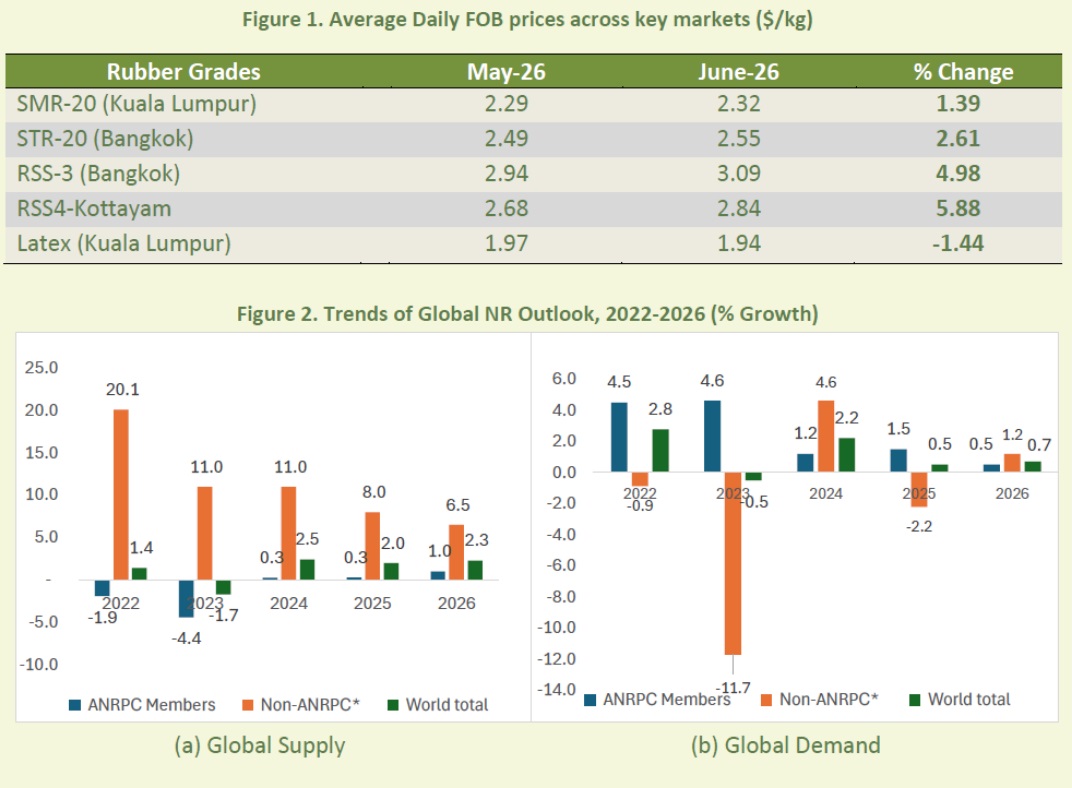
Global production for 2026 is projected at 15.310 million tonnes, up 2.3 percent from 2025, driven by gains in Thailand, China, India and Malaysia. However, June output fell 3.7 percent year-on-year to 1.207 million tonnes due to seasonal wintering and El Niño-related weather disruptions. Malaysia, Indonesia and Cambodia have introduced new incentive and governance measures to strengthen their sectors. Global consumption is forecast to grow 0.7 percent to 15.411 million tonnes in 2026, with June consumption rising 3.3 percent to 1.300 million tonnes, led by China and India amid steady tyre and EV-related demand.
Currency markets saw the Malaysian ringgit trade between RM3.96 and RM4.08 against the US dollar, while the Thai baht ranged from 32.56 to 33.24. In futures trading, the SHFE September 2026 contract averaged 17,580.68 CNY per tonne, down 0.45 percent month-on-month, while the SGX September contract averaged USD 2.24 per kilogramme, up 1.75 percent, with both reflecting tightening supply and firm downstream demand.


Comments (0)
ADD COMMENT