

From Lignin To Tyre Fillers
- By Sharad Matade
- June 19, 2026

The tyre industry faces growing pressure to reduce fossil-based inputs, prompting a shift towards bio-based materials as industrial alternatives. Once a niche research area, bio-based solutions are now entering mainstream engineering as manufacturers balance performance and sustainability. This shift is clear in next-generation fillers, with companies like UPM advancing lignin-based solutions from concept to commercial validation.
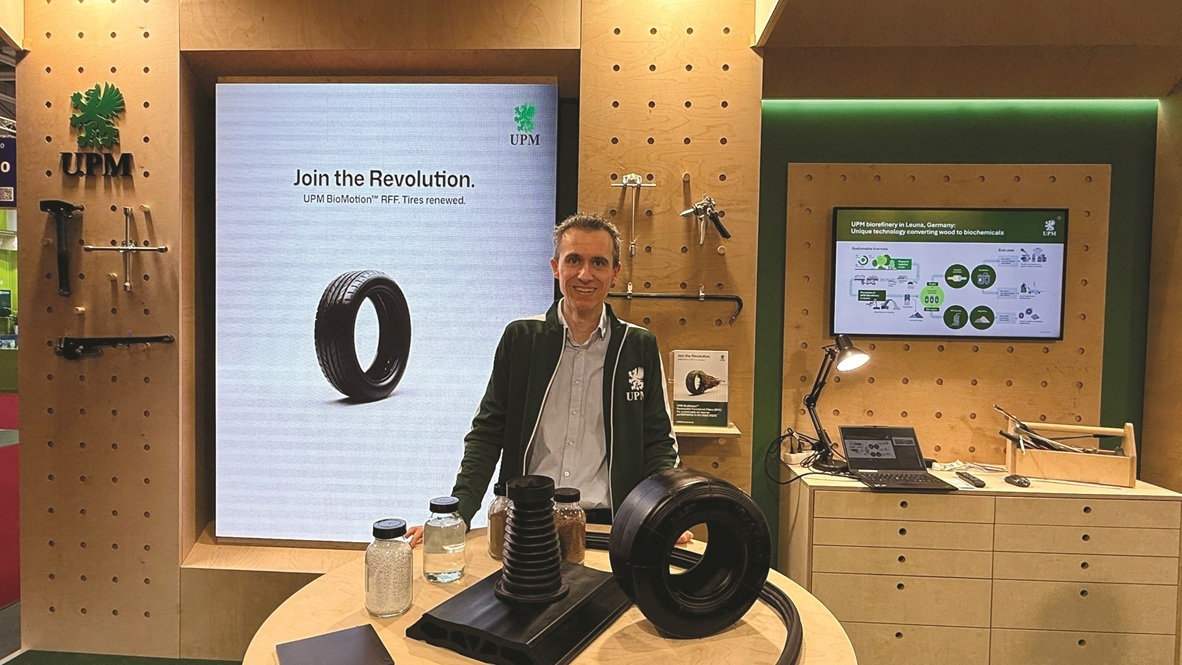
Florian Diehl, Director of Sales RFF at UPM Biochemicals GmbH, explained that the company positions its BioMotion renewable functional fillers (RFF) as a new material class that addresses sustainability while delivering measurable performance gains.
NEXT-GEN FILLERS
Functional fillers are not peripheral to tyre design; they are central. Typically accounting for nearly 30 percent of a tyre’s composition, materials such as carbon black and precipitated silica have defined performance characteristics for decades. Against this entrenched backdrop, UPM’s innovation is not incremental – it is structural. “This is not a one-to-one drop-in replacement for carbon black, but rather a new material class that sits somewhere between carbon black and silica, with some properties closer to carbon black and others closer to silica,” said Diehl.
This approach is intentional. Instead of matching legacy materials, UPM expands the formulation options for tyre engineers, though this adds complexity. “You cannot just take out carbon black and put in RFF without making adjustments, because while it can replace both carbon black and silica to some extent, it requires changes in the formulation and curing system,” Diehl added.
Adoption will require iterative, collaborative development between material suppliers and tyre manufacturers.
PROOF THROUGH PARTNERSHIP
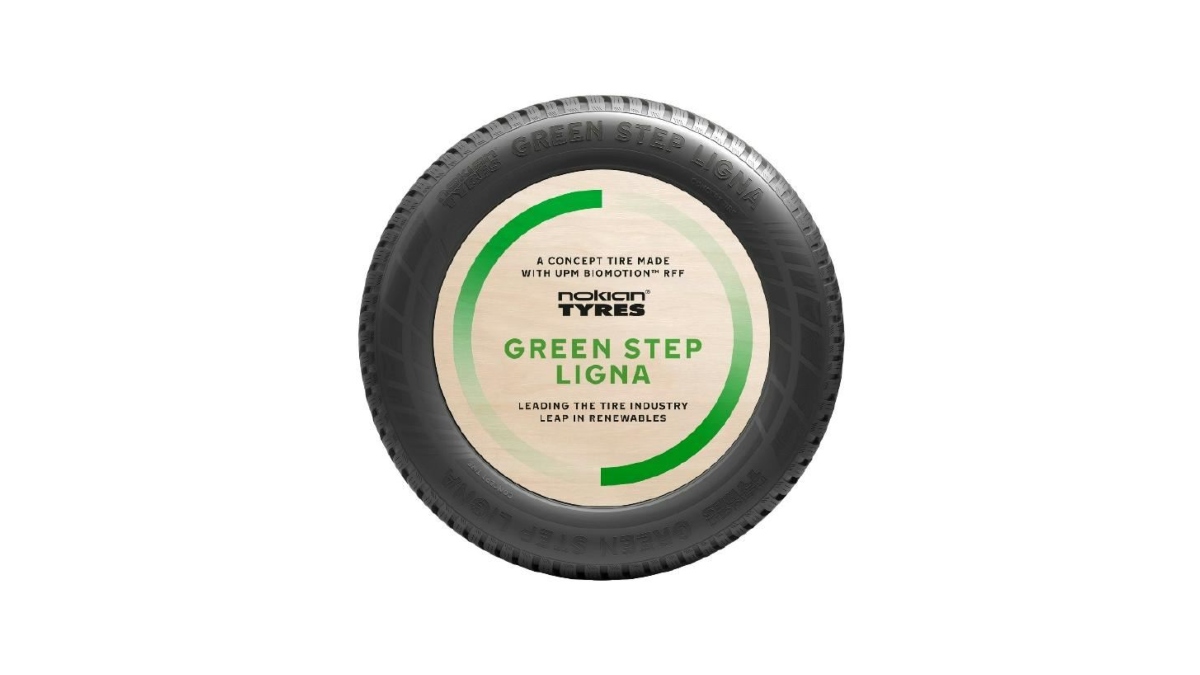
The collaboration between UPM and Nokian Tyres marks a key milestone in applying material innovation. In June 2024, they introduced the Green Step Ligna concept tyre, the first to use UPM BioMotion RFF, a fully renewable, wood-based lignin material. In this tyre, all fossil-derived carbon black in the sidewalls has been replaced by the lignin-based filler.
The concept tyre demonstrates the practical viability of lignin-based material in tyres and sets a higher benchmark for environmental responsibility in the industry.
For UPM, this collaboration is a strategic turning point. It marks the company’s entry into global tyre markets with renewable functional fillers and supports scaling its biorefinery business through proven application value.
Diehl noted that such collaborations are essential for industrial validation.
 “The Nokian Tyres case is the only one we can discuss publicly, but we are working with most major tyre companies behind the scenes, even though we are not allowed to disclose their names,” he said.
PERFORMANCE STILL DOMINATES
Despite the strong sustainability narrative, Diehl was unequivocal that performance remains the primary driver of adoption. “For example, Nokian Tyres reported that when they replaced virgin carbon black in the sidewall, they observed improved rolling resistance, which is a clear performance advantage,” he said. This is consistent with early test findings, which suggest that substituting traditional fillers with RFF can enhance efficiency while reducing environmental impact.
Rolling resistance is particularly critical in electric vehicles, where it directly influences battery range. “In inner liner applications, we have seen that it improves air impermeability, meaning the tyre retains air pressure better, which is another functional benefit,” Diehl noted.
UPM’s data confirms improved air retention and efficiency as key outcomes.
The material’s lower density also reduces weight. “Compared to carbon black and silica, our material has a lower density, so you need less material, which makes the final product lighter and further supports improvements in rolling resistance,” Diehl said.
LIGNIN: UNLOCKING AN UNDERUTILISED RESOURCE
The foundation of UPM’s innovation lies in lignin, a natural polymer that has historically been undervalued. “Lignin is the second most abundant natural polymer and is present in all plants, but in the paper industry, it is typically separated and burned as an energy source rather than being used as a material,” Diehl explained.
For UPM, this represented a strategic opportunity. “As a company with deep expertise in wood handling and wood chemistry, we decided to move from fibre-based applications to the molecular level and develop biochemicals,” he said.
 Through proprietary processing, lignin is transformed into a rigid particulate filler with controlled surface properties. “We developed a process that converts lignin into a particulate material that behaves like a filler, with tunable surface area and without the typical polymer characteristics,” Diehl added.
This transition – from waste stream to high-performance material – illustrates the broader industrial shift towards biomass valorisation.
SCALING FROM CONCEPT TO INDUSTRY
While the concept tyre proves technical feasibility, scaling is the next critical step. “The material is just becoming commercially available, and manufacturers prefer to test it from the final production site rather than pilot batches, so the current limitation is availability while our Leuna Biorefinery is in its start-up phase,” Diehl explained.
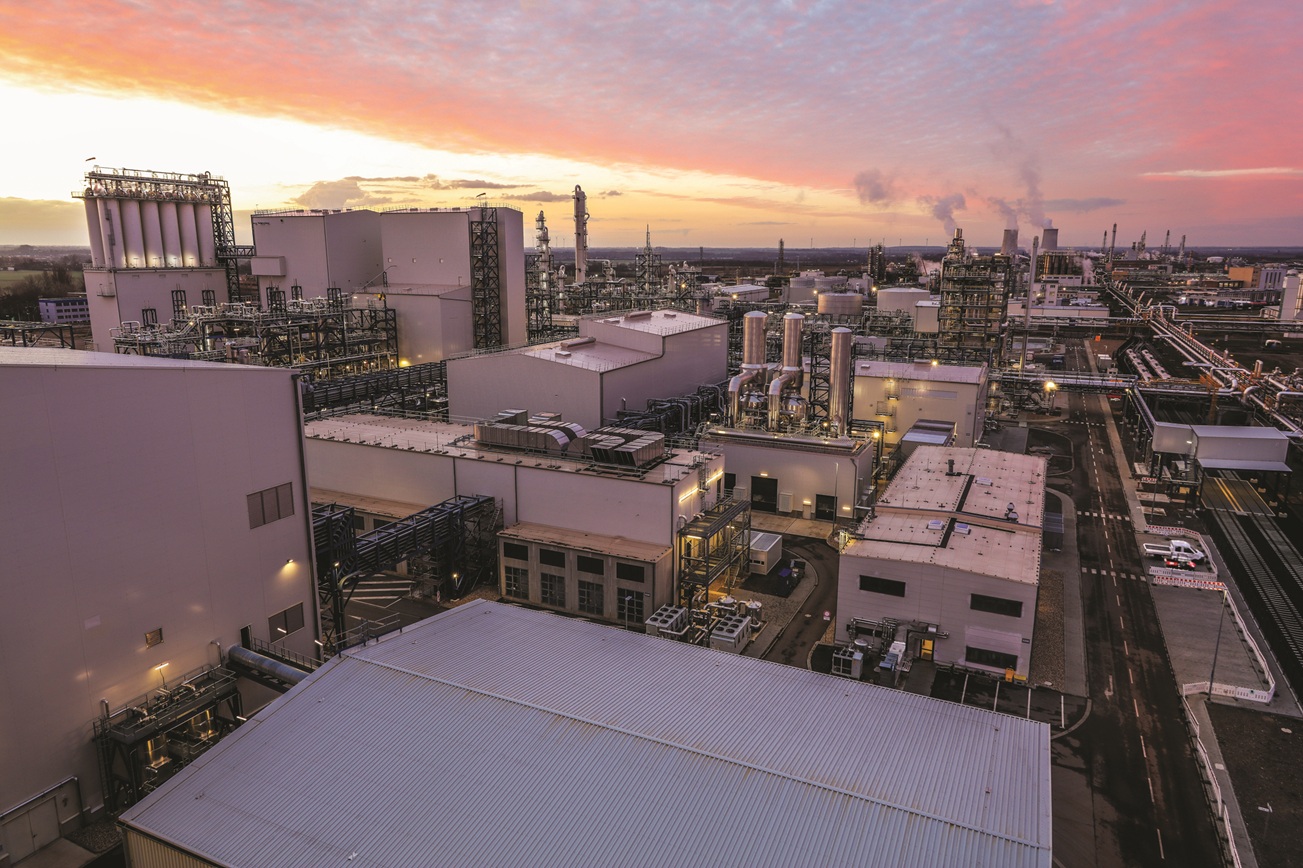
UPM’s Leuna biorefinery is central to addressing this. “At our biorefinery in Leuna, we will produce a total of 220,000 tonnes of biochemicals, with renewable functional fillers representing a significant share,” he said.
The facility itself represents a substantial industrial commitment, with investment exceeding EUR 1 billion and designed to convert sustainably sourced hardwood into next-generation biochemicals.
Crucially, scalability is underpinned by feedstock availability. “Lignin is already available at industrial scale in pulp and paper mills, so if the market adopts our solution, we can scale production significantly,” Diehl added.
COMPLEMENTARY MATERIAL STRATEGY
The rise of recovered carbon black (rCB) adds complexity to sustainability efforts. UPM positions its material as complementary rather than competitive. “We see our solution as complementary, meaning tyre manufacturers can use recovered carbon black alongside our renewable functional fillers to replace fossil-based carbon black,” Diehl said.
He also challenged assumptions around cost. “There is a perception that recovered carbon black is cheaper, but in some European markets, we hear that it can even be more expensive than virgin carbon black,” he noted. This suggests future tyre compounds will likely blend recycled and renewable inputs, rather than rely on a single alternative.
MARKET STRATEGY: PREMIUM FIRST
UPM’s commercial approach follows a well-established pathway for advanced materials. “As with most new materials, we expect initial adoption in premium segments before it gradually expands into the mass market, although this transition will take time,” Diehl said.
Premium manufacturers are expected to lead this transition, with emerging global players likely to follow as they move up the value chain.
ELECTRIFICATION DRIVES CHANGE
The rise of electric vehicles introduces new performance constraints. “Electrification will have a clear impact on tyre design because vehicles are becoming heavier and have higher torque, which makes wear resistance more critical,” Diehl said.
UPM is already adapting. “With our current solutions, we would not yet fully meet all requirements in such applications, which is why we are already working on a second generation that can compete more effectively,” he added.
SUSTAINABILITY
UPM’s RFF is positioned as a 100 percent renewable, CO₂-negative solution (from cradle to gate, considering the biogenic carbon and purchasing 100 percent green electricity), contributing to reduced reliance on fossil-based materials. However, Diehl is candid about market realities. “A few years ago, sustainability was the dominant driver, but today the focus has shifted towards combining sustainability with performance,” he said. “The willingness to pay higher prices is currently limited, which is a challenge, even though we believe our material delivers additional value,” he added.
REGULATION NOT ENOUGH
“There are discussions around end-of-life tyre regulations that could include bio-based quotas, which would support solutions like ours,” Diehl said. Yet he remains cautious. “Ultimately, the product must deliver performance, because regulations can change and cannot be relied upon as the only factor,” he added.
 “We designed our processes so that the material can be handled and dispersed in a similar way to traditional carbon black and silica,” Diehl said. “When tyres containing our material are recycled, the filler will end up in pyrolysis oil, similar to natural rubber,” he added.
MEASURED TRANSFORMATION
UPM’s strategy focuses on systematic integration: introducing a new material class, validating it through partnerships and scaling it through industrial infrastructure. The Nokian Tyres concept tyre offers a tangible glimpse of what that future may look like: a tyre in which fossil-derived fillers are partially or fully replaced by renewable alternatives, without compromising performance. As Diehl concluded, “we are convinced the product delivers the performance and provides additional value, and will succeed in the market.”
- Association of Natural Rubber Producing Countries
- ANRPC
- Monthly NR Statistical Report
- Natural Rubber
ANRPC Publishes Monthly NR Statistical Report For August 2026
- By TT News
- October 02, 2026
The Association of Natural Rubber Producing Countries (ANRPC) published its Monthly Natural Rubber Statistical Report for August 2026, noting firmer prices in several markets. Supply constraints, stable downstream demand and persistent geopolitical and macroeconomic uncertainty shaped the month. Renewed conflict and disruptions to major shipping routes added further pressure.
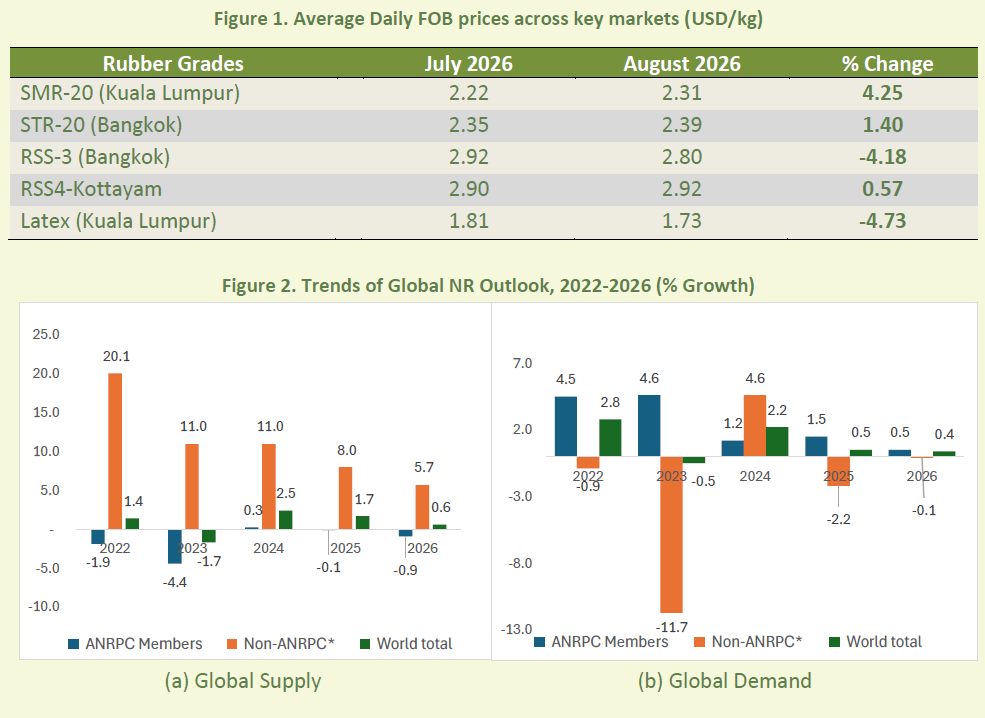
Physical prices for major grades moved in different directions. SMR-20 in Kuala Lumpur averaged USD 2.31 per kg, up 4.25 percent from July, while STR-20 in Bangkok rose 1.40 percent to USD 2.39 per kg. RSS-3 dropped 4.18 percent to USD 2.80 per kg, but RSS-4 in Kottayam gained 0.57 percent to USD 2.92 per kg. Latex-in-bulk fell 4.73 percent to USD 1.73 per kg. Brent crude averaged USD 91.08 per barrel, driven by concerns over possible restrictions on oil shipments through the Strait of Hormuz and wider Middle East instability, which raised energy supply risks and strengthened the oil market risk premium.
On trade, China's imports climbed 3.39 percent month-on-month, while India fell 10.18 percent and Malaysia dropped 8.24 percent; Viet Nam rose 5.08 percent. Exports advanced 5.63 percent in Viet Nam but declined in Thailand (-5.24 percent), Indonesia (-5.36 percent), Malaysia (-1.48 percent) and Cambodia (-1.88 percent).
Global production is projected to rise 0.6 percent to 15.039 million tons in 2026 from 14.952 million tonnes in 2025, after revisions to Thailand's 2025 output and updated 2026 estimates for Thailand, Malaysia and Indonesia. Weather, including erratic rainfall and drier Southeast Asian conditions, affected output. August 2026 production was estimated at 1.396 million tonnes, down 4.51 percent from 1.462 million tonnes a year earlier. Demand is forecast to grow 0.4 percent to 15.356 million tonnes in 2026 from 15.301 million tonnes, with the largest consumption gains expected in China, Malaysia and Cambodia. Prospects depend on vehicle sales, tyre production, shipping conditions and weather-related supply disruptions, while steady EV-linked demand supported modest growth led by China and India. The ringgit traded between RM4.02 per USD and RM4.09 per USD, and the baht between 32.68 and 33.34. The SHFE January 2027 contract averaged 18,109 CNY per tonne, up 7.78 percent month-on-month, while the SGX November 2026 contract averaged USD 2.24 per kg, up 4.32 percent.
HS HYOSUNG To Expand Mexico Investments From 2027 Under New State Agreement
- By TT News
- September 30, 2026
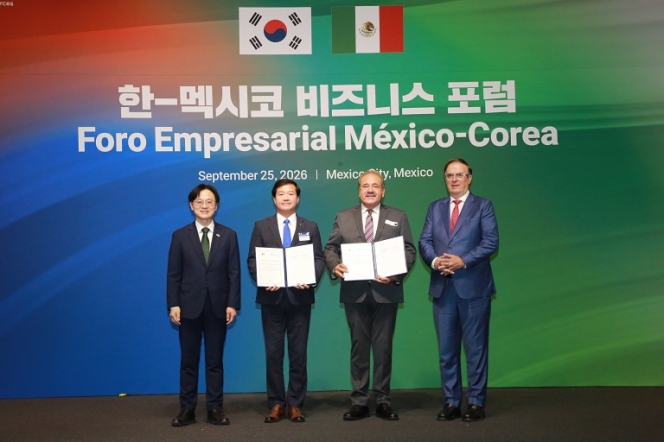
HS HYOSUNG has formalised a memorandum of understanding (MoU) with the State Government of San Luis Potosí, with the signing taking place at the World Trade Center Mexico City. The event formed part of the Korea-Mexico Business Forum, held alongside the Korean economic delegation's visit to Mexico.
Attending officials included Marcelo Ebrard, Mexico's Secretary of Economy, and Mario García Valdez, Secretary of Economic Development of San Luis Potosí. The two sides confirmed their shared resolve to back the company's local investment and regional growth. Separately, HS HYOSUNG's leadership met bilaterally with Secretary Ebrard to elaborate on its strategic vision and investment plans.
The agreement sets out a phased expansion of HS HYOSUNG's investments in San Luis Potosí beginning in 2027, with the goal of creating a major advanced materials production hub that bolsters supply for North American and wider global markets. The company's advanced materials span tyre cord, a flagship world-leading product, along with mobility, energy, aerospace and defence applications. Its North American operations, spanning Mexico and the United States, turn out tyre cord, airbag materials and mobility interior components for global leaders such as General Motors and Goodyear, underpinned by a highly dependable global supply chain.
Nak-yang Sung, CEO, HS HYOSUNG ADVANCED MATERIALS, said, “This investment goes beyond establishing a simple manufacturing base – it reflects our strategy to turn Mexico into a pivotal hub connecting North America with global supply networks. We are also committed to strengthening local supply chains and creating high-quality jobs to contribute directly to the region's industrial ecosystem.”
Kumho Petrochemical Group Shifts Focus To R&D and Speciality Materials
- By TT News
- September 25, 2026
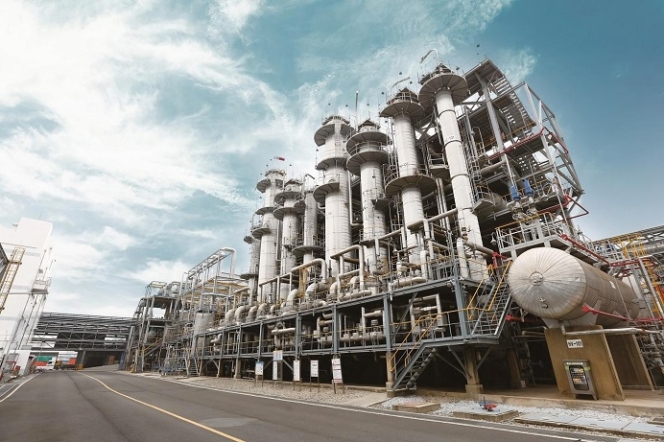
Kumho Petrochemical Group is steering its business towards research-driven, higher-value outputs as oversupply and soft demand continue to weigh on the worldwide petrochemical sector. The Seoul-based group outlined plans to boost spending on speciality chemicals, sustainable materials and novel production methods, a push intended to lift profits while building a foundation for future expansion.
Underlying the move is a deliberate evolution in the group's identity, from a bulk materials vendor to a provider of technology-backed solutions that address shifting customer requirements and stricter environmental rules. A central element of that effort involves widening the speciality lineup, exemplified by added capacity for solution styrene butadiene rubber, a synthetic rubber that enhances durability, rolling resistance and tread wear in high-performance electric vehicle tyres.
Environmental initiatives form another pillar. Facilities built by the company can trap approximately 76,000 metric tonnes of carbon dioxide each year, while separately developed technology turns recycled acrylonitrile butadiene styrene sourced from scrapped household appliances into automotive-grade interior components that satisfy performance standards and generate fewer emissions than conventional methods. The group has also joined forces with POSCO Future M and BEI on anode-free lithium-metal battery development.
Parallel technology-focused programmes are underway at affiliated units. Kumho P&B Chemicals is formulating water-based epoxy resins that curb volatile organic compound releases while incorporating more bio-based inputs to reduce carbon intensity. Kumho Mitsui Chemicals is advancing bio-based polyurethane systems and electric vehicle materials, alongside debottlenecking work to add 100,000 tonnes of annual methylene diphenyl diisocyanate capacity. Kumho Polychem, meanwhile, is targeting ethylene propylene diene monomer through low-temperature polymerisation paired with energy-efficiency improvements.
Birla Carbon Announces Asia-Wide Speciality Materials Price Hike Of Up To 15%
- By TT News
- September 22, 2026

Birla Carbon has confirmed a price increase of up to 15 percent for its Speciality Materials products across Asia, scheduled to take effect on 1 October 2026. The company pointed to significant and sustained rises in feedstock costs, driven partly by ongoing geopolitical instability and disruptions in global feedstock markets, as the reason behind the adjustment.
Although Birla Carbon pursued operational efficiencies, supply chain optimisation and disciplined cost management to soften the impact, the scale and persistence of the cost escalation left a price adjustment unavoidable. The company's sales teams will engage customers directly to explain the details and help them navigate the transition.

Comments (0)
ADD COMMENT