

Hidden Reinforcements
- By Sharad Matade & Gaurav Nandi
- June 22, 2026
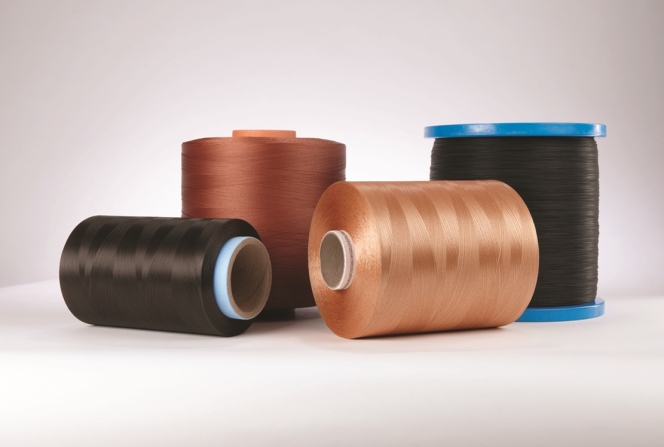
As the tyre industry confronts electrification, sustainability mandates and shifting supply chains, Milliken Textiles is focusing on specialised textile reinforcements rather than volume tyre cord. The strategy reflects a deliberate choice to concentrate on high-value niches where engineering expertise, rather than scale, defines competitiveness. Products such as Beadwrap and Millicap highlight how materials hidden inside tyres can influence safety, rolling resistance and rubber consumption.
The global tyre industry is approaching a structural turning point, driven by electrification, sustainability targets and changes in manufacturing footprints. For Milliken, this transition is creating opportunities for specialised textile reinforcements that improve tyre performance while reducing material usage.
Speaking about the company’s strategy, Lieven Keymeulen, Marketing Director at Milliken Textiles, explained that the US-based materials science company has deliberately avoided competing in the high-volume tyre cord market dominated by large suppliers.
“We are more of a speciality textile reinforcement supplier,” Keymeulen said. “We are not looking at mainstream tyre cord applications. We are focused on specialised solutions.”
Instead of commodity tyre cord production, the company positions itself as a development partner to tyre manufacturers seeking customised solutions for specific applications.
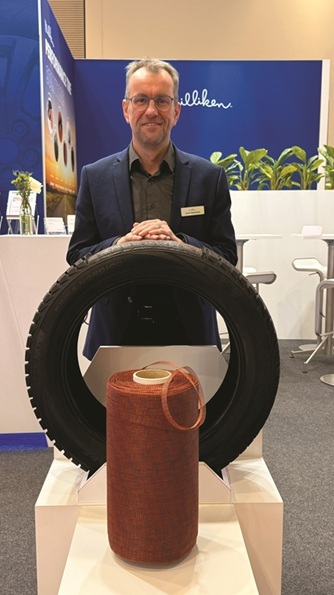 “As a textile company, we are active in many different markets, so we can take knowledge from other applications and bring that into tyres,” Keymeulen explained. “That allows us to develop products that are much more specific than standard tyre cord.”
Over time, the company has also developed strong application knowledge, investing significant effort in understanding how its materials behave inside tyres. This helps refine its textile solutions further.
OCTAGONAL STEELCORD SOLUTIONS
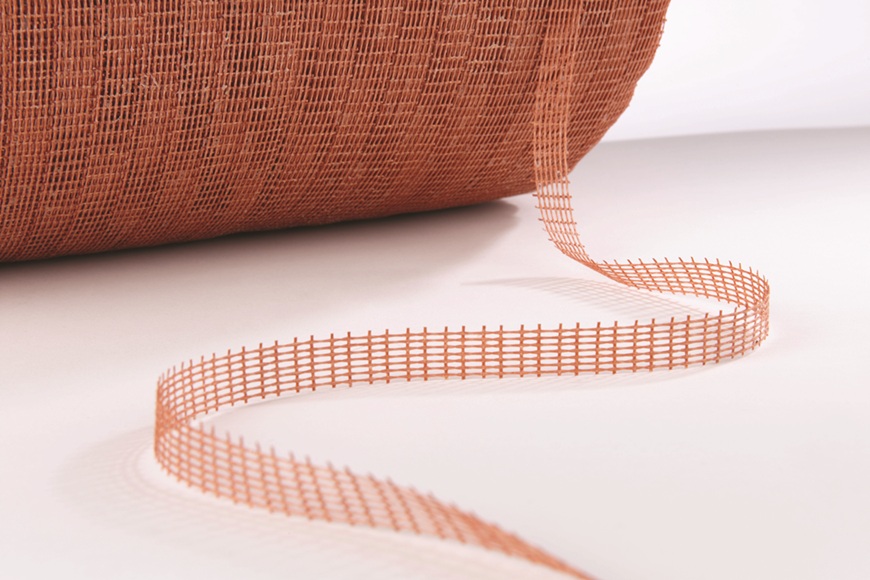
One example of this approach is Beadwrap, a reinforcement designed as a safety component within tyres. It is particularly relevant for larger tyres, where it helps maintain structural integrity, and for passenger car radial tyres with orthogonal design solutions, where it secures the structure and stabilises the tyre. Another established offering is Millicap, which supports tyre performance improvements linked to sustainability. With the rise of electric vehicles, rolling resistance has become a critical parameter because it directly affects battery range. Tyres that reduce rolling resistance can also reduce rubber consumption, resulting in cost savings and lower carbon emissions.
Although around 90 percent of the tyre market consists of mass-market tyres, the company has deliberately chosen not to focus on that segment.
“The mass market is highly crowded, with many companies offering similar products and limited opportunities for differentiation,” Keymeulen said. “Our strategy is to remain innovation- and technology-driven, concentrating on specialised applications where we can offer unique, customised solutions.”
HIDDEN VALUE IN NICHE COMPONENTS
The tyre industry is vast, meaning even niche components can generate significant volumes. Products like Beadwrap may represent only a small portion of a tyre, but when each tyre uses several centimetres of material across millions of tyres, volumes quickly become substantial.
Although such components remain hidden inside the tyre, the company’s primary focus is not end consumers but tyre manufacturers and their engineering teams.
“A key part of our role is educating engineers within tyre companies about the capabilities of textile reinforcements and how they can improve tyre performance,” Keymeulen explained. “Manufacturers typically approach us with specific technical challenges, and we work together on customised solutions.”
Global supply-chain diversification and geopolitical concerns are also influencing partnerships, as tyre makers increasingly prefer suppliers with a balanced global presence. With operations in United States, Europe and India, Milliken offers a more resilient supply base.
“Collaboration often begins in the early stages of tyre development, focusing first on understanding the application and the problem,” he noted. “Over time, this builds strong trust with tyre manufacturers.”
The company also collaborates with machine suppliers, enabling it to present tyre makers with semi-finished integrated solutions that combine materials with compatible processing equipment. This ensures alignment between materials, machinery and manufacturing processes.
FOCUS ON INDIA AND EMERGING REGIONS
India is a key market for the company, partly because many Indian tyre manufacturers operate relatively modern equipment, making them competitive and more open to adopting new technologies.
 While the company cannot be equally active in every region, such as the Chinese domestic market, it maintains strong engagement with Indian manufacturers as well as Japanese and Korean tyre brands.
“Innovation does not always start with large tyre manufacturers,” Keymeulen said. “Tier-II companies can often be more agile and willing to test new ideas more quickly.”
Regionally, Europe is gradually regaining momentum, Korean tyre manufacturers remain highly innovative, and Southeast Asia continues to drive industry growth.
SUSTAINABILITY AND MATERIAL EFFICIENCY
Looking ahead, tyre companies have ambitious sustainability goals, with many targeting tyres made entirely from renewable or sustainable resources by around 2050. A major contribution to this transition will come from recycled yarns, particularly recycled nylon, which remains one of the best-performing reinforcement materials but is difficult to recycle at scale.
While tyres cannot be produced without rubber, textile solutions can help reduce rubber usage.
One important contribution comes from specialised tackified textile reinforcements, produced using a proprietary dipping process that makes the material naturally adhesive. This eliminates the need for calendaring the textile with an additional rubber layer and enables direct placement within the tyre structure.
“This approach is particularly valuable in space-constrained areas such as the bead,” Keymeulen explained. “By eliminating extra rubber layers, we can reduce thickness and rubber consumption.”
Similar benefits apply to Millicap. According to customer data, rubber savings can reach around around 200 grammes for smaller 15-inches tyres to 500 grammes and more for large size tyres, leading to lower tyre weight and reduced carbon emissions.
Millicap is currently produced mainly using nylon, with a polyester version also available. Over time, the expected transition is towards recycled polyester.
ADAPTING TO INDUSTRY SHIFTS
The industry has faced several structural challenges following the Covid-19 pandemic, while the global tyre manufacturing footprint continues to shift geographically. New capacity is increasingly located in India and Southeast Asia, while European production is moving towards Eastern Europe and parts of Africa.
To remain close to customers, Milliken is reconsidering the traditional model of a few large factories.
“We are exploring smaller, strategically distributed operations,” Keymeulen said. “The idea is to create regional hubs that can source yarns and raw materials locally.”
Currently, the company operates major tyre-related production plants in United States and Europe, along with a processing facility in Bengaluru, India. The Bengaluru plant focuses on slitting and converting master rolls into customised formats closer to customers, with plans to expand its capabilities over time.
NEW AVENUES FOR GROWTH
In terms of tyre segments, the truck and bus radial market remains the largest for the company, while solutions also enable entry into passenger car tyres.
Another growing focus area is bicycle tyres, driven by rising demand for off-road and electric bicycles, which require higher strength and cut resistance.
“In tyre construction, steel cord has historically been dominant,” Keymeulen explained. “Textile reinforcements offer far greater flexibility for innovation. That opens up many more possibilities for optimising performance.”
The company is also exploring new variations of Millicap, including hybrid material concepts and alternative structures aimed at further improving tyre efficiency.
- Association of Natural Rubber Producing Countries
- ANRPC
- Monthly NR Statistical Report
- Natural Rubber
ANRPC Publishes Monthly NR Statistical Report For August 2026
- By TT News
- October 02, 2026
The Association of Natural Rubber Producing Countries (ANRPC) published its Monthly Natural Rubber Statistical Report for August 2026, noting firmer prices in several markets. Supply constraints, stable downstream demand and persistent geopolitical and macroeconomic uncertainty shaped the month. Renewed conflict and disruptions to major shipping routes added further pressure.
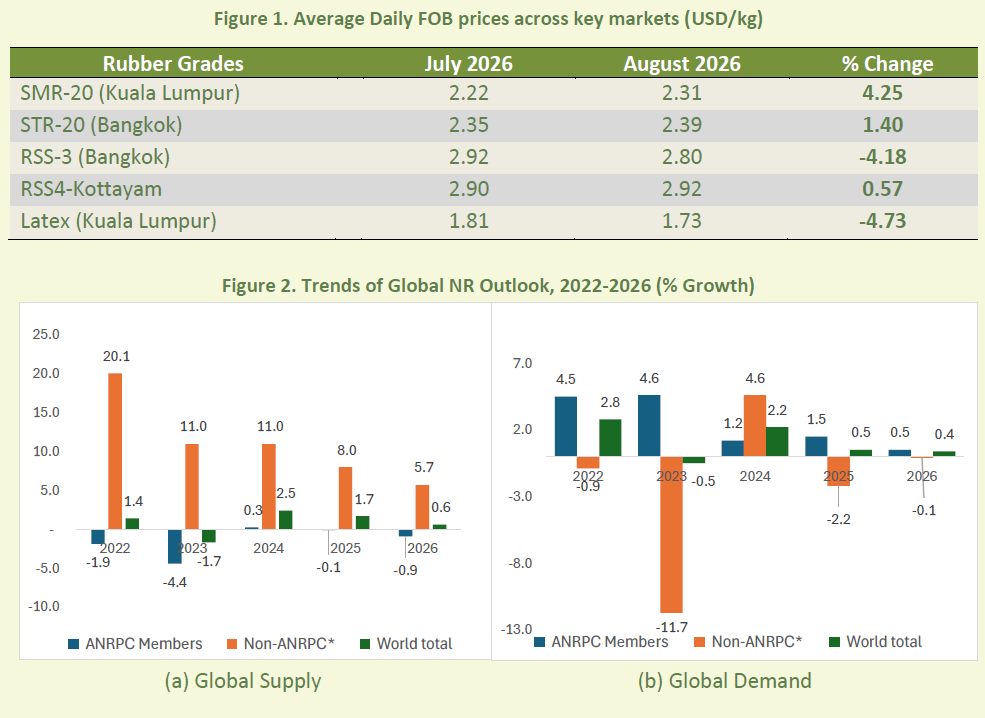
Physical prices for major grades moved in different directions. SMR-20 in Kuala Lumpur averaged USD 2.31 per kg, up 4.25 percent from July, while STR-20 in Bangkok rose 1.40 percent to USD 2.39 per kg. RSS-3 dropped 4.18 percent to USD 2.80 per kg, but RSS-4 in Kottayam gained 0.57 percent to USD 2.92 per kg. Latex-in-bulk fell 4.73 percent to USD 1.73 per kg. Brent crude averaged USD 91.08 per barrel, driven by concerns over possible restrictions on oil shipments through the Strait of Hormuz and wider Middle East instability, which raised energy supply risks and strengthened the oil market risk premium.
On trade, China's imports climbed 3.39 percent month-on-month, while India fell 10.18 percent and Malaysia dropped 8.24 percent; Viet Nam rose 5.08 percent. Exports advanced 5.63 percent in Viet Nam but declined in Thailand (-5.24 percent), Indonesia (-5.36 percent), Malaysia (-1.48 percent) and Cambodia (-1.88 percent).
Global production is projected to rise 0.6 percent to 15.039 million tons in 2026 from 14.952 million tonnes in 2025, after revisions to Thailand's 2025 output and updated 2026 estimates for Thailand, Malaysia and Indonesia. Weather, including erratic rainfall and drier Southeast Asian conditions, affected output. August 2026 production was estimated at 1.396 million tonnes, down 4.51 percent from 1.462 million tonnes a year earlier. Demand is forecast to grow 0.4 percent to 15.356 million tonnes in 2026 from 15.301 million tonnes, with the largest consumption gains expected in China, Malaysia and Cambodia. Prospects depend on vehicle sales, tyre production, shipping conditions and weather-related supply disruptions, while steady EV-linked demand supported modest growth led by China and India. The ringgit traded between RM4.02 per USD and RM4.09 per USD, and the baht between 32.68 and 33.34. The SHFE January 2027 contract averaged 18,109 CNY per tonne, up 7.78 percent month-on-month, while the SGX November 2026 contract averaged USD 2.24 per kg, up 4.32 percent.
HS HYOSUNG To Expand Mexico Investments From 2027 Under New State Agreement
- By TT News
- September 30, 2026
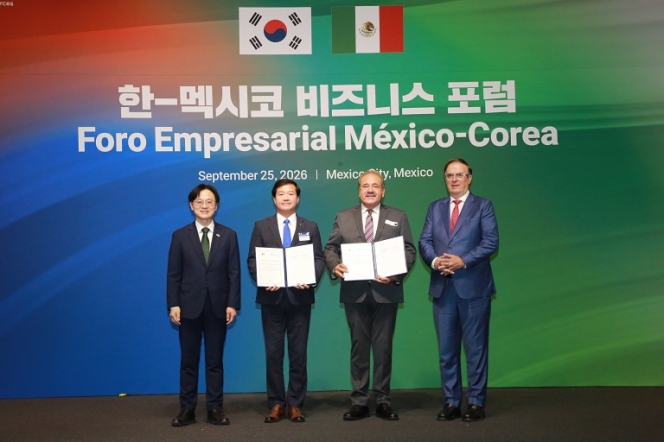
HS HYOSUNG has formalised a memorandum of understanding (MoU) with the State Government of San Luis Potosí, with the signing taking place at the World Trade Center Mexico City. The event formed part of the Korea-Mexico Business Forum, held alongside the Korean economic delegation's visit to Mexico.
Attending officials included Marcelo Ebrard, Mexico's Secretary of Economy, and Mario García Valdez, Secretary of Economic Development of San Luis Potosí. The two sides confirmed their shared resolve to back the company's local investment and regional growth. Separately, HS HYOSUNG's leadership met bilaterally with Secretary Ebrard to elaborate on its strategic vision and investment plans.
The agreement sets out a phased expansion of HS HYOSUNG's investments in San Luis Potosí beginning in 2027, with the goal of creating a major advanced materials production hub that bolsters supply for North American and wider global markets. The company's advanced materials span tyre cord, a flagship world-leading product, along with mobility, energy, aerospace and defence applications. Its North American operations, spanning Mexico and the United States, turn out tyre cord, airbag materials and mobility interior components for global leaders such as General Motors and Goodyear, underpinned by a highly dependable global supply chain.
Nak-yang Sung, CEO, HS HYOSUNG ADVANCED MATERIALS, said, “This investment goes beyond establishing a simple manufacturing base – it reflects our strategy to turn Mexico into a pivotal hub connecting North America with global supply networks. We are also committed to strengthening local supply chains and creating high-quality jobs to contribute directly to the region's industrial ecosystem.”
Kumho Petrochemical Group Shifts Focus To R&D and Speciality Materials
- By TT News
- September 25, 2026
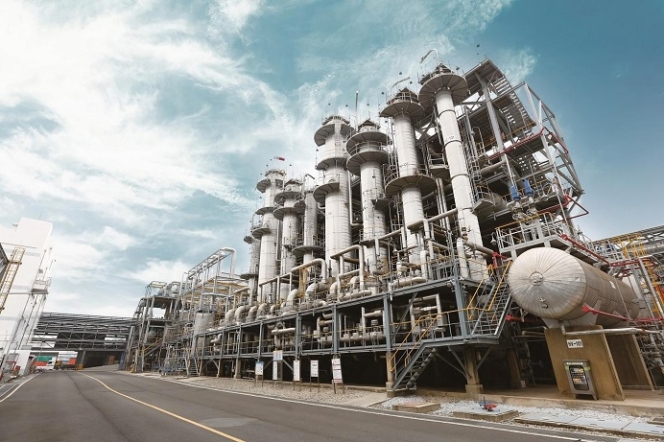
Kumho Petrochemical Group is steering its business towards research-driven, higher-value outputs as oversupply and soft demand continue to weigh on the worldwide petrochemical sector. The Seoul-based group outlined plans to boost spending on speciality chemicals, sustainable materials and novel production methods, a push intended to lift profits while building a foundation for future expansion.
Underlying the move is a deliberate evolution in the group's identity, from a bulk materials vendor to a provider of technology-backed solutions that address shifting customer requirements and stricter environmental rules. A central element of that effort involves widening the speciality lineup, exemplified by added capacity for solution styrene butadiene rubber, a synthetic rubber that enhances durability, rolling resistance and tread wear in high-performance electric vehicle tyres.
Environmental initiatives form another pillar. Facilities built by the company can trap approximately 76,000 metric tonnes of carbon dioxide each year, while separately developed technology turns recycled acrylonitrile butadiene styrene sourced from scrapped household appliances into automotive-grade interior components that satisfy performance standards and generate fewer emissions than conventional methods. The group has also joined forces with POSCO Future M and BEI on anode-free lithium-metal battery development.
Parallel technology-focused programmes are underway at affiliated units. Kumho P&B Chemicals is formulating water-based epoxy resins that curb volatile organic compound releases while incorporating more bio-based inputs to reduce carbon intensity. Kumho Mitsui Chemicals is advancing bio-based polyurethane systems and electric vehicle materials, alongside debottlenecking work to add 100,000 tonnes of annual methylene diphenyl diisocyanate capacity. Kumho Polychem, meanwhile, is targeting ethylene propylene diene monomer through low-temperature polymerisation paired with energy-efficiency improvements.
Birla Carbon Announces Asia-Wide Speciality Materials Price Hike Of Up To 15%
- By TT News
- September 22, 2026

Birla Carbon has confirmed a price increase of up to 15 percent for its Speciality Materials products across Asia, scheduled to take effect on 1 October 2026. The company pointed to significant and sustained rises in feedstock costs, driven partly by ongoing geopolitical instability and disruptions in global feedstock markets, as the reason behind the adjustment.
Although Birla Carbon pursued operational efficiencies, supply chain optimisation and disciplined cost management to soften the impact, the scale and persistence of the cost escalation left a price adjustment unavoidable. The company's sales teams will engage customers directly to explain the details and help them navigate the transition.

Comments (0)
ADD COMMENT