

Beontag And Kumho Tire Join Hands For RFID-Enabled Tyres
- By TT News
- April 18, 2025

Beontag, one of the world’s largest manufacturers of self-adhesives and smart tags such as RFID, NFC and BLE, has entered into a collaboration with Kumho Tire to develop RFID-enabled tyres for commercial and passenger vehicles.
The partnership will see new Kumho tyres use Beontag's TyreTag RFID technology. Traceability will be possible with the RFID-enabled tyres from the point of origin to recycling and disposal. Following years of research and development, according to both the companies, the new RFID-enabled tyre is very robust and dependable, able to survive high temperatures and pressures over the course of years of intensive use. The new TyreTag-enabled tyres' traceability will also adhere to the forthcoming Ecodesign for Sustainable Product Regulations (ESPR), which will need Digital Product Passports (DPPs) and be in force for tyres starting in 2028–2030.
Thiago Horta, Global VP of Digital Transformation, Beontag, said, “We are extremely proud to share what we have achieved in our partnership with Kumho Tire. Through rigorous testing, we have worked hard to develop the necessary technology and durability capabilities in these RFID-enabled tyres; I look forward to continuing this journey with Kumho Tire for years to come”
Jihon Park, Assistant Manager with Kumho Tire, said, “Kumho Tire has been producing RFID-enabled tyres since 2013. Beontag’s technical expertise and collaborative approach were instrumental in helping us meet our rigorous standards and enhance our technology. We look forward to delivering even greater quality and reliability to our customers around the world.”
Anyline Rolls Out TireBuddy 1.9 With Redesigned Inspection Report
- By TT News
- October 25, 2026
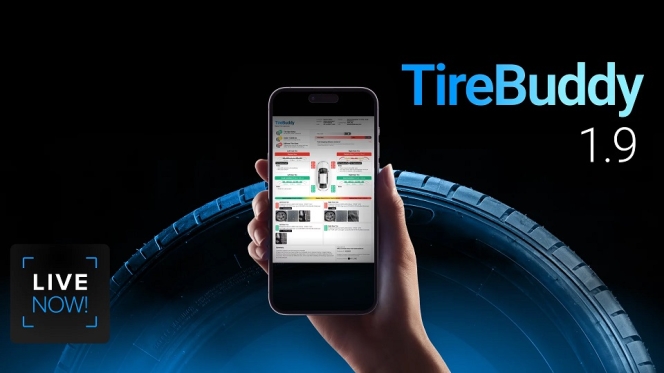
Anyline, a global leader in mobile AI and intelligent data capture technology, has rolled out version 1.9 of TireBuddy, featuring a redesigned inspection report that aims to help customers more easily understand the condition of their tyres and place greater trust in technician recommendations. The updated report is intended to make the information gathered during an inspection simpler for customers to digest.
The report presents tread depth, tyre age and estimated braking distance to convey overall tyre health, while make, model, size and seasonal markings identify exactly which tyres are mounted on the vehicle. The new version also allows technicians to attach images of sidewall and rim damage to the report, transparently documenting issues that require attention so customers can have confidence in the recommended work.
Technicians can now record rim and tyre damage, such as scratches on rims and bulges on sidewalls, during the inspection workflow and display it in the report. Photo evidence of rim and sidewall damage can be attached to technician notes and added to the report. A not-roadworthy flag can also be set for a tyre with healthy tread depth but other serious defects, showing in the report as recommended for immediate replacement. All existing and new elements continue to fit on a single page, which can be saved as an image or PDF for sharing with the customer.
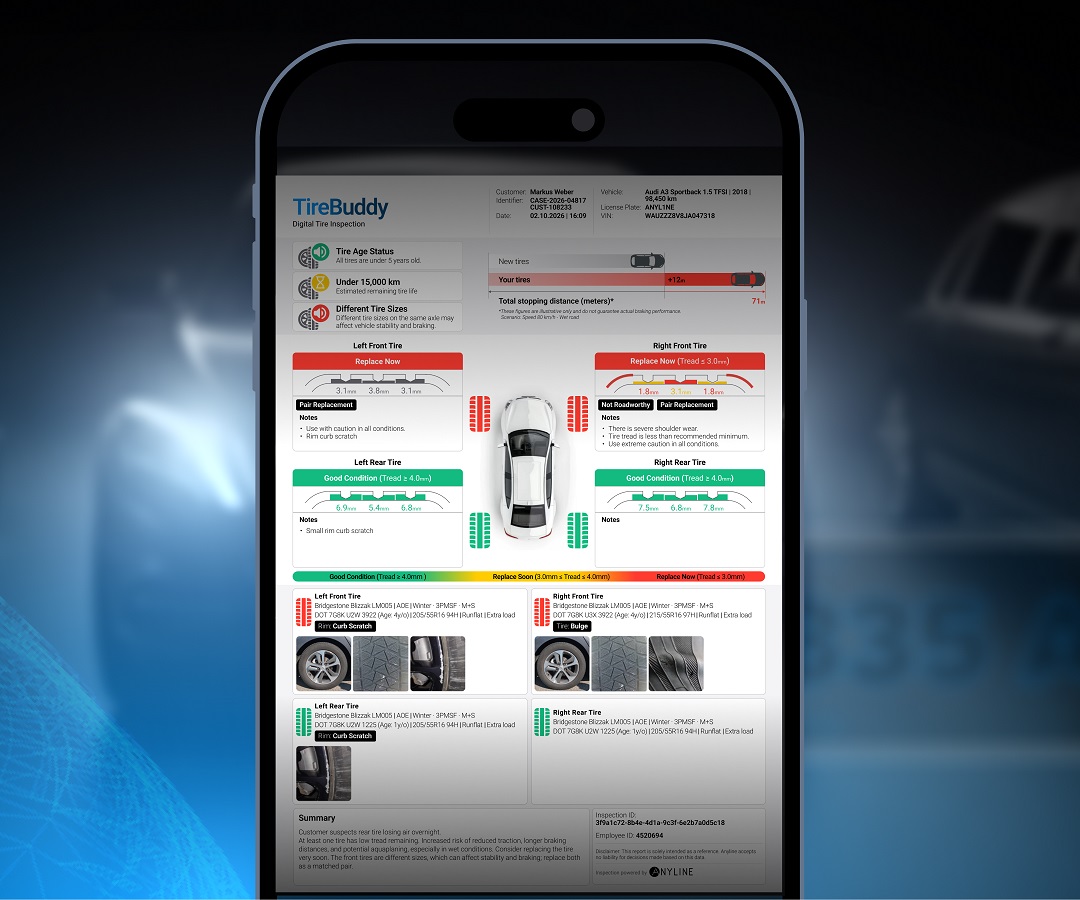
The TireBuddy report addresses a critical issue for workshops by ensuring customers fully understand inspection findings. Verbally conveying such information is not always easy, and traditional inspection forms tend to be dense and text-heavy. Everything a technician finds in the bay needs to be detailed in the report the customer sees, which should serve as visual support for service recommendations. With version 1.9, evidence appears alongside the recommendation, and photos of tyre or rim damage are inserted with other tyre information so customers can recognise findings without entering the bay.
Damages are categorised alongside visual evidence, so a bulge is recorded consistently regardless of technician, location or shift, turning individual reports into a comparable record that still captures the state of every tyre on the inspection day. From version 1.9, every report can carry damage, roadworthiness and photo evidence alongside the tread reading. Smaller changes include an optional pair replacement setting that automatically marks the paired tyre on the same axle for replacement when one tyre is not OK, up to 10 custom fields per account in the vehicle identification step for work order or storage numbers and a redesigned vehicle identification screen consistent with the tyre identification screen.
Lukas Kinigadner, CRO, Anyline, “Every replacement recommendation is a request for trust. With 1.9, the technician doesn't have to ask for it. The damage is on the report, photographed, next to the tyre it belongs to.”
From Data Overload To Decisive Action
- By Nilesh Wadhwa
- October 23, 2026
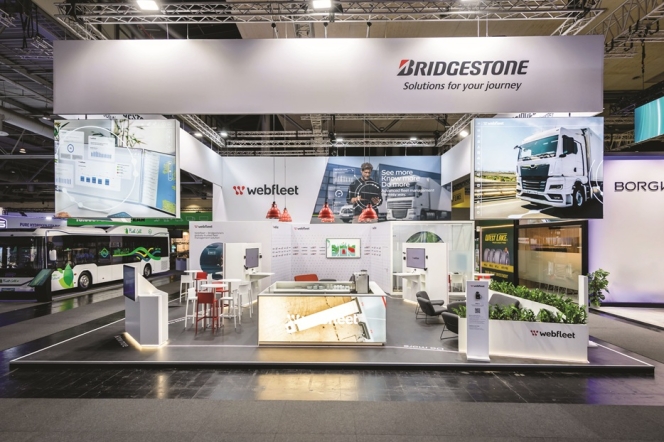
As commercial vehicle operators face mounting pressure from regulations, rising costs and the shift to electric power, Webfleet, a subsidiary of Bridgestone, is focusing on turning ever-growing volumes of vehicle data into practical recommendations that improve performance and ease the daily burden on fleet managers.
Founded in Leipzig in 1999 as one of the world’s first web-based fleet management platforms, Webfleet has grown from a pioneering software-as-a-service (SaaS) start-up to Europe’s leading solution and a core part of Bridgestone’s global offering. Today it serves drivers across more than 180 countries with AI-powered insights, electric-vehicle tools and sustainability data that turn complex operations into clearer, more efficient decisions.
In an exclusive interaction with Tyre Trends, Marc Notenboom, Director of Product Management at Webfleet, shares how the company has watched the fleet-management sector evolve over more than a quarter of a century. Interestingly, it was just last year the company marked its 25th anniversary.
From its inception, Webfleet has seen the volume of available data explode, yet the real challenge remains converting that information into meaningful guidance.
“Fleets give you more data but not more insights, which continues to be a challenge. Because of new regulations, new sensors, increasing competition and customer demands, we end up generating more data. We also have access to more data, which is growing exponentially. And then comes the real question, how do you make sense of that data?” Notenboom observed.
 Marc Notenboom, Director of Product Management, Webfleet
Webfleet obtains its information through black-box devices installed in vehicles, sensors or direct connections to original-equipment manufacturers. This includes telematics, GPS, video, driver behaviour and vehicle diagnostics, among others. The company then processes that stream to deliver fleet-management services.
The next step, he explained, is moving beyond retrospective analysis. “Insights tell you what happened and why it happened, perhaps, but not what you need to do to improve your performance. That is what we are doing now with the help of artificial intelligence (AI). For example, we analyse data, see if patterns are different or you have anomalies in your data to predict what is happening or what is going wrong. And then we also use AI to analyse our data to see how you are performing, for instance, against competition. And then give customers suggestions on how to improve on certain topics like fuel consumption or driver safety,” he said.
The industry, in Webfleet’s view, is therefore evolving from raw data collection towards insights, recommendations and concrete actions.
SHARED PRESSURES ACROSS DIVERSE FLEETS
Webfleet serves a wide spectrum of customers, from large transport and logistics operators to small fleets of one or two vehicles, service-and-maintenance businesses and last-mile delivery companies.
Each customer faces distinct operational issues, yet common themes emerge. “What they all have in common is that the amount of data and the pressure to enhance their performance is increasing a lot. And then there is the regulatory compliance pressures as well,” said Notenboom.
Performance, in this context, covers delivery times, cost per kilometre, driver wages, safety and fuel consumption – metrics that matter differently according to the sector, but all that demand continuous improvement.
One of Europe’s most persistent difficulties is the shortage of skilled drivers, which has led to greater reliance on migrant workers whose experience of road conditions may vary widely between countries.
Webfleet addresses part of this challenge through tools such as OptiDrive, which shows fleet managers how individual drivers perform on fuel use and safety. Language barriers are tackled with automatic translation features built into the driver’s work app or tablet.
“They can interact with their fleet manager in their own language, and the fleet manager can also interact back in their own language,” explained Notenboom. The same interface delivers active coaching: if a driver exceeds the speed limit, for example, an immediate warning appears. These software-based interventions help maintain standards without requiring constant direct supervision.
MEASURABLE GAINS AND EV TRANSITION
Notenboom agrees that customers understandably scrutinise the return on any additional technology cost. He reported that Webfleet users typically achieve efficiency improvements of up to 15 percent, though results depend heavily on the starting point. This ranges from fuel savings, faster turnaround, downtime reduction or improved driver behaviour, among others.
“If a company is already really good at saving fuel, then adding tools and driver coaching and technology might not change a lot. At the same time, even if it’s a small improvement, especially with the high fuel prices today, it could already translate to a lot of savings,” averred Notenboom.
The arrival of electric trucks introduces a fresh set of complexities. Research indicates that driver behaviour exerts an even greater influence on energy consumption in electric vehicles than in conventional combustion models. Smooth operation becomes critical to range, while decisions about when and where to charge add further layers of planning. Webfleet supports the transition by helping managers determine the right vehicle for each duty cycle.
“If you do long-distance transport, electric trucks are perhaps not the best option. But if you do inner-city deliveries, then electric trucks become an interesting option. And trying to find out where the optimum is, when to use Internal Combustion Engine-vehicles, where to use electric vehicles, that is also a part where we can help the fleet manager to make that decision,” he said.
On the technology package itself, every Webfleet customer receives the software platform. Hardware can be selected according to need, or in some cases, dispensed with entirely through the OEM.connect service (access vehicle data directly from OEMs via APIs), without installing extra hardware that draws data directly from the vehicle manufacturer.
“A number of customers are preferring to use OEM.connect. So that is a solution where we don’t install hardware but take the data directly from the OEM offerings,” he explained. On the other hand, where original-equipment data fall short, Webfleet’s own devices remain available.
PRIVACY, BENCHMARKING AND THE ROAD AHEAD
Growing data volumes inevitably raise questions of privacy and regulatory compliance. Webfleet adheres strictly to General Data Protection Regulation (GDPR) – a strict European Union (EU) law that protects information privacy and data rights for individuals in the EU and the European Economic Area (EEA) – requirements.
Certain categories of information can be processed only with explicit customer permission, and for benchmarking purposes, the company anonymises data so that individual vehicles or fleets cannot be identified.
A recent example is Webfleet’s Commercial Trip Monitor, which aggregates anonymised information across the entire customer base to generate comparative insights.
Looking three to five years ahead, Notenboom identified three principal challenges for the commercial-vehicle industry: the practical difficulties of electrification, the continuing shortage of drivers (with autonomous vehicles potentially addressing certain use cases over a longer horizon) and relentless competitive pressure to deliver higher quality service at lower cost.
He regards these same pressures as sources of opportunity for those able to convert them into advantage.
Interestingly, he shared that Webfleet itself continues to evaluate new markets beyond its established presence in Europe, South Africa, South America and Australia. Bridgestone’s ownership of the US-focused Azuga platform complements the portfolio, while Asia-Pacific, including India, remains under active review even if no immediate plans have been confirmed.
As Notenboom puts it, the goal is not to simply collect more information but to translate that information into clearer decisions that keep vehicles productive, drivers safer and costs under control – regardless of whether the powertrain is diesel or electric.
Vaculug Rolls Out VMS Pro Max Next-Gen Fleet Management App
- By TT News
- October 20, 2026

Vaculug has released VMS Pro Max, the next generation of its fleet management application. The product, developed over a three-year period, pairs a redesigned interface with AI-enhanced software intended to make commercial fleet management faster and more intelligent. The app is now available for download through the Apple App Store and Google Play Store.
The upgraded platform offers clear, real-time access to tyre and vehicle data, accelerates background report uploads to reduce driver time and allows measuring tools to be connected for automatic tread depth capture. It also incorporates an embedded VAN Driver Guide and can instantly flag vehicles left uninspected across 30, 60 or 90 days. Existing users must sync all pending inspections and confirm cloud upload before updating to prevent data loss.
Yokohama Rubber, dotData Partner On Human-In-The-Loop AI Agent For Manufacturing R&D
- By TT News
- October 15, 2026

The Yokohama Rubber Co., Ltd. and dotData, Inc. have announced joint development an AI agent to help engineers form hypotheses, interpret findings and make decisions in manufacturing R&D. Before full deployment, the initiative will validate the agent's required capabilities and technical feasibility.
The solution combines technical documents such as design specifications and experimental reports with engineers' accumulated expertise and features extracted from measurement data via dotData's Signal Intelligence technology. It will provide insights tailored to each project's objectives, circumstances and constraints.
The agent is not meant to produce a single correct answer. Operating in a human-in-the-loop framework where engineers retain decision-making authority, it will present multiple possibilities, perspectives and risks to broaden thinking and support professional development.
Manufacturing R&D generates diverse data through experiments, simulations, production and evaluation. Developing hypotheses requires specialised knowledge and context. Since new technology R&D rarely has one predetermined answer, abductive reasoning plays a key role. AI can add value by using data and organisational knowledge to widen engineers' perspectives rather than replace judgment.
The agent will explore measurement and experimental data patterns beyond factors engineers previously identified, combining quantitative insights with design documents and expert knowledge to reveal difficult-to-spot relationships. It will offer input from materials, design, analysis, production and evaluation perspectives, challenge existing hypotheses and raise questions about alternative interpretations and conditions. Engineers will then test hypotheses and feed results back into further dialogue, guiding Signal Intelligence processes so non-specialists can explore data features as needed.
Yokohama Rubber has advanced HAICoLab since 2020, using dotData as a foundational technology in tyre design and rubber mixing. This joint development expands those efforts, with engineers interpreting and evaluating the agent's suggestions using their own expertise rather than accepting them unquestioningly. The companies aim to transform R&D processes while strengthening engineers' creativity and judgment, establishing a new model for human-AI collaboration in manufacturing R&D.
Motoji Fujita, Head of Research & Advanced Development Division, The Yokohama Rubber Co., Ltd., said, “Since 2020, we have conducted research and development under the HAICoLab framework, drawing on the complementary strengths of people and AI to create a collaborative environment. We believe AI agents will give engineers access to perspectives beyond their own experience and enable them to evaluate hypotheses from multiple angles. Through this development initiative, we aim to advance our R&D capabilities while supporting the continued growth of our engineers.”
Ryohei Fujimaki, CEO, dotData, Inc., said, “Success in manufacturing R&D depends heavily on an organisation’s ability to connect its proprietary data and knowledge with AI. The quantitative context generated from data through automated Signal Intelligence provides a foundation for AI agents to engage engineers in practical, data-driven discussions. Together with Yokohama Rubber, which has many years of experience in advanced data utilisation, we intend to establish standards for using AI in highly specialised business domains.”




Comments (0)
ADD COMMENT