

Japan–Indonesia Research Effort Reports Progress On Tackling Rubber Tree Leaf Fall Disease
- By TT News
- December 11, 2025
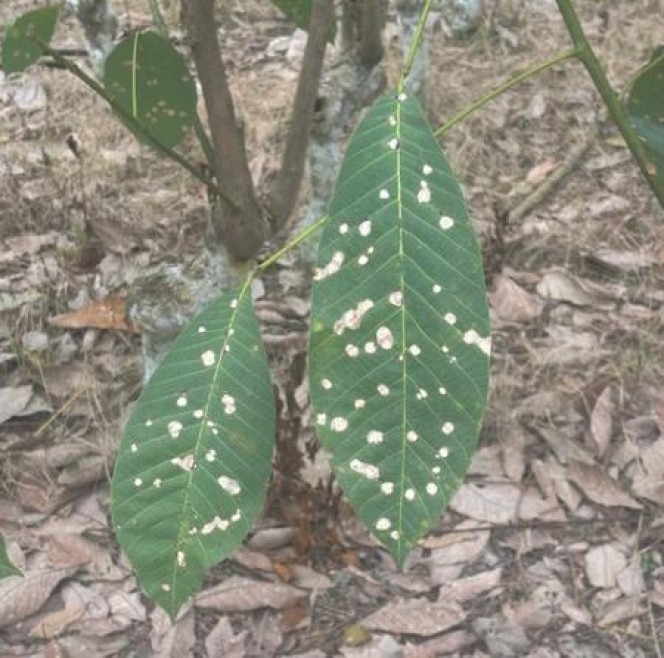
Yokohama Rubber has reported new findings from an international research programme aimed at combating leaf fall disease, a fungal infection that has disrupted natural rubber production in Indonesia, the world’s second-largest supplier.
The results were presented on 9 December at the fifth Joint Coordinating Committee Meeting held at Universitas Indonesia. The initiative, formally titled “Development of Complex Technologies for Prevention and Control of Rubber Tree Leaf Fall Diseases”, forms part of the Science and Technology Research Partnership for Sustainable Development, a scheme run by the Japan Science and Technology Agency and the Japan International Cooperation Agency with support from Japan’s foreign and education ministries.
The project brings together Japanese industry, government and academic institutions, including the national research agency RIKEN, with Indonesian partners. Its objective is to maintain output from smallholders, who account for more than 90 per cent of Indonesia’s natural rubber production. The programme is pursuing several approaches: pesticide-based disease control; the development of disease-resistant clones; and early detection using satellite and drone imagery.
Yokohama Rubber, which uses natural rubber as a principal raw material for tyres, has been involved since the project’s launch in 2020. The company began assessing pesticide effects on rubber quality in 2024, following a screening process. Field tests on large plantations have shown that correctly applied pesticides do not impair the properties of raw or vulcanised rubber. Yokohama Rubber is now contributing to research on how such treatments may affect smallholders.
The group said its “Procurement Policy for Sustainable Natural Rubber” incorporates support for participants across the supply chain, including small-scale farmers. It expects its role in the project to aid the sustainable production of natural rubber and help stabilise smallholder incomes. Yokohama Rubber is also an official partner in a separate SATREPS initiative on using rubber seeds to develop environmentally focused products intended to mitigate global warming and plastic pollution.
Under its sustainability theme, “Caring for the Future”, the company has emphasised links between its commercial activities and broader environmental and social objectives.
Zeon Establishes Kurashiki Subsidiary To Absorb Tohpe's Acrylic Rubber Business
- By TT News
- September 18, 2026
Zeon Corporation established Zeon Chemicals Kurashiki Co., Ltd. on 23 July 2026 to take over the acrylic rubber operations of fellow group firm Tohpe Corporation. The new entity, headquartered in Kurashiki City, Okayama Prefecture, is wholly owned by Zeon with paid-in capital of JPY 10 million and is led by representative Koji Minami.
On 21 August, Tohpe and the new subsidiary signed an absorption-type company split agreement, prompting Zeon to begin the procedures required under the Companies Act. Operations at the new company, focused on manufacturing and selling acrylic rubber and related activities, are scheduled to commence on 30 October 2026.
Acrylic rubber, known for its heat resistance, is used in automotive components including oil seals and hoses. The Zeon Group already maintains four production sites across Japan, United States and Thailand, forming a global supply network for the material.
The restructuring follows Zeon’s 11 May 2026 announcement that it would transfer Tohpe shares to NATOCO Co., Ltd. of Miyoshi City, Aichi Prefecture, as part of Tohpe’s paints business divestiture. Tohpe’s acrylic rubber operations, which complement Zeon’s Elastomers Business, will now be positioned as a key specialty rubber manufacturing site, with closer operational coordination intended to strengthen Group competitiveness and corporate value.
Revyre Targets SBS Market With Tyre-Derived Polymer After Auckland Road Trial
- By Gaurav Nandi
- September 14, 2026
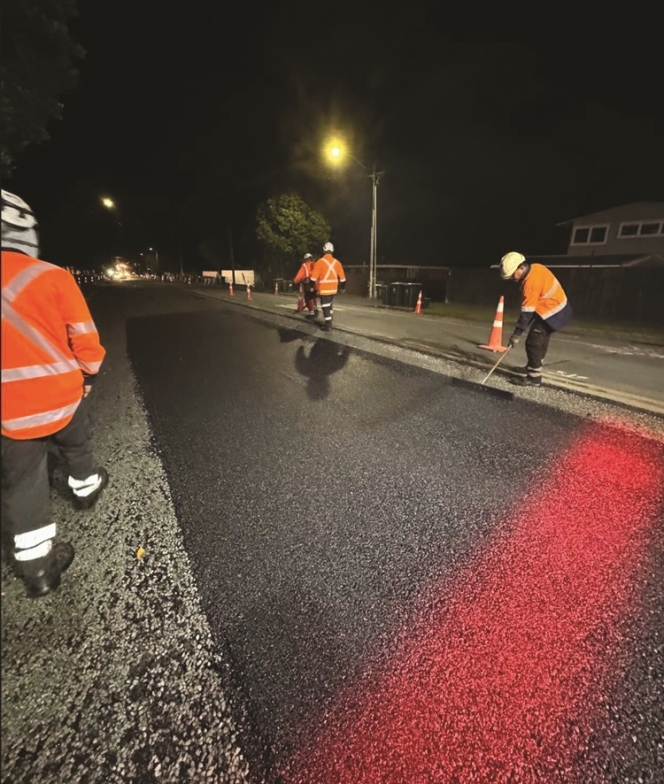
The company is betting that a polymer manufactured from end-of-life truck tyres can disrupt the market for petroleum-based styrene-butadiene-styrene (SBS), a widely used road-binding additive whose pricing and availability are tied to global oil markets. After completing a live road trial with Road Science and Auckland Transport in New Zealand, the company is preparing to use the results as a springboard for expansion into Australia and Sub-Saharan Africa, positioning the recycled material as a lower-cost, lower-carbon alternative to virgin polymers.
New Zealand-based Revyre Global Limited is positioning a polymer manufactured from end-of-life truck tyres as a lower-cost alternative to petroleum-based styrene-butadiene-styrene (SBS) after completing a live road trial with Road Science and Auckland Transport in New Zealand.
The company has spent several years developing the product as a direct replacement for SBS. Unlike conventional tyre-derived asphalt, which relies on crumb rubber, the company’s Chief Executive Officer Shaun Zukor told Tyre Trends that its proprietary thermomechanical process produces a remanufactured polymer with blending characteristics similar to SBS, allowing it to be used in existing asphalt infrastructure.
“Our primary objective was to develop a drop-in replacement for SBS, which is a petroleum-derived synthetic polymer,” Zukor said. “SBS is expensive, made from virgin materials and is widely used to improve road durability, fatigue resistance and overall pavement performance.”
The company began engaging Road Science, a division of Downer, and Auckland Transport after completing laboratory validation with engineering consultancy WSP in New Zealand.
Before approaching customers, it invested around 18 months in laboratory testing to validate the material’s performance.
Following successful laboratory trials, Road Science carried out its own evaluations before, together with Auckland Transport, deciding to trial the material on Blockhouse Bay Road, one of Auckland’s busiest roads.
The project then underwent another lengthy approval process involving Auckland Council and scientific advisers.
“It took another year to a year and a half to obtain all the necessary approvals from the council and its scientific advisors,” Zukor said. “They wanted to verify that all the claims in our technical literature were accurate.”
Construction of the trial road took place over three days in March and the company expects to receive the first performance data around September. Those results are expected to support commercialisation in overseas markets.
“Our business is focused only on New Zealand at the moment because we’re using it as a proof of concept,” Zukor said. “Once those results are available, we’ll publish them. That will place us in a much stronger position to take the product into Australia and Sub-Saharan Africa.”
The company estimates that entering Australia would take another 12 to 18 months after trial results are available and a planned New Zealand manufacturing facility becomes operational.
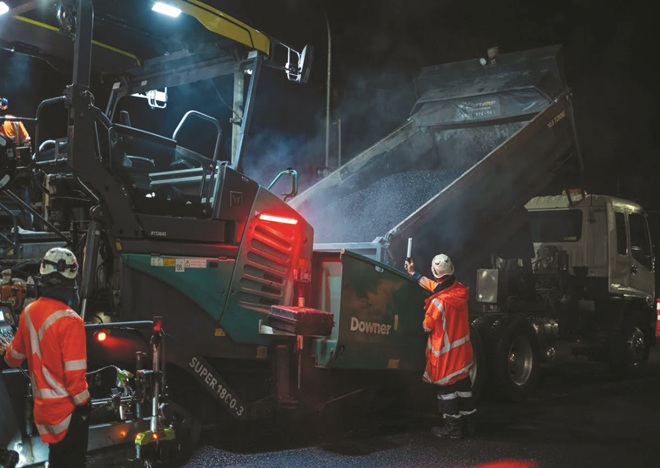
Although the current road project used only a small quantity of material because it is a demonstration, Zukor said the commercial opportunity could expand significantly.
“We used a relatively small amount of material for this particular project, but if the opportunity grows as expected, supplying the Auckland Transport network alone could eventually consume between 40–50 percent of our production capacity,” he noted.
MATERIAL ECONOMICS
The company currently manufactures the material primarily from truck and bus radial (TBR) tyres and earthmover tyres because of the higher natural rubber content.
While the SBS substitute represents the company’s immediate focus, it has divided its broader product portfolio into three categories. Revpol A, manufactured mainly from passenger and light truck tyres is intended for lower-performance rubber products such as rubber tiles, shoe soles and conveyor belts.
Revpol B targets asphalt applications and new tyre manufacturing, while Revpol C, produced largely from earthmover tyres, is designed for higher-performance applications.
The company is not currently manufacturing at its own facility but plans a new production unit in New Zealand. Until that facility is operational, product for trials is being supplied by its Canadian partner.
The technology relies primarily on a thermomechanical recycling process rather than chemical recycling. Whole tyres are broken down with steel separated from the rubber before the rubber is processed to a 30-mesh particle size and passed through Revyre’s proprietary thermomechanical process.
Zukor said only a very small amount of non-toxic, FDA-approved chemicals are used and that the process is driven primarily by operating parameters rather than chemical reactions.
He added that one of the key advantages of the technology is that it can be incorporated into existing SBS blending infrastructure with minimal changes as most development work focused on determining the optimum blending ratio rather than overcoming technical limitations.
“The primary technical challenges relate to the blending ratio,” he said, adding, “The higher the percentage of Revpol you add, the higher the temperatures and shear forces required in the bitumen blending terminals.”
Although the company has successfully blended as much as 20 percent Revpol into bitumen during development, Zukor said performance gains diminish beyond a certain point.
It has identified an optimum blend of between 5 percent and 10 percent depending on the application, ranging from conventional roads to heavy-duty pavements and airport runways.
“Any facility that currently blends SBS using its existing infrastructure can also blend our product using that same infrastructure,” he said.
CATALYST FOR SAVINGS
Zukor believes the material can reduce both costs and environmental impacts while improving pavement performance.
“We want to create a product that is environmentally sustainable, has an abundant raw material supply and is 20–40 percent cheaper than virgin materials while also having a significantly lower carbon footprint,” he stated.
Laboratory testing has produced encouraging results. According to Zukor, New Zealand’s wheel-tracking standard requires materials to withstand 800,000 load cycles, while Revyre’s product continued to perform until testing was halted at two million cycles.
“Our product achieved nearly two to three times the required wheel-tracking performance compared with standard bitumen,” he noted.
He also added that the objective is to produce road surfaces that are less expensive, more durable and environmentally sustainable while simultaneously addressing the challenge of managing end-of-life tyres.
“We believe this product ticks all of those boxes and have obtained a patent for it,” he said.
MANUFACTURING SCALABILITY
Although the company is currently relying on manufacturing capacity in Canada, Zukor said its modular production model could support significant expansion once commercial demand develops.
“We can currently produce up to 10,000 tonnes of this product, but because our production facilities are modular, capacity can easily be scaled anywhere from 1,000 tonnes to 50,000 tonnes, depending on market demand and the requirements of a particular region,” said Zukor.
Once the planned New Zealand facility becomes operational, Zukor expects its tyre feedstock to be supplied through Tirewise, the country’s extended producer responsibility (EPR) scheme for end-of-life tyres.
Under the programme, every imported tyre attracts a levy that funds incentives for registered collectors, processors and end users to move tyres through the approved recycling chain. Zukor said Revyre intends to register again as a processor after commissioning its new plant.
GOING PAST HURDLES
Zukor acknowledged that customer adoption remains the biggest hurdle. Road contractors also need to validate new formulations through laboratory testing before incorporating them into their pavement designs. Hence, Revyre is focusing on multinational contractors already operating in New Zealand to accelerate adoption, believing successful validation locally could support deployment elsewhere within those organisations.
He also believes global dependence on petroleum-derived SBS strengthens the case for tyre-derived alternatives.
“If you look at SBS, it’s already a product that’s in very high demand globally. Because it’s petroleum-based, its availability and pricing are heavily influenced by global macro-economic and geopolitical events,” Zukor said.
He said the company’s commercial proposition rests on three principles viz-a-viz consistent quality, supply and pricing.
According to Zukor, replacing virgin SBS with tyre-derived polymers could help localise supply chains, reduce exposure to petroleum price volatility and improve environmental outcomes while lowering costs for road owners.
Beyond New Zealand, Revyre is also evaluating opportunities in North America through its Canadian partner and is exploring future markets for tyre-derived materials.
Azur’s Blueprint For A Circular Tyre Industry
- By Gaurav Nandi
- September 11, 2026

Europe’s tyre industry stands at a crossroads as mounting regulatory pressure, resource constraints and circular economy targets reshape the end-of-life tyre landscape. Despite Germany achieving one of the world’s highest recycling rates, an estimated 100,000 tonnes of used tyres continue to leave the country annually, undermining domestic recovery efforts. In conversation with Tyre Trends, AZuR Network Coordinator Anna-Maria Guth outlines the policy reforms, recycling technologies, retreading opportunities and cross-border collaboration needed to keep valuable raw materials in circulation and build a fully circular European tyre ecosystem.
What gaps in the traditional tyre value chain led to the establishment of the AZuR network?
In Germany, we have a very high recycling rate for end-of-life tyres. However, following a merger of certified tyre disposal companies that collect and sort tyres, it became clear that we needed to bring all stakeholders together to really make progress. The excellent response to the AZuR network shows that this is the right approach.
The European tyre industry is under increasing pressure regarding emissions, waste management and the circular economy. What policy measures are still needed to accelerate the widespread adoption of tyre recycling?
Couple of policy implementations must be achieved in order to reach this goal. The first is a strict ban on the export of ELTs and rigorous enforcement of this regulation. Secondly, clear, predictable and statutory regulations regarding the use of ELT granulate. Lastly, consistent implementation of circular economy strategies.
 What role can recovered carbon black (rCB) play in reducing Europe’s dependence on primary fossil raw materials?
The pyrolysis companies in the AZuR network are making great strides in improving the quality of rCB. We are optimistic that in the foreseeable future, we will be able to produce a grade that allows the material to be incorporated into new tyres in larger quantities. That would be a major breakthrough and would create real added value as it would keep the raw materials within the circular economy.
How does AZuR distinguish between mechanical recycling, devulcanisation and pyrolysis in terms of sustainability and scalability?
Within the network, we adhere to the European waste hierarchy viz-a-viz prevention, reuse, recycle including mechanical and chemical and, finally, thermal recycling.
We are open to all technologies when it comes to processes. However, it is clear that in the interests of the circular economy, we want to minimise thermal recovery. And this also applies to pyrolysis oil provided it is not used for the production of new products but as a secondary fuel.
How close is the tyre industry to establishing tyres made with recycled materials without compromising on performance?
Some manufacturers are already field-testing tyres containing over 70 percent recycled and bio-based raw materials. The industry is very active in this area. However, we would like to see a more nuanced approach to recycled materials and bio-based materials.
Bio-based materials cannot be the solution in the medium term and the EUDR is already restricting the use of bio-based materials in Europe. Our focus must be more on recycled materials and their qualities so that raw materials can be kept in the cycle.
More than 500,000 tonnes of end-of-life tyres are generated in Germany every year. What are currently the biggest bottlenecks in the infrastructure for collection, sorting and processing?
At present, the SME sector in Germany is structured in such a way that all tyres generated can be collected, sorted and processed. Our biggest challenge is that the material is currently being exported rather than ending up with responsible companies in the circular economy. We estimate that around 100,000 tonnes are exported annually without proper regulation.
How will the network influence future EU regulations on the circular economy?
We are delighted to be engaging in growing dialogue with EU bodies, which enables us to raise the profile of the circular economy, which is dominated by small and medium-sized enterprises. Our aim is to set the right course at European level as quickly as possible so that companies can work successfully with the materials and keep as many raw materials as possible in the cycle.
Which groundbreaking technologies or business models are currently attracting the most attention?
There are quite a few, and to name just a few, we have companies in the network working on AI-driven solutions for tyre sorting as well as start-ups producing devulcanised materials for the new tyre industry or AI-assisted machines for the professional regrooving of truck tyres.
How important is cross-border cooperation in establishing a sustainable circular economy for tyres across Europe, rather than in isolated national markets?
AZuR started as a German network, but we can now safely say that we have become a European network. We have partners from Italy, the Netherlands, Austria, Ukraine, Estonia and Poland. All these countries face similar challenges as the relevant legislation is often decided at European level and we can achieve very little at national level. We can only take the big steps together in Europe.
How difficult is it to reconcile economic interests within such a diverse ecosystem?
All AZuR partners are united by a shared vision of 100 percent recycling of end-of-life tyres generated in Europe. We know that this is economically viable. However, we also know that we can only tackle the hurdles that are currently preventing us from reaching our goal by working together.
Our target of 100 percent recycling of end-of-life tyres is very realistic and, in our view, can be achieved in the short term with the right measures.
How do you respond to the market’s ongoing concerns regarding the safety, quality and performance of retreaded tyres?
The retreaders currently operating in Germany are industrial retreaders whose quality standards are in no way inferior to those of new tyre manufacturers. Real-world use shows that there are no quality limitations with retreaded tyres. When retreaded, the casings from premium manufacturers offer a quality comparable to that of the original new tyre.
Incidentally, the safety of the technology is demonstrated by retreaders of aircraft tyres as such tyres are retreaded 12 to 14 times and are highly relevant to safety. And retreading is the ideal solution for recycling as it allows the tyre to be used a second and third time as a tyre.
Why has retreading uptake in the passenger car sector remained relatively limited compared to that in the commercial vehicle sector?
One of the major challenges facing retreading in the passenger car sector is the vast variety of sizes, which makes retreading economically unviable. We are constantly seeking dialogue with vehicle manufacturers on this issue.
Furthermore, passenger car tyres are often in use for longer because they are driven less frequently, meaning fewer casings are available for retreading. However, we believe in passenger car tyre retreading, particularly given the growing share of electric vehicles, and are delighted that a retreader in Germany will be relaunching operations in this segment this year.
How important will AI, predictive analytics and sensor-based tyre management become over the next decade?
Smart tyre management is both an economic factor for haulage companies and an environmental one. We know that how a tyre is used has a significant impact on its service life. And at the top of the waste hierarchy is waste prevention. Here, both the new tyre industry and users are called upon to make optimal use of tyres so that they can remain in service for as long as possible.
What would success look like for AZuR in the next five years?
We would have reason to celebrate if we were to achieve the following key objectives in the coming years. The objectives include 40 percent market share for retreaded lorry tyres in Europe, 10 percent market share for retreaded passenger car tyres in Europe, 100 percent recycling of end-of-life tyres in Europe and clear legal regulations governing the use of recycled ELTs.
Epsilon Carbon Doubles Speciality Carbon Capacity To 600,000 TPA With New Karnataka Plant
- By TT News
- September 10, 2026
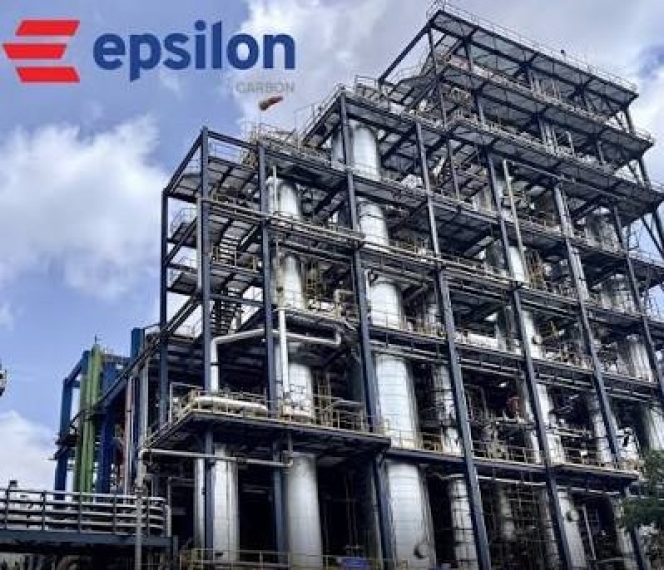
Epsilon Carbon has significantly expanded its manufacturing footprint with the formal activation of a new 300,000-tonne-per-annum speciality carbon plant in Vijayanagar, Karnataka. This latest addition brings the company’s aggregate production capacity in this segment to 600,000 tonnes annually, a development that elevates the firm to a leading position among domestic producers and reinforces India’s broader influence in the international speciality carbon market.
The new installation operates on a fully digitised manufacturing architecture, incorporating real-time process monitoring, automated quality controls and interconnected production systems. Such technological integration is intended to minimise operational variability, maximise throughput and provide overseas buyers with a stable and predictable supply base across multiple product categories.
Output from the Vijayanagar complex will encompass a wide array of coal-tar derivatives, including binder and impregnated pitches, refined naphthalene, anthracene and creosote oils and wash oil. These intermediates find application across a spectrum of heavy and light industries, ranging from primary aluminium and graphite electrode production to tyre compounding, pigment formulation, pharmaceutical synthesis and speciality construction materials.
Looking ahead, the company has outlined a trajectory towards further capacity enhancement, with a proposed integrated facility in Jharsuguda, Odisha, expected to push total speciality carbon output to one million tonnes per annum by the end of the decade. Meanwhile, the Karnataka plant has been configured with closed-loop water management, recycling all treated effluent internally, and derives its entire power requirement from a 17‑megawatt captive unit running on recycled process off-gases. Certifications such as Responsible Care, EcoVadis Silver and SA8000 attest to the company’s adherence to stringent safety, environmental and labour standards.
Gaurav Mathur, Chief Executive Officer, Epsilon Carbon, said, "This expansion reflects India's growing capability to become a global supplier of speciality carbon materials. With 600,000 TPA of Speciality Carbon capacity, we are strengthening supply chain resilience for both domestic industries and international customers, particularly the global aluminium sector. As the world looks to diversify supply chains, Epsilon Carbon is proud to contribute to India's emergence as a reliable, sustainable and globally competitive manufacturing hub."

Comments (0)
ADD COMMENT