

- Nokian Tyres
- Kelirengas. Teemu Soini. Marko Saari
- Lumi-Hakkapeliitta
- Snow-Hakkapeliitta
- Hakkapeliitta
Nokian Tyres’ Innovative Winter Tyre Marks 90th Anniversary Milestone
- By TT News
- October 10, 2024
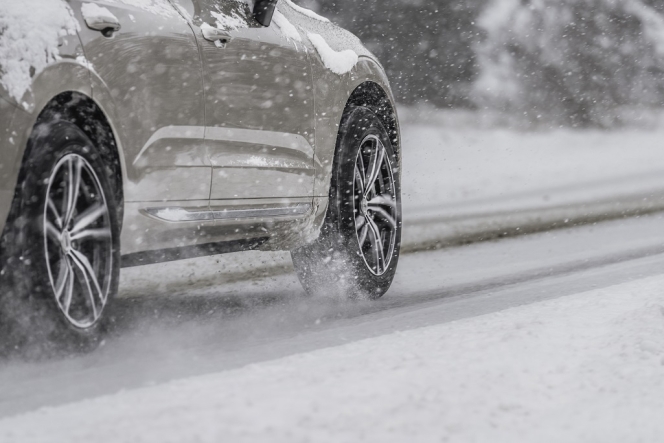
Nokian Tyres will celebrate the 90th anniversary of its innovation the - winter tyre. The company states it invented the world’s first winter tyre in 1934, and 90 years later it has continued to be the pioneer of safe winter driving. The winter tyre continues to be reinvented to meet the demands of modern drivers and changing conditions.
The company invented the world’s first winter tyre to tackle the harsh Finnish winter. Prior to the invention there were no tyres suitable for winter driving: tyres had a smooth surface and required snow chains on top of them for grip in winter. The winter tyre on the other hand featured a rough tread pattern for grip and traction, and the tread pattern was also designed open enough to clean itself of snow while driving, enabling a safe journey on winter roads.
The world’s first winter tyre Kelirengas, weather tyre, was mostly designed for trucks, and two years later, in 1936, a further improved design specifically for passenger cars, Lumi-Hakkapeliitta, Snow-Hakkapeliitta, were introduced. To meet the demands of slippery roads, caused by the increased number of vehicles and ploughing, Lumi-Hakkapeliitta featured small suction cups to prevent slipping on icy surfaces. Nearly 90-years later, the Nokian Tyres Hakkapeliitta is one of the world’s best-known winter tyre brands.
In the early 1960s, studs were introduced into the design, creating yet another innovation for safe winter driving.
Nokian Tyres states that winter tyre continue to be one of the most important pieces of safety equipment for winter driving is as relevant today as it was 90 years ago. The modern winter tyre features a mix of about 100 different raw materials, roughly three times more than the winter tyre in the 1930’s, including both renewable and recycled raw materials.
Teemu Soini, VP – Innovations and Development, Nokian Tyres said, “The winter tyre taught us that we can ensure safety by keeping ahead of the challenges. As the world keeps on changing, so do the challenges. In these 90 years, the weather conditions have changed, new materials have been innovated, and product development has taken leaps towards creating more and more sustainable tyres.”
“The two main areas of our innovation and development are safety and sustainability, and especially in winter tyres safety is a priority,” added Soini.
The modern winter tyre relies on decades of product development and innovation work. Continuous testing in real winter conditions for example in Nokian Tyres’ test centre in Finnish Lapland makes sure that the tyres from the inventor of the winter tyre will be able to safeguard drivers in all conditions.
Marko Saari, VP – Product Management, Nokian Tyres said, “Different driving conditions call for different types of winter tyres, as winter conditions vary greatly depending on the area and its climate: in Central Europe, winter has more rain, whereas in Scandinavia roads are covered in snow or ice. That’s why Nokian Tyres tailors its winter tyres according to the conditions of the area they are meant to be driven in.”
In addition to the varying winter driving conditions, development in vehicle technology affects the development of winter tyres.
“For example, tyres for EVs need to carry heavier loads because of the extra weight of the battery and instantly respond to the high-torque power. Our starting point is that all our products make driving safe no matter what car you drive. Testing has remained a key to ensure tyre performance to meet the needs of modern drivers,” says Saari.
At present, Nokian Tyres manufactures winter tyres for the Nordic market and for North America in its factory in Finland, and tyres for Central Europe will be manufactured in its factory in Romania.
Birla Carbon To Showcase Sustainable Carbon Black Solutions At Global Polymer Summit 2026
- By TT News
- September 18, 2026

Birla Carbon will present its carbon black solutions at the Global Polymer Summit 2026, scheduled for 28–30 September at the Kentucky International Convention Center in Louisville. The company will exhibit at Booth 417, targeting tyre and mechanical rubber goods (MRG) manufacturers seeking higher performance and reduced environmental impact.
The company’s portfolio spans tyre and MRG applications, addressing durability, strength, abrasion resistance and product life across tyres, belts, hoses, sealing systems and anti-vibration products. Birla Carbon will also feature Continua Sustainable Carbonaceous Material (SCM), a circular carbon range with consistent quality and global availability and Continua Sustainable Carbon Black (SCB), produced from recycled or bio-based feedstocks.
Supported by extensive manufacturing, technical expertise and customer-focused teams across the Americas, Birla Carbon provides reliable volumes, responsive service and tailored solutions. Attendees can meet company experts at Booth 417 to explore its product portfolio, technical capabilities and sustainable offerings.
John Davidson, President – Americas & EMEA, Birla Carbon, said, “The tyre and mechanical rubber goods industries are at an important phase, where performance, supply resilience and sustainability must advance together. The next phase of growth will depend on stronger collaboration across the value chain and the ability to translate innovation into scalable, commercially viable solutions. At Birla Carbon, we are combining our manufacturing network, portfolio strength, technical expertise and regional capabilities to help customers navigate this transition and build more resilient and sustainable businesses.”
Michelin Launches X Multi Energy D2 Tyre For Regional Haul Fleets
- By TT News
- September 18, 2026
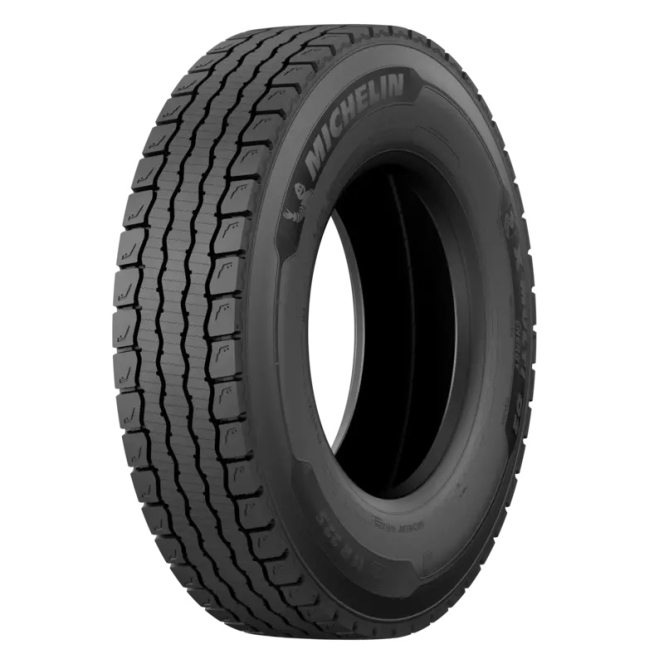
Michelin has unveiled the X Multi Energy D2 tyre, developed to address the specific challenges of regional haul operations. Fleets in this segment face demanding roads, frequent stop-and-start cycles and escalating fuel expenses that affect both performance and profitability. By blending durability, fuel savings and Michelin’s established performance standards, the new tyre aims to boost fleet productivity while reducing overall operating costs.
The tyre features a revised tread pattern and a new tread compound to better resist tread damage caused by high-torque vehicles and stop-and-go regional driving. It is constructed on Michelin’s Duracore casing, which integrates Infinicoil and Powercoil technologies and benefits from a reinforced bead design known as Duracoil Technology. This casing is engineered to last up to one million miles and support as many as four retreads.
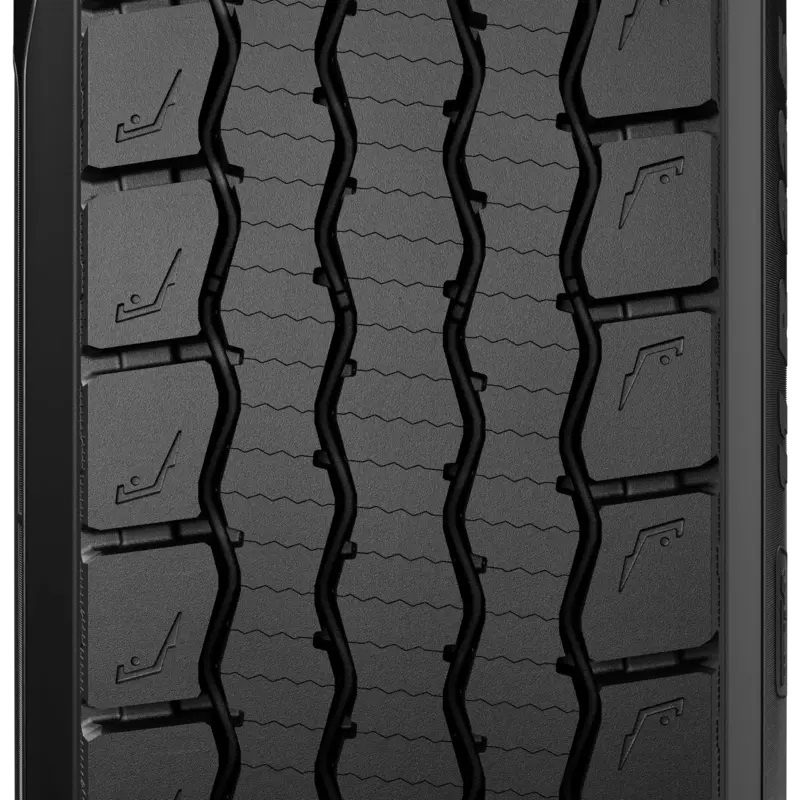
In the effort to curb fuel expenses, the X Multi Energy D2 improves rolling resistance by 9 percent over its predecessor, the Michelin X Multi Energy D tyre, and by 18 percent compared with leading competitors. It also enhances late-life traction, offering 10 percent better wet handling and 16 percent better snow starting traction when worn, giving drivers and operations managers greater confidence on varying roads.
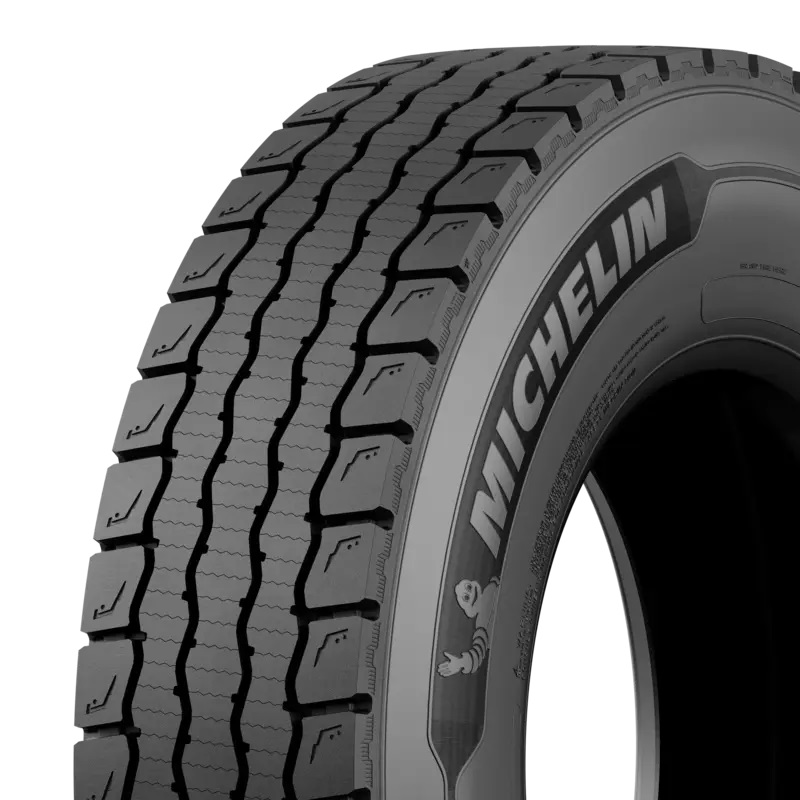
For original equipment manufacturers, the tyre meets Greenhouse Gas standards and supports applicable vehicle carbon-reduction requirements. Designed for regional applications where traction, durability and fuel efficiency matter, it is available in 295/75R22.5 LRG and 11R22.5 LRG and LRH sizes, replacing the X Multi Energy D tyre in those sizes.
Yahn Heurlin, VP of B2B Marketing, Michelin North America, Inc., said, “Michelin is driven by a deep commitment to understanding the needs and challenges customers face every day. This customer-first mindset inspires the development of purpose-built solutions designed to address real-world pain points and help fleets operate more efficiently.”
Firestone Launches Destination LE4 Highway Touring Tyre
- By TT News
- September 18, 2026
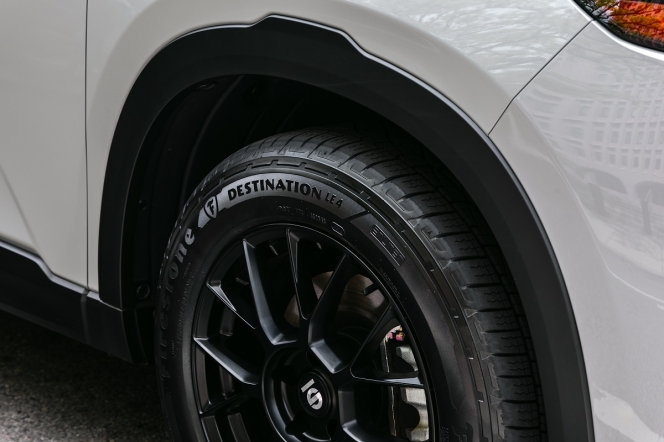
Firestone, a Bridgestone Americas subsidiary, has unveiled the Destination LE4 highway touring tyre as the successor to its best-selling Destination LE3. The new model features a deeper tread depth, an advanced compound and a non-directional tread pattern, delivering longer wear life along with improved wet and light snow performance for year-round driving confidence.
Backed by a 70,000-mile limited warranty, the Destination LE4 is projected in external testing to wear 16 percent longer than its predecessor, 9 percent longer than the General Grabber H/T and 43 percent longer than the BFGoodrich Advantage Control HT. Thinner 3D sipes enhance traction and handling, while internal testing showed wet stopping distances reduced by 8 feet versus the Toyo Open Country H/T II and 4 feet versus the BFGoodrich Advantage Ctrl HT, with dry stopping improved by 8 feet and 2 feet, respectively, plus a 2-foot dry gain over the LE3.
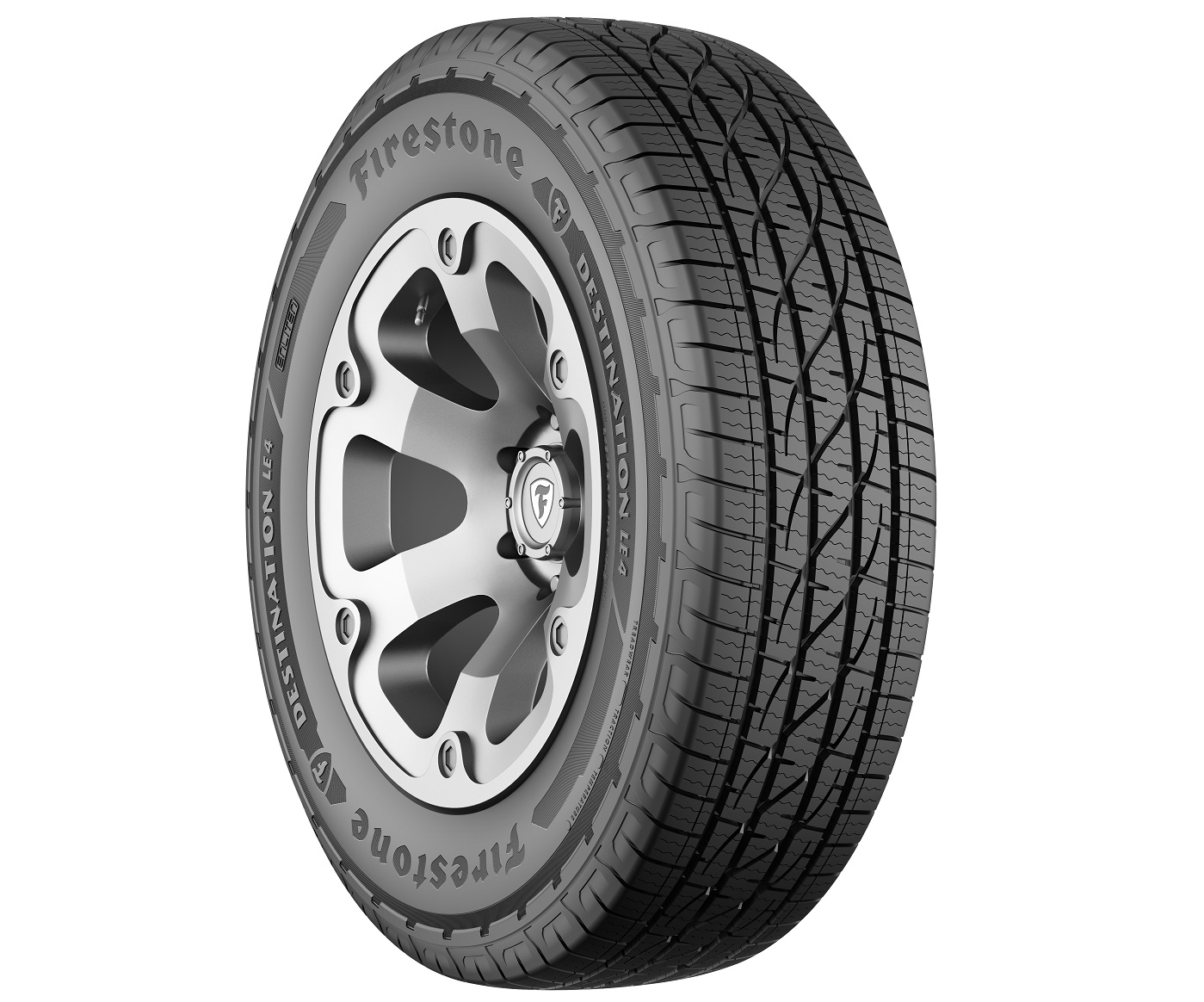
Sustainability gains come through wear-resistance technology, optimised material usage that lowers raw material consumption and enhanced traction technology. Two technical firsts originated at the Bridgestone Americas Technology Center in Akron, Ohio: a high-strength, lightweight carcass architecture using light body plies and steel cords for durability and low rolling resistance despite deeper tread, and advanced compound mixing that improves ingredient consistency for tread wear, handling and wet grip.
Available in 65 sizes for 15- to 22-inch rims, the Destination LE4 covers small CUVs, SUVs, pickups and larger trucks, including the Mazda CX-5, Ford F-150, RAM 1500, Chevrolet Trailblazer and Nissan Armada.
Jeremy Norwood, Chief Engineer, New Product Engineering, Bridgestone Americas, said, “Drivers loved the Firestone Destination LE3 for its comfortable, quiet ride and all-season reliability. With the new Destination LE4, we enhanced those strengths by extending wear life and improving wet-weather handling, delivering dependable performance, confident control and everyday value.”
Yokohama Rubber's Thai Subsidiary Earns Provincial CSR Honour
- By TT News
- September 18, 2026
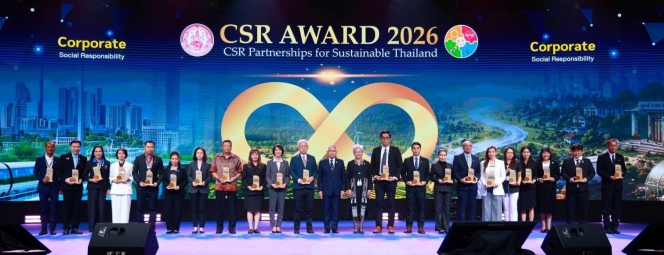
The Yokohama Rubber Co., Ltd. has announced that Y.T. Rubber Co., Ltd. (YTRC), its Thai subsidiary focused on natural rubber processing, earned the Outstanding Provincial-Level CSR Organization Award. The honour formed part of the ‘CSR Award 2026’ initiative run by Thailand’s Ministry of Social Development and Human Security, and the presentation took place on 22 August 2026.
Built around the idea of ‘CSR Partnerships for Sustainable Thailand’, the award programme highlights organisations demonstrating exemplary corporate social responsibility at provincial or metropolitan level throughout the country’s 76 provinces and Bangkok. A total of 92 recipients – among them YTRC, other firms and bodies chosen nationwide and provincial CSR centres – convened at IMPACT Challenger Hall in Nonthaburi Province to collect commemorative plaques.

Governor Jumpot Wannachatsiri (left) presents flowers to YTRC Managing Director Noboru Takita (centre) and Department Manager Supachai Choosuwan at the Surat Thani Provincial Council.
YTRC, established in Surat Thani Province in 2008, has long pursued environmental preservation and dependable ties with nearby communities. Working with the Rubber Authority of Thailand (RAOT), it surveys natural rubber plantations and supplies management assistance to farmers, supporting sustainable procurement of the material. The company further backs agroforestry practices that give rubber farmers steadier incomes while partnering with the Surat Thani Provincial Office of Social Development and Human Security on efforts to nurture constructive community relations.
The recognition reflects YTRC’s continuous community-oriented CSR work and its notable local impact. A special event on 31 August saw the Surat Thani Provincial Council once more acknowledge those contributions, with the governor presenting a celebratory bouquet. Separately, the CSR Center of Surat Thani Province ranked among only nine centres nationwide to win the Outstanding Provincial CSR Promotion Center Award.

Comments (0)
ADD COMMENT