

- Yokohama Rubber
- CDP’s A List On Climate Change
- Corporate Sustainability
- Environmental Transparency
- Climate Change
Yokohama Rubber Secures Spot In CDP’s A List On Climate Change
- By TT News
- February 07, 2025

The Yokohama Rubber Co., Ltd., has once again secured a spot in CDP’s A List of companies for its leadership in corporate sustainability. This is Yokohama Rubber’s third-straight and sixth time on the A list by the global environmental non-profit organisation. The company received the highest score for its leadership in environmental transparency and climate change.
Based on its answers to the CDP's 2024 climate change questionnaire, Yokohama Rubber was chosen in recognition of its efforts to reduce greenhouse gas emissions, reduce the risks associated with climate change and publish extremely transparent information. By tackling social concerns via its business operations, Yokohama Rubber is generating shared value under the sustainability motto ‘Caring for the Future’.
The global environmental disclosure system for businesses, cities, governments and regions is managed by CDP. Since its founding in 2000, it has encouraged businesses to reveal their environmental effects, cut greenhouse gas emissions, maintain forests and preserve water supplies. CDP scores are frequently used to influence procurement and investment choices in the direction of a resilient, sustainable and carbon-free economy. More than 2,100 firms in Japan and over 24,800 companies worldwide, including over 70 percent of corporations listed on the Tokyo Stock Exchange's Prime Market, answered CDP's environmental disclosure questionnaire in 2024.
- Golden Extreme Group
- Messe Frankfurt Middle East
- Sand Storm Tyres
- Adham Alblooshi
- Automechanika Dubai
Golden Extreme Plans UAE Tyre Factory With 3m-Unit Annual Capacity
- By TT News
- November 27, 2026
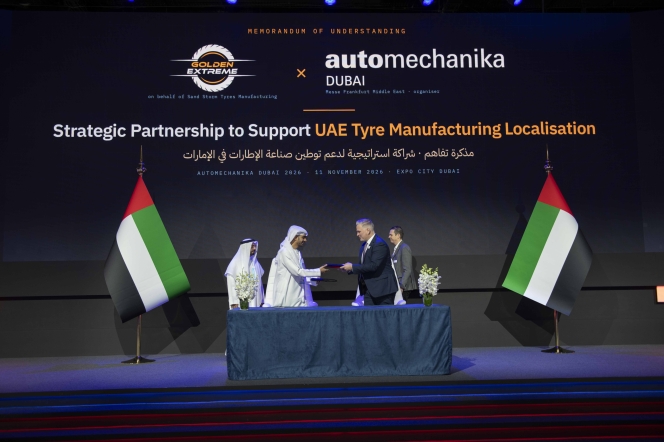
Golden Extreme Group plans to establish a tyre manufacturing facility in the United Arab Emirates, with production targeted to begin in 2029 and an initial annual capacity of about 3 million passenger tyres.
The group has signed a memorandum of understanding (MoU) with Messe Frankfurt Middle East, organiser of Automechanika Dubai, in support of the proposed Sand Storm Tyres factory. The agreement was signed on recently during the exhibition in Dubai.
The project marks Golden Extreme's planned expansion from tyre trading and exports into manufacturing in the UAE. Construction is scheduled for 2027 and 2028, with the first tyres expected in 2029.
Phase 1 will have a targeted annual production capacity of 25,500 tonnes, equivalent to about 3m passenger tyres. The proposed product range includes passenger car, sport utility vehicle (SUV) and electric vehicle (EV) tyres.
"This memorandum is a proud moment for Golden Extreme Group and a step towards localising tyre manufacturing in the UAE. Bringing international expertise together with local ambition is how we build an industry for the future of our country, and we thank Messe Frankfurt Middle East and Automechanika Dubai for their partnership," said Adham Alblooshi, Group Chief Executive of Golden Extreme Group.
Production based on regional demand
Golden Extreme said it had used its regional tyre trading data to identify the sizes for Phase 1 production, focusing on those with the highest demand in the UAE market.
The proposed facility is targeting automation levels of 60–70 percent across its production lines. Its products are also intended to meet UAE, Gulf Co-operation Council, Saudi Arabian and European Union standards. These remain project targets rather than certifications already obtained.
The group's longer-term expansion plans include a second phase covering truck and bus tyres, with a targeted annual capacity of 300,000 units.
Project targets up to 500 jobs
The project is expected to create 450–500 jobs. Golden Extreme also plans to introduce training programmes for Emiratis, focusing on the technical skills required for tyre manufacturing and the development of local expertise in the sector.
Epsilon Carbon Reports Complete Industrial Waste Diversion For FY 2025–26
- By TT News
- November 27, 2026
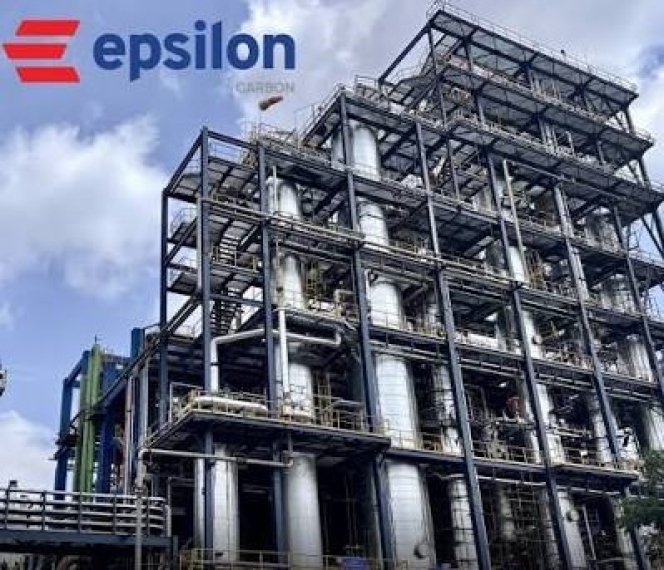
Epsilon Carbon Pvt. Ltd., a prominent global producer of carbon black and speciality carbon products, has recorded complete diversion of its industrial waste from landfill throughout FY 2025–26. This milestone delivered greenhouse gas emission savings amounting to 723.23 tonnes of CO₂ equivalent, with an equivalent carbon absorption attributed to roughly 28,929 trees over a single year. The outcome underscores the company's sustained drive to embed sustainable waste management across its industrial operations.
Rather than following a conventional disposal route, the firm pursues value recovery from industrial waste through alternative channels. These include co-processing waste in the cement sector and recycling via authorised facilities. Channelling waste into productive applications advances resource recovery, curtails landfill dependence and enables materials to be reused within the industrial ecosystem.
The landfill-free result rests on broader sustainability efforts encompassing energy circularity, resource efficiency and responsible manufacturing. Moving forward, Epsilon Carbon intends to reinforce its waste recovery practices and monitor their environmental impact in subsequent reporting periods. This commitment supports the company's continuing emphasis on circularity and ongoing improvement.
Vikram Handa, Managing Director, Epsilon Carbon, said, “Sustainability in manufacturing is about making responsible choices across everyday operations and ensuring that resources are used more effectively. Our progress on waste diversion reflects the importance of looking beyond conventional disposal and finding productive pathways to recover, reduce & recover. We believe that such operational improvements, when pursued consistently, can contribute to meaningful decrabonisation in any industry.”
Vipal Deepens European Presence With Smart Uno Installation At Boleca In Spain
- By TT News
- November 27, 2026
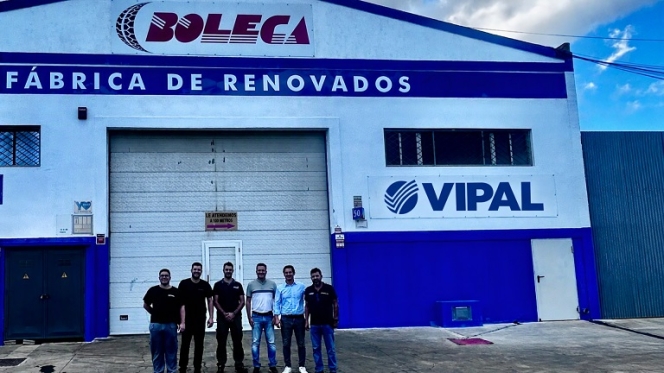
Vipal Rubber, one of the largest manufacturers of tyre retreading rubber globally and a leader in commercial tyre retreading in Latin America, has strengthened its position in the European tyre retreading sector by installing a VR01 Smart Uno buffing machine at Boleca S.L., a retreader based in Gran Canaria, Spain. The move marks a new phase in the longstanding partnership between the two companies.
Boleca, which has operated in truck and bus tyre retreading for nearly three decades and works exclusively with Vipal products, now possesses one of the most advanced buffing solutions developed by the manufacturer. The equipment is designed to improve consistency in the buffing process, supporting uniform results and more efficient retreading operations.
The technology raises process control and operational efficiency while promoting uniformity and productivity gains. The installation also advances Vipal's strategy of expanding its industrial footprint in Europe, making Boleca part of a select group using the technology and bringing the fourth Vipal-equipped machine to the continent.
For Vipal, the project reflects its customer-close approach and its focus on solutions that support continuous business evolution. With more than 50 years of retreading market experience and an international presence, the company continues investing in solutions for different markets and applications, reinforcing its European operation and partnerships built on quality, technology and performance.
Daniel Peñate Sall, General Director, Boleca, said, “The Smart Uno has features that add value to our processes and further increase the quality of the services we offer our clients. This acquisition strengthens the trust we have built throughout the years in our partnership with Vipal, a company with which we fully work in our production.”
Fabricio Nedeff, Commercial Manager, Vipal EMEA, said, “The installation of the VR01 Smart Uno in Boleca represents the expansion of a solid, longstanding partnership. More than supplying products, we aim to support our clients with technologies that add efficiency, quality and competitiveness to their processes. We are very pleased to see Boleca incorporate this innovation into its operation and to become part of this new moment for the company.”
Tyres Europe Outlines Three Priorities For EU Circular Economy Act
- By TT News
- November 27, 2026
Tyres Europe has outlined three priorities for the forthcoming Circular Economy Act (CEA), which it views as an opportunity to strengthen EU resilience and position the bloc as a leader in circular tyre products. Regulatory certainty will encourage manufacturers to innovate and invest, while fragmented rules, legal uncertainty and limited markets for recycled materials hinder circularity. Addressing these barriers requires harmonising end-of-waste (EoW) criteria to establish a single market for secondary raw materials and bolstering demand for circular products.
Creating a genuine single market for recovered materials tops the list. Because recovered tyre materials only re-enter production once they cease to count as waste, country-by-country end-of-waste rules fragment the market badly. Tyres Europe wants the Waste Framework Directive revised so EU-wide criteria cover all tyre-derived materials, whether mechanically or chemically recycled, cutting duplicated regulatory work and administrative burden.
Stronger circular markets form the second priority. End-of-use products should be assessed for further use before being classed as waste, with tyres deemed waste only after expert assessment rules out reuse and retreading. Common EU definitions of end-of-use, recycled, biobased and renewable materials would help authorities apply rules consistently. Europe also needs targeted investment in recycling infrastructure to close its treatment capacity shortfall, while public procurement of retreaded truck tyres and tyre-derived road surfacing can build dependable demand.
Finally, producer responsibility systems, which have delivered collection and treatment rates above 95 percent over more than 25 years, should be reformed carefully rather than overhauled. Tyres Europe favours targeted changes reflecting each product's value chain, with transparent, traceable tyre flows and enforceable financial obligations for companies placing tyres on the market. Reliable demand for recovered materials underpins these schemes, reinforcing the case for harmonised EU end-of-waste criteria without delay.
Taken together, support for reuse and retreading, harmonised rules for recovered materials and conditions fostering investment and demand would let the Circular Economy Act strengthen the European tyre industry's contribution to a sustainable, circular economy, according to Tyres Europe.

Comments (0)
ADD COMMENT