

Ceat Signs Rana Daggubati As Brand Ambassador
- By TT News
- February 13, 2021
Ceat Tyres has signed the Bahubali-fame star Rana Daggubati as its brand ambassador for promoting the 'Puncture Safe' range of bike tyres across various media platforms.
 Daggubati will be part of the company's integrated marketing campaign across all five southern states of India. He is also expected to feature in the new commercial for 'Puncture Safe' tyres to be aired across TV and digital platforms.
The Indian tyre manufacturer has launched the unique 'Puncture Safe Tyres' for motorcycles in Andhra Pradesh, Telangana, Karnataka, Tamil Nadu and Kerala.
The tyres prevent the loss of air by sealing themselves after getting punctured. The technology can seal punctures for nails up to 2.5 mm in diameter. Ceat has developed the patented technology in house.
Arnab Banerjee, Chief Operating Officer, Ceat Tyres, said, "We at Ceat have always believed in our vision of 'Making Mobility Safer and Smarter Every day'. The launch of our new campaign articulates the same for motorcycles. The central idea is to highlight the importance of using durable tyres to prevent disruptions on any terrain. We are delighted to have Rana Daggubati on board for this campaign as he perfectly embodies the strength and durability of Ceat's 'Puncture Safe' technology. The India-England test series offers an ideal opportunity for us to connect with our customers as it is one of the most widely watched event in India with a massive viewership."
Daggubati said, "I am proud to be associated with one of the most respected brands in India. Playing a 'Keel wale baba' character was a unique experience, and I thoroughly enjoyed the shoot. I am looking forward to an exciting journey with Ceat Tyres"
Rohit Dubey, Group Creative Director, O&M said, "As privileged creative partners of Brand Ceat, we believe that the only predictable thing about a Ceat tyre commercial should be that it should not follow hackneyed codes of tyre advertising. 'Keel wale baba', is another essential brick in bolstering Ceat's brand voice. On this project, we dug into our Indian cultural references of nails, godmen, and connected the dots leading to innovative puncture safe technology. And as always, it was an absolute joy creating it with the ever positive and courageous Ceat marketing team." (TT)
HF Group Announces EUR 20 Million Greenfield Investment In India
- By Sharad Matade
- June 23, 2026
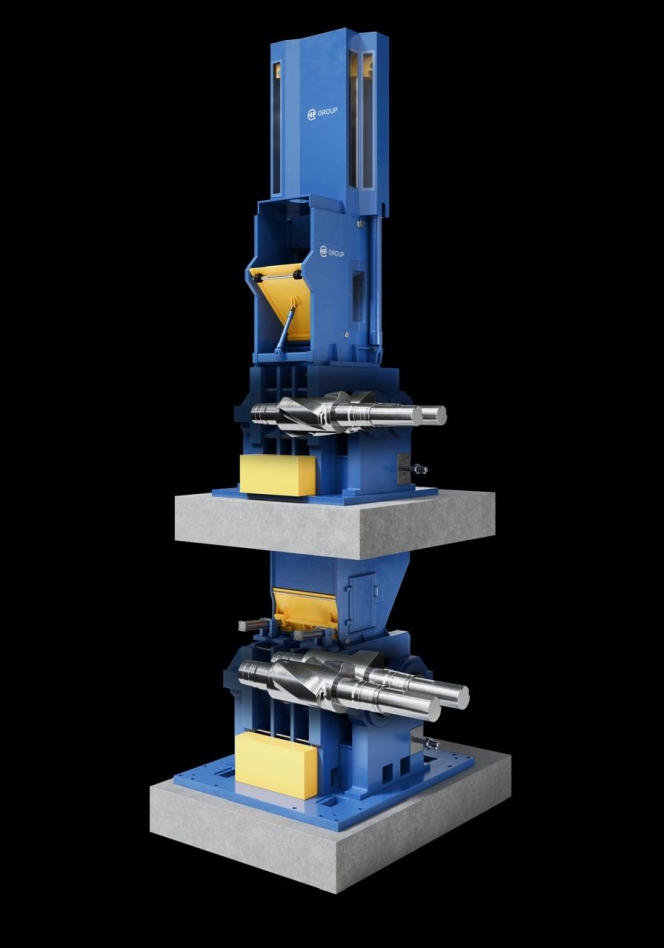
India’s growing importance in the global tyre and rubber industry received a strong endorsement with HF Group announcing a EUR 20 million investment in a new state-of-the-art manufacturing facility in Bengaluru.
The announcement was made during the inauguration of HF India’s new Assembly Hall Unit II, a milestone that reflects the company’s long-term commitment to India and its confidence in the country’s manufacturing future.
The proposed greenfield facility will be developed on a 10-acre site near Bengaluru Airport and is scheduled for completion by 2028. Spread across nearly 20,000 sq. metres, the new factory will be almost four times larger than the current assembly operations and will incorporate digital manufacturing, automation, smart production systems, and advanced engineering capabilities.
The upcoming facility will focus on productivity, precision engineering, sustainability, and smart manufacturing while supporting both the Indian market and HF’s global operations. The investment underlines the company’s confidence in India as a major manufacturing hub for the global tyre and rubber industry.
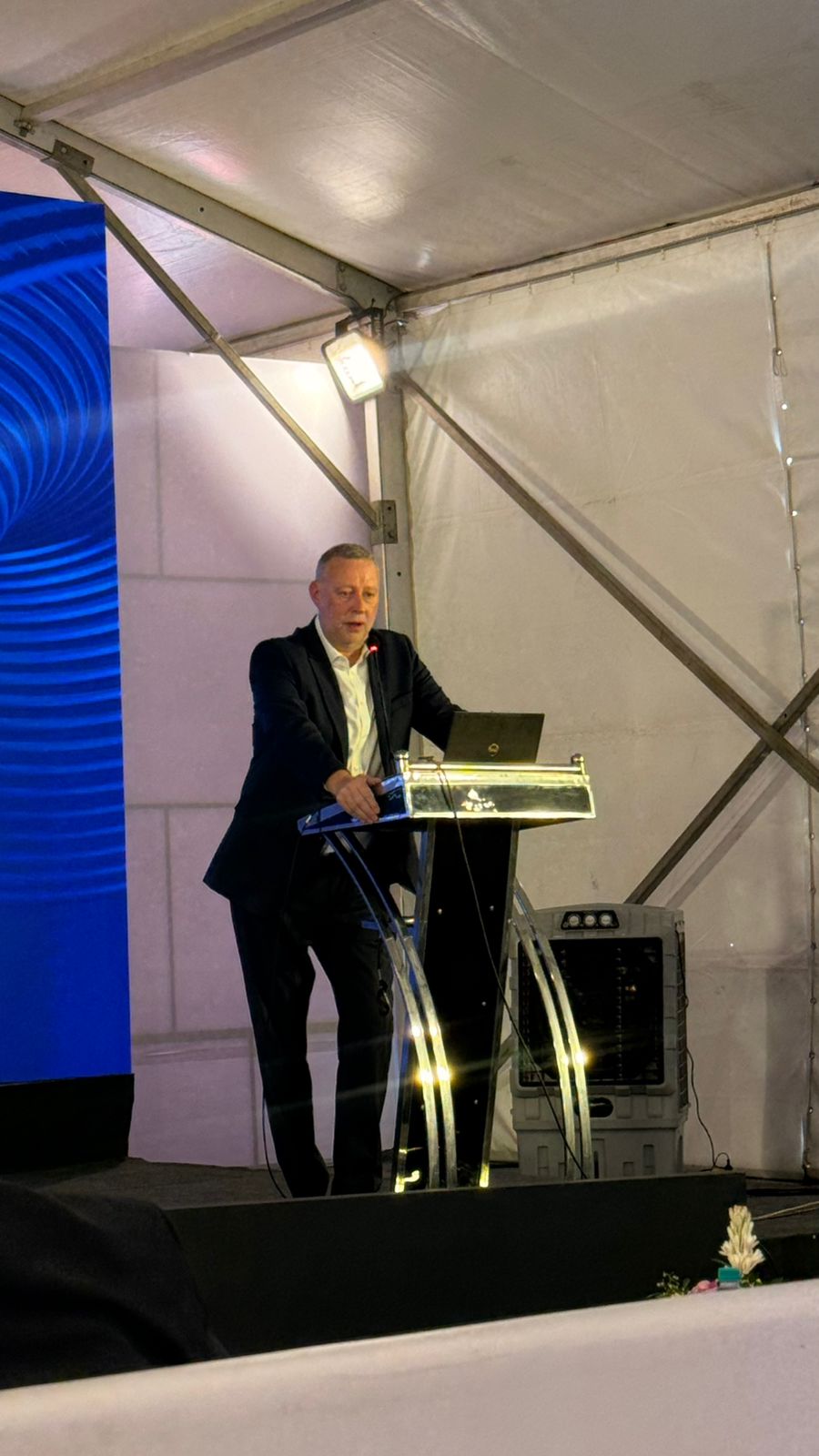 Ian Wilson, Managing Director & Co-CEO, HF Group, said, “This is not the end of our investment in India. It is perhaps the end of the beginning. India is entering a take-off decade and the economy runs on tyres. We see tremendous opportunities for growth and are committed to investing in the future of the Indian market.”
With more than 175 years of global experience, HF Group has steadily strengthened its presence in India. The journey began in 1995 with the establishment of Indus to serve the growing rubber processing industry. The partnership with HF Mixing Group in 2011 brought global mixing technology expertise to India, while the complete acquisition of the Indian subsidiary in 2024 marked another important milestone in the company’s India strategy.
Today, HF India manufactures and supports a broad portfolio of mixing and rubber processing equipment, including intermeshing and tangential mixers, banbury technology, mills, curing presses, and aftermarket services. The company also offers process support, training, upgrades, inspections, and spare parts under its customer-centric philosophy of ‘Holding the Customer’s Hand.’
Emphasising the importance of customer partnerships, Wilson said, “We are not here simply to sell machinery. We want to hold our customers’ hands throughout the entire lifecycle of their equipment and support them through process optimisation, performance improvements and future growth.”
As HF embarks on its next chapter in India, the new facility represents not only an investment in manufacturing capacity but also a long-term commitment to localisation, technology and customer partnerships.
TBC Corporation Appoints Ron Harper As Chief Supply Chain Officer
- By TT News
- June 20, 2026

TBC Corporation (TBC), one of North America’s largest marketers of automotive replacement tyres through wholesale and franchise operations, has named Ron Harper as its new Chief Supply Chain Officer. He will report directly to President and CEO Don Byrd and assume responsibility for the company’s entire supply chain function.
Harper brings over 26 years of experience steering global supply chains for multi-billion-dollar enterprises. His most recent role was Executive Vice President of Supply Chain at PrimeSource Building Products, overseeing planning, inventory, repack operations, service metrics and analytics. He has also held senior logistics and strategy positions at Sonepar USA, Nordstrom, Samsung SEA, and JCPenney.
The new chief holds a master’s degree in supply chain management from the University of Denver and a bachelor’s in industrial management from Michigan Technological University. His appointment underscores TBC’s focus on strengthening operational efficiency and logistics performance.
Byrd said, “Ron’s depth of experience in building transformative supply chain solutions aligns with our deep commitment to providing customers with the high-level efficiency, product availability and agility they expect from TBC. As market needs change and demands fluctuate, TBC is continuing to respond by having a supply chain strategy that minimises disruptions and maximises efficiency to ensure the highest levels of customer support and satisfaction.”
Rubber Board Of India Appoints N Hari As New Chairman
- By TT News
- June 16, 2026

The Rubber Board of India has announced the appointment of N Hari as its new Chairman, effective for a tenure of three years. Hailing from Pallikkathode in Kottayam, Kerala, Hari brings considerable experience to the leadership role, having previously served as a Board member representing small rubber growers from the state.
His initial term on the Board commenced on 28 June 2022 and spanned three years. During this period, he also held the position of Executive Committee Member from 7 October 2023 to 6 October 2024. This progression from membership to the executive committee and now to the chairmanship reflects his sustained engagement with the organisation.
His appointment is expected to steer the Board's initiatives in supporting the rubber sector, focusing on grower welfare and industry development across India.
- Bridgestone
- Bridgestone India
- Rajarshi Moitra
- Turanza 6i
- Automotive Tyre Manufacturers’ Association
- ATMA
Bridgestone India To Sharpen Focus On PV & CV Segments
- By Nilesh Wadhwa
- June 12, 2026
The Indian automotive landscape is currently undergoing a seismic shift. Driven by the rapid rise of rural urbanisation, an aggressive government push for electrification and the development of world-class road infrastructure, the industry is witnessing a period of robust growth. With sales of both new and used vehicles touching record highs, the demand for high-quality tyres remains in a significant upswing.
At the helm of one of the market’s most prominent players is Rajarshi Moitra, Managing Director of Bridgestone India and Vice-Chairman, Automotive Tyre Manufacturers’ Association (ATMA).
In an interaction with Tyre Trends, Moitra discusses the company’s future-ready roadmap, from its substantial capacity expansions to a ‘sharp and deep’ strategic focus designed to maintain leadership in an increasingly premium and electrified market.
A BULLISH OUTLOOK ON THE SUBCONTINENT
While global economic indicators remain varied, Moitra is unequivocally optimistic about the local trajectory. “The Indian automotive industry is at an exceptionally positive juncture from a medium-to-long-term perspective,” he asserts.
This optimism is grounded in several structural tailwinds that suggest India is slated for very strong growth. Key among these factors is the sheer room for market expansion.
“Firstly, we are still significantly under-indexed in terms of car penetration, with only 50 cars per 1,000 people – well below even some smaller developing nations,” Moitra explains.
Furthermore, the geographical spread of wealth is changing. Bridgestone is observing massive growth in Tier 2, 3 and 4 towns, a phenomenon Moitra attributes to ‘rural urbanisation’.
Bridgestone India estimates a transformative half-decade ahead for the industry. “The number of affordable households – those capable of purchasing a car – will double in India over the next five year. When you couple this with the government’s massive capital outflow into road connectivity and the rise of e-commerce, it creates a very bullish environment for both passenger and commercial mobility,” Moitra says.
THE ‘SHARP AND DEEP’ STRATEGIC PILLAR
Despite India being the world’s largest two-wheeler market, Bridgestone is famously absent from that segment – and intends to stay that way for now. Moitra clarifies that the company’s philosophy is rooted in specialisation rather than horizontal expansion. “At Bridgestone, we believe in being ‘sharp and deep’ in our strategy,” he says.
Currently, Bridgestone India’s business split is heavily weighted towards the consumer segment, with 70 percent of sales coming from Passenger Car Radial (PCR), 25 percent from Truck and Bus Radial (TBR) and 5 percent from Off-the-Road (OTR) segment.
“We see enough headroom for growth within the passenger car segment across products, channels and customer experience, so we are focusing our resources on maintaining our leadership there,” Moitra notes, dismissing any near-term plans to enter the two-wheeler space.
Instead, the company is doubling down on ‘white spaces’ within the consumer car category, specifically targeting higher rim diameters and specialised compounds for Original Equipment Manufacturers (OEMs).
INVESTING IN CAPACITY AND LOCAL INTELLIGENCE
To support this growth, Bridgestone is moving aggressively on the manufacturing front. With current operations running at 90–95 percent capacity, the company is in the midst of a major investment cycle.
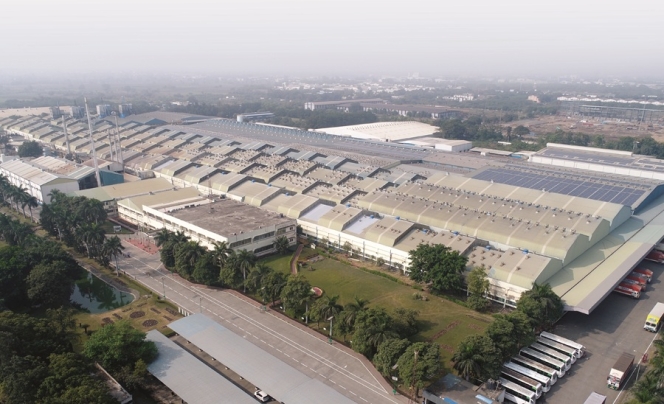
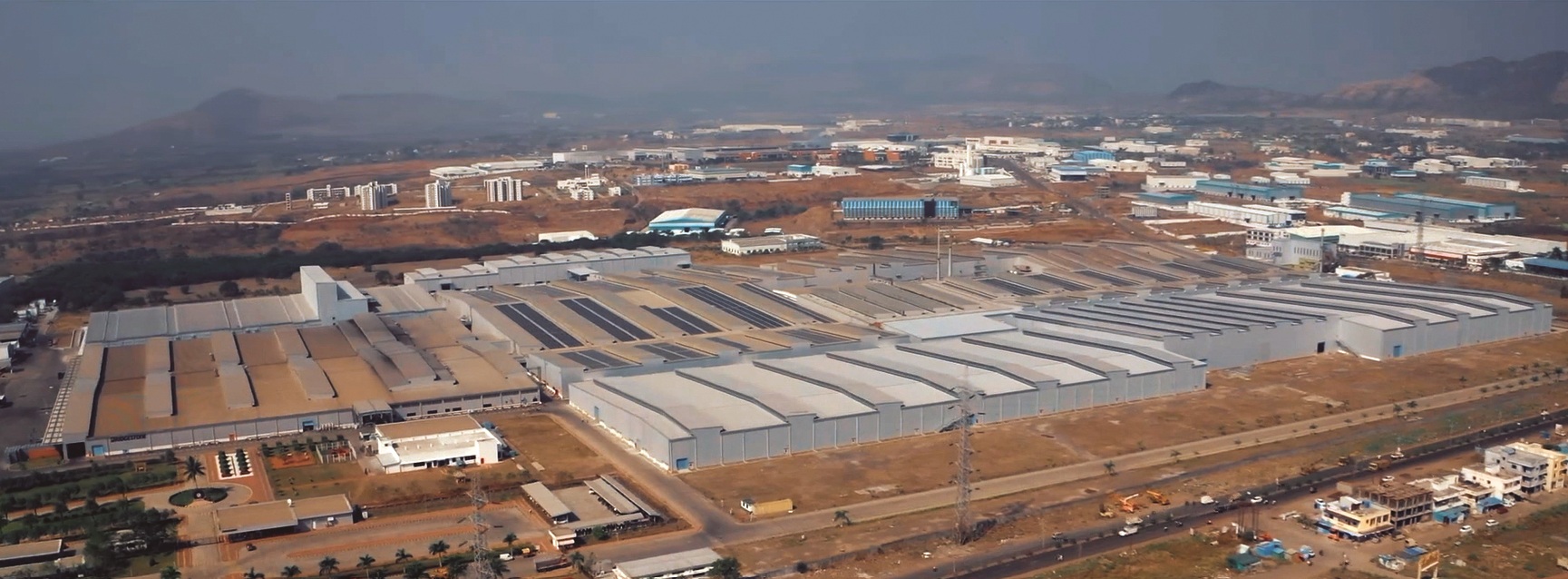
At present, the company’s Pune plant has a capacity to produce 4.01 million passenger car tyres and around 693,000 truck & bus radial tyres, while the Indore plant has a capacity to produce 7.11 million radial tyres for passenger cars and light trucks.
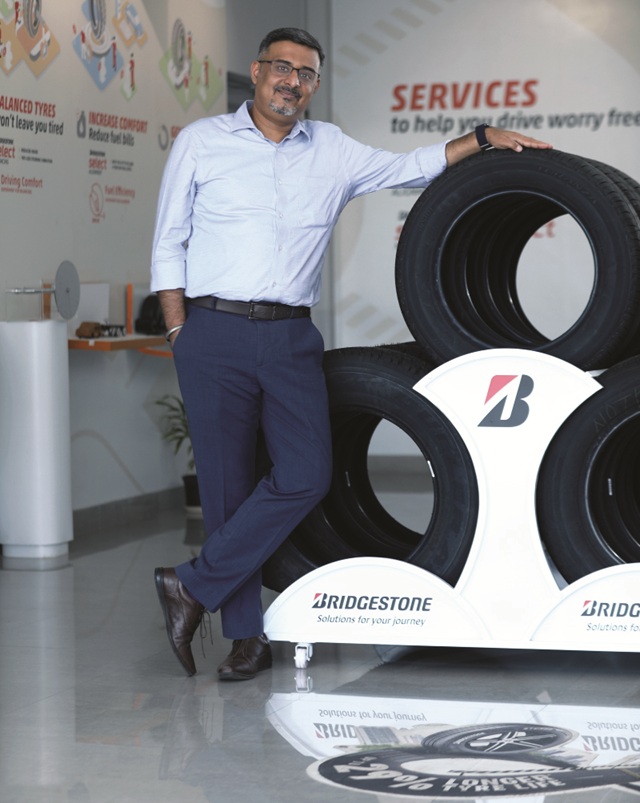 “Our last major investment was USD 85 million in October 2024, which is being ramped up in phases through 2029,” Moitra confirms. This capital is being used to scale volumes and enhance technical capabilities at the Indore factory.
The new investment is expected to further add 1.1 million tyre production capacity in Pune by CY2029, thus taking its total production capacity to around 11.1 million units in the country.
“Our strategy is two-fold: we want to be future-ready for market demand while simultaneously sweating our current assets to drive higher efficiency,” Moitra explains. Crucially, this expansion isn’t just about physical output; it’s about local autonomy. Moitra highlights that a ‘very large part’ of procurement is now local, decided by teams on the ground in India.
The launch of a Satellite Technology Centre in 2025 has further decentralised the company’s innovation engine. According to Moitra, this centre plays a pivotal role in increasing local leverage and technical presence, allowing the Indian arm to maintain a balance between local agility and global sourcing.
EVs AND PREMIUMISATION
As the Indian market matures, consumers are demanding larger wheel sizes – a trend Moitra says is led by OEMs. “We are seeing a clear market shift towards higher inches – for example, a car like the Maruti Suzuki Swift moving from 14-inch to 15-inch and others moving from 16-inch to 17-inch,” he observes.
Bridgestone’s ‘all-inch’ strategy covers the spectrum from 12 to 20 inches, but their brand strength is most potent in these premium, higher-diameter sizes.
This premiumisation dovetails with the transition to electric vehicles (EVs). Bridgestone has positioned itself with an ‘EV-ready’ portfolio, exemplified by the Turanza 6i. “It balances long-lasting durability and safety with low noise and comfort – essential for EVs,” says Moitra. To ensure they capture this nascent but fast-growing market, the company expanded the range from 36 sizes in 2024 to 72 sizes by 2025.
The OEM relationship remains the cornerstone of this technological foresight. “The OEM segment allows us to see ahead of the curve regarding future vehicle technologies,” Moitra explains.
At present, 35 percent of their consumer business is OE-based and Bridgestone is in active discussions with many of the newer automotive entrants arriving in India.
While Bridgestone is aggressively expanding its footprint in new tyre technology and premium consumer segments, it is taking a markedly more conservative approach towards the retreading sector in India. Despite the potential for material circularity, the company does not view retreading as a strategic priority for the immediate future.
Moitra clarifies that Bandag, Bridgestone’s global retreading arm, is not currently active in India, and there are no plans to introduce it in the near-term. This decision is driven largely by the unique and challenging dynamics of the local market, which is currently dominated by cold retreading.
He points out that a significant pricing challenge exists when ‘cold retreads versus biased tyres versus some of the cheaper tyres’ are compared, making the business case difficult to justify at this stage. Consequently, Bridgestone has opted to remain focused on its core segments for the next two to three years rather than entering the retreading space.
SUSTAINABILITY AND THE ‘INSTITUTION OF RESPECT’
Beyond the numbers, Bridgestone is attempting to build what Moitra calls an ‘institution of respect’. This involves a heavy commitment to environmental goals. The Pune plant already holds the distinction of being the first carbon-neutral facility in the Bridgestone group.
“Sustainability is a core agenda across our entire value chain,” Moitra explains, noting a public commitment to reduce the company’s carbon footprint by 50 percent by 2030, including Scope 3 emissions. This holistic approach ranges from manufacturing processes to material circularity in the tyres themselves.
Looking ahead, the goal is to protect a dominant market share – currently over 20 percent by volume and 23 percent by value in the passenger car aftermarket. To do this, Bridgestone plans to expand its physical reach by 30 percent over the next five years, building upon its current network of over 4,000 touchpoints.
As the company transitions its branding from the Olympics to Formula E, the focus remains clear: high performance and the next era of mobility. “It’s the perfect platform to showcase our technological edge,” Moitra concludes.

Comments (0)
ADD COMMENT